


Page 210 - Jurnal Kurikulum BPK 2020
P. 210
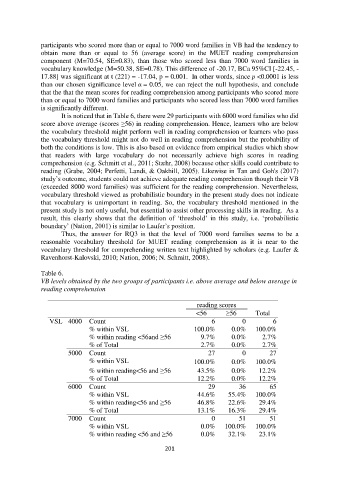
participants who scored more than or equal to 7000 word families in VB had the tendency to
               obtain  more  than  or  equal  to  56  (average  score)  in  the  MUET  reading  comprehension
               component  (M=70.54,  SE=0.83),  than  those  who  scored  less  than  7000  word  families  in
               vocabulary knowledge (M=50.38, SE=0.78). This difference of -20.17, BCa 95%CI [-22.45, -
               17.88] was significant at t (221) = -17.04, p = 0.001.  In other words, since p <0.0001 is less
               than our chosen significance level α = 0.05, we can reject the null hypothesis, and conclude
               that the that the mean scores for reading comprehension among participants who scored more
               than or equal to 7000 word families and participants who scored less than 7000 word families
               is significantly different.
                       It is noticed that in Table 6, there were 29 participants with 6000 word families who did
               score above average (scores ≥56) in reading comprehension. Hence, learners who are below
               the vocabulary threshold might perform well in reading comprehension or learners who pass
               the vocabulary threshold might not do well in reading comprehension but the probability of
               both the conditions is low. This is also based on evidence from empirical studies which show
               that  readers  with  large  vocabulary  do  not  necessarily  achieve  high  scores  in  reading
               comprehension (e.g. Schmitt et al., 2011; Stæhr, 2008) because other skills could contribute to
               reading (Grabe, 2004; Perfetti, Landi, & Oakhill, 2005). Likewise in Tan and Goh's (2017)
               study’s outcome, students could not achieve adequate reading comprehension though their VB
               (exceeded 8000 word families) was sufficient for the reading comprehension. Nevertheless,
               vocabulary threshold viewed as probabilistic boundary in the present study does not indicate
               that  vocabulary  is  unimportant  in  reading.  So,  the  vocabulary  threshold  mentioned  in  the
               present study is not only useful, but essential to assist other processing skills in reading.  As a
               result,  this  clearly  shows  that  the  definition  of  ‘threshold’  in  this  study,  i.e.  ‘probabilistic
               boundary’ (Nation, 2001) is similar to Laufer’s position.
                       Thus,  the  answer  for  RQ3  is  that  the  level  of  7000  word  families  seems  to  be  a
               reasonable  vocabulary  threshold  for  MUET  reading  comprehension  as  it  is  near  to  the
               vocabulary threshold for comprehending written text highlighted by scholars (e.g. Laufer &
               Ravenhorst-Kalovski, 2010; Nation, 2006; N. Schmitt, 2008).

               Table 6.
               VB levels obtained by the two groups of participants i.e. above average and below average in
               reading comprehension

                                                                      reading scores
                                                                      <56       ≥56        Total
                  VSL   4000  Count                                        6          0          6
                                % within VSL                         100.0%       0.0%     100.0%
                                % within reading <56and ≥56             9.7%      0.0%       2.7%
                                % of Total                              2.7%      0.0%       2.7%
                         5000  Count                                      27          0         27
                                % within VSL                         100.0%       0.0%     100.0%
                                % within reading<56 and ≥56           43.5%       0.0%      12.2%
                                % of Total                            12.2%       0.0%      12.2%
                         6000  Count                                      29         36         65
                                % within VSL                          44.6%      55.4%     100.0%
                                % within reading<56 and ≥56           46.8%      22.6%      29.4%
                                % of Total                            13.1%      16.3%      29.4%
                         7000  Count                                       0         51         51
                                % within VSL                            0.0%    100.0%     100.0%
                                % within reading <56 and ≥56            0.0%     32.1%      23.1%


                                                           201

