


Page 207 - Jurnal Kurikulum BPK 2020
P. 207
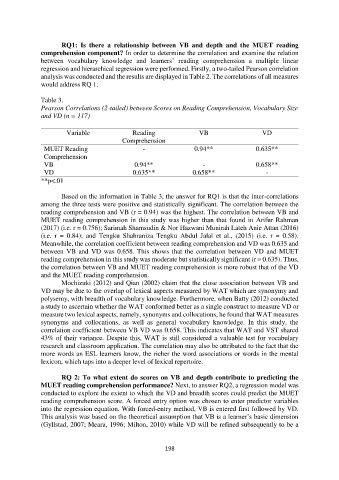
RQ1:  Is  there  a  relationship  between  VB  and  depth  and  the  MUET  reading
               comprehension component? In order to determine the correlation and examine the relation
               between  vocabulary  knowledge  and  learners’  reading  comprehension  a  multiple  linear
               regression and hierarchical regression were performed. Firstly, a two-tailed Pearson correlation
               analysis was conducted and the results are displayed in Table 2. The correlations of all measures
               would address RQ 1.

               Table 3.
               Pearson Correlations (2-tailed) between Scores on Reading Comprehension, Vocabulary Size
               and VD (n = 117)

                        Variable                Reading                VB                    VD
                                            Comprehension
                MUET Reading                       -                 0.94**                0.635**
                Comprehension
                VB                              0.94**                  -                  0.658**
                VD                              0.635**              0.658**                  -
               **p<.01

                       Based on the information in Table 3, the answer for RQ1 is that the inter-correlations
               among the three tests were positive and statistically significant. The correlation between the
               reading comprehension and VB (r = 0.94) was the highest. The correlation between VB and
               MUET reading comprehension in this study was higher than that found in Arifur Rahman
               (2017) (i.e. r = 0.756); Sarimah Shamsudin & Nor Hazwani Munirah Lateh Anie Attan (2016)
               (i.e.  r  =  0.84);  and  Tengku  Shahraniza  Tengku  Abdul  Jalal  et  al.,  (2015)  (i.e.  r  =  0.58).
               Meanwhile, the correlation coefficient between reading comprehension and VD was 0.635 and
               between VB and VD was 0.658. This  shows that  the  correlation  between VD and MUET
               reading comprehension in this study was moderate but statistically significant (r = 0.635). Thus,
               the correlation between VB and MUET reading comprehension is more robust that of the VD
               and the MUET reading comprehension.
                       Mochizuki (2012) and Qian (2002) claim that the close association between VB and
               VD may be due to the overlap of lexical aspects measured by WAT which are synonymy and
               polysemy, with breadth of vocabulary knowledge. Furthermore, when Batty (2012) conducted
               a study to ascertain whether the WAT conformed better as a single construct to measure VD or
               measure two lexical aspects, namely, synonyms and collocations, he found that WAT measures
               synonyms  and  collocations,  as  well  as  general  vocabulary  knowledge.  In  this  study,  the
               correlation coefficient between VB VD was 0.658. This indicates that WAT and VST shared
               43% of their variance. Despite this, WAT is still considered a valuable test for vocabulary
               research and classroom application. The correlation may also be attributed to the fact that the
               more words an ESL learners know, the richer the word associations or words in the mental
               lexicon, which taps into a deeper level of lexical repertoire.

                       RQ 2: To what extent do scores on VB and depth contribute to predicting the
               MUET reading comprehension performance? Next, to answer RQ2, a regression model was
               conducted to explore the extent to which the VD and breadth scores could predict the MUET
               reading comprehension score. A forced entry option was chosen to enter predictor variables
               into the regression equation. With forced-entry method, VB is entered first followed by VD.
               This analysis was based on the theoretical assumption that VB is a learner’s basic dimension
               (Gyllstad, 2007; Meara, 1996; Milton, 2010) while VD will be refined subsequently to be a


                                                           198

