


Page 208 - Jurnal Kurikulum BPK 2020
P. 208
catalyst for automaticity of lexical access in reading comprehension (Henriksen, 1999; Qian,
               1999, 2000, 2002).

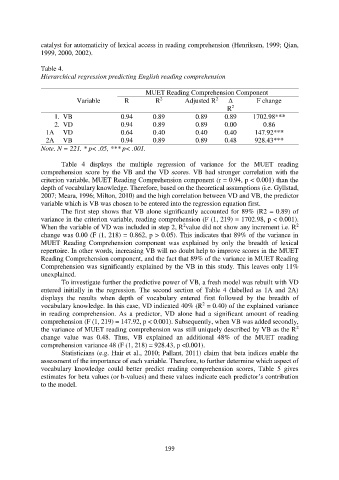
               Table 4.
               Hierarchical regression predicting English reading comprehension

                                                       MUET Reading Comprehension Component
                                                                             2
                                                         2
                            Variable         R          R         Adjusted R     Δ         F change
                                                                                  2
                                                                                 R
                    1.   VB                0.94        0.89           0.89      0.89      1702.98***
                    2.   VD                0.94        0.89           0.89      0.00         0.86
                  1A   VD                  0.64        0.40           0.40      0.40      147.92***
                  2A   VB                  0.94        0.89           0.89      0.48      928.43***
               Note. N = 221. * p< .05, *** p< .001.

                       Table  4  displays  the  multiple  regression  of  variance  for  the  MUET  reading
               comprehension score by the VB and the VD scores.  VB had stronger correlation  with  the
               criterion variable, MUET Reading Comprehension component (r = 0.94, p < 0.001) than the
               depth of vocabulary knowledge. Therefore, based on the theoretical assumptions (i.e. Gyllstad,
               2007; Meara, 1996; Milton, 2010) and the high correlation between VD and VB, the predictor
               variable which is VB was chosen to be entered into the regression equation first.
                       The first step shows that VB alone significantly accounted for 89% (R2 = 0.89) of
               variance in the criterion variable, reading comprehension (F (1, 219) = 1702.98, p < 0.001).
                                                                                                         2
                                                                 2
               When the variable of VD was included in step 2, R value did not show any increment i.e. R
               change was 0.00 (F (1, 218) = 0.862, p > 0.05). This indicates that 89% of the variance in
               MUET  Reading  Comprehension  component  was  explained  by  only  the  breadth  of  lexical
               repertoire. In other words, increasing VB will no doubt help to improve scores in the MUET
               Reading Comprehension component, and the fact that 89% of the variance in MUET Reading
               Comprehension was significantly explained by the VB in this study. This leaves only 11%
               unexplained.
                       To investigate further the predictive power of VB, a fresh model was rebuilt with VD
               entered initially in  the regression. The second section of Table 4 (labelled as  1A and 2A)
               displays  the  results  when  depth  of  vocabulary  entered  first  followed  by  the  breadth  of
                                                                        2
               vocabulary knowledge. In this case, VD indicated 40% (R  = 0.40) of the explained variance
               in  reading  comprehension.  As  a  predictor,  VD  alone  had  a  significant  amount  of  reading
               comprehension (F (1, 219) = 147.92, p < 0.001). Subsequently, when VB was added secondly,
                                                                                                         2
               the variance of MUET reading comprehension was still uniquely described by VB as the R
               change  value  was  0.48.  Thus,  VB  explained  an  additional  48%  of  the  MUET  reading
               comprehension variance 48 (F (1, 218) = 928.43, p <0.001).
                       Statisticians (e.g. Hair et al., 2010; Pallant, 2011) claim that beta indices enable the
               assessment of the importance of each variable. Therefore, to further determine which aspect of
               vocabulary  knowledge  could  better  predict  reading  comprehension  scores,  Table  5  gives
               estimates for beta values (or b-values) and these values indicate each predictor’s contribution
               to the model.


                                                           199

