


Page 211 - Jurnal Kurikulum BPK 2020
P. 211
% of Total                              0.0%     23.1%      23.1%
                         8000  Count                                       0         45         45
                                % within VSL                            0.0%    100.0%     100.0%
                                % within reading<56 and ≥56             0.0%     28.3%      20.4%
                                % of Total                              0.0%     20.4%      20.4%
                         9000  Count                                       0         22         22
                                % within VSL                            0.0%    100.0%     100.0%
                                % within reading<56 and ≥56             0.0%     13.8%      10.0%
                                % of Total                              0.0%     10.0%      10.0%
                        10000  Count                                       0          5          5
                                % within VSL                            0.0%    100.0%     100.0%
                                % within reading<56 and ≥56             0.0%      3.1%       2.3%
                                % of Total                              0.0%      2.3%       2.3%
                  Total         Count                                     62        159        221
                                % within VSL                          28.1%      71.9%     100.0%
                                % within reading<56 and ≥56          100.0%     100.0%     100.0%
                                % of Total                            28.1%      71.9%     100.0%


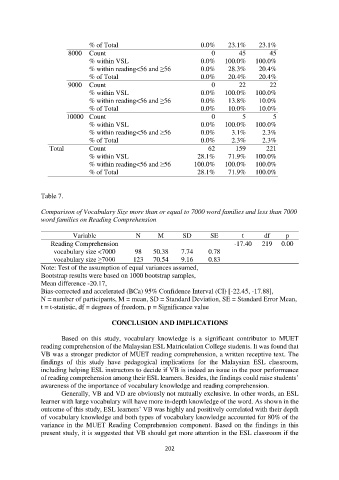
               Table 7.

               Comparison of Vocabulary Size more than or equal to 7000 word families and less than 7000
               word families on Reading Comprehension

                           Variable              N      M        SD        SE         t       df     p
                   Reading Comprehension                                           -17.40    219    0.00
                    vocabulary size <7000       98     50.38     7.74     0.78
                    vocabulary size ≥7000       123    70.54     9.16     0.83
               Note: Test of the assumption of equal variances assumed,
               Bootstrap results were based on 1000 bootstrap samples,
               Mean difference -20.17,
               Bias-corrected and accelerated (BCa) 95% Confidence Interval (CI) [-22.45, -17.88],
               N = number of participants, M = mean, SD = Standard Deviation, SE = Standard Error Mean,
               t = t-statistic, df = degrees of freedom, p = Significance value

                                        CONCLUSION AND IMPLICATIONS

                       Based  on  this  study,  vocabulary  knowledge  is  a  significant  contributor  to  MUET
               reading comprehension of the Malaysian ESL Matriculation College students. It was found that
               VB was a stronger predictor of MUET reading comprehension, a written receptive text. The
               findings  of  this  study  have  pedagogical  implications  for  the  Malaysian  ESL  classroom,
               including helping ESL instructors to decide if VB is indeed an issue in the poor performance
               of reading comprehension among their ESL learners. Besides, the findings could raise students’
               awareness of the importance of vocabulary knowledge and reading comprehension.
                       Generally, VB and VD are obviously not mutually exclusive. In other words, an ESL
               learner with large vocabulary will have more in-depth knowledge of the word. As shown in the
               outcome of this study, ESL learners’ VB was highly and positively correlated with their depth
               of vocabulary knowledge and both types of vocabulary knowledge accounted for 80% of the
               variance  in  the  MUET  Reading  Comprehension  component.  Based  on  the  findings  in  this
               present study, it is suggested that VB should get more attention in the ESL classroom if the


                                                           202

