


Page 360 - fbkCardioDiabetes_2017
P. 360
Role of Nuclear Imaging in The Evaluvation of Non Coronary
                336
                                                           Artery Disease


              Schwartz and co-workers [10] and have been adopt-  potential to improve the early detection of myocardial
              ed widely. These guidelines indicate a baseline LVEF   inflammation, enable quantification of disease activi-
              evaluation before beginning chemotherapy or before   ty, guide therapeutic interventions, and monitor treat-
              100 mg/m2 doxorubicin administration. Further serial   ment success. Leukocyte scintigraphy is highly spe-
              follow-up  studies are  based on the patient cardiac   cific for infection because granulocytes are recruited
              function,  risk  factors, and doxorubicin dose.  If  the   to the site  of  infection. Whereas  general  utility has
              baseline calculated LVEF is ≤ 30%, doxorubicin should   been  compromised  by  limited  sensitivity,  the imple-
              not  be chosen as an agent for  therapy; if LVEF is   mentation  of  single  photon emission  computed to-
              from >30% to < 50%, follow-up ERNA should be ob-   mography (SPECT) imaging has increased diagnostic
              tained before each dose and doxorubicin therapy dis-  performance and opened new possibilities in settings
              continued when LVEF declines ≥ to 10% and/or LVEF   in which high specificity is needed, e.g., in endocardi-
              is ≤ 30%; if LVEF is ≥50%, ERNA should be obtained at   tis imaging. Since increased glucose metabolism due
              dose  of  250-300  mg/m2, 400-450  mg/m2  (at 400   to overexpression of glucose transporters and over-
              mg/m2 in patient with risk factors), and before each   production of glycolytic  enzymes in inflammatory
              higher doses after. Doxorubicin should be discontin-  cells considered as a hallmark of inflammation FDG
              ued if the LVEF decreases to ≥ 10% to a level of ≤ 50%.   PET-CT is the standard of reference for molecular im-
              A review article by Mitra et al. describes various utility   aging of myocardial inflammation. Indications include
              of MUGA stuy in great details [11]                 endocarditis, myocarditis,  or  sarcoidosis  but as  well
                                                                 the detection  of inflammatory  changes after acute
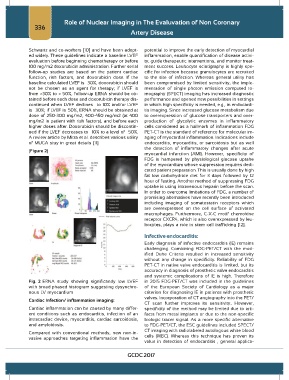
              (Figure 2)
                                                                 myocardial infarction (AMI). However,  specificity  of
                                                                 FDG is  hampered  by  physiological  glucose  uptake
                                                                 of the myocardium whose suppression requires dedi-
                                                                 cated patient preparation. This is usually done by high
                                                                 fat  low carbohydrate diet for  3 days followed  by 12
                                                                 hour of fasting. Another method of suppressing FDG
                                                                 uptake is using intravenous heparin before the scan.
                                                                 In order to overcome limitations of FDG, a number of
                                                                 promising alternatives have recently been introduced
                                                                 including imaging  of  somatostatin receptors  which
                                                                 are  overexpressed  on the cell  surface  of  activated
                                                                 macrophages.  Furthermore,  C-X-C motif chemokine
                                                                 receptor CXCR4, which is also overexpressed by leu-
                                                                 kocytes, plays a role in stem cell trafficking [12].

                                                                 Infective endocarditis:
                                                                 Early diagnosis of infective endocarditis (IE) remains
                                                                 challenging.  Combining FDG-PET/CT  with the mod-
                                                                 ified  Duke Criteria  resulted  in increased  sensitivity
                                                                 without  any change  in specificity. Reliability  of  FDG
                                                                 PET-CT in native valve endocarditis is limited, but its
                                                                 accuracy in diagnosis of prosthetic valve endocarditis
                                                                 and systemic complications of  IE  is  high. Therefore
              Fig. 2  ERNA  study showing significantly low  LVEF   in 2015 FDG-PET/CT was included  in the  guidelines
              with broad phased histogram suggesting dysynchro-  of the European Society  of Cardiology  as a major
              nous LV myocardium                                 criterion for diagnosing IE in patients with prosthetic
                                                                 valves. Incorporation of CT angiography into the PET/
              Cardiac Infection/ inflammation imaging:
                                                                 CT  scan further  improves  its  sensitivity..  However,
              Cardiac inflammation can be caused by many differ-  specificity of the method may be limited due to arti-
              ent conditions  such as  endocarditis, infection of  an   facts from metal implants or due to the non-specific
              intracardiac device, myocarditis, cardiac sarcoidosis,   biologic  tracer signal.  As  a more  specific  alternative
              and amyloidosis.                                   to FDG-PET/CT, the ESC guidelines included SPECT/
                                                                 CT imaging with radiolabeled autologous white blood
              Compared with conventional methods,  new non-in-
              vasive  approaches targeting  inflammation  have the   cells  (WBC). Whereas  this technique  has proven  its
                                                                 value in detection of endocarditis  , general  applica-


                                                         GCDC 2017

