


Page 361 - fbkCardioDiabetes_2017
P. 361
Cardio Diabetes Medicine 2017                                   337


                 tion was  compromised  by  limited sensitivity  due to   vestigated. In a rat model of autoimmune myocardi-
                 a  weak  signal  from  the valvular  target  region  and   tis, feasibility of [11C]-methionine-PET imaging for the
                 difficult localization of  inflammatory foci. The  speci-  detection  of cardiac inflammation  could  recently be
                 ficity of leukocyte scintigraphy with SPECT/CT could   demonstrated. Methionine accumulation co-localized
                 be  particularly  useful when  diagnostic uncertainty   with histologically confirmed cardiac inflammatory le-
                 remains after echocardiography and FDGPET/ CT,     sions and [18F]-FDG-uptake, indicating that [11C]-me-
                 especially in patients who have had cardiac surgery   thionine-PET might represent a promising  imaging
                 within the past 4 weeks.                           agent for the noninvasive  diagnosis  of myocarditis.
                                                                    Another new approach needing further evaluation in-
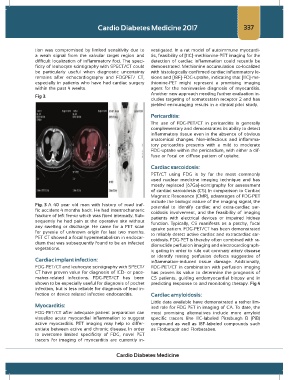
                 Fig 3.
                                                                    cludes targeting of somatostatin receptor 2 and has
                                                                    yielded encouraging results in a clinical pilot study.

                                                                    Pericarditis:
                                                                    The  use  of  FDG-PET/CT  in pericarditis  is  generally
                                                                    complementary and demonstrates its ability to detect
                                                                    inflammatory tissue even in the absence of obvious
                                                                    anatomical  changes. Non-infectious and  inflamma-
                                                                    tory pericarditis presents  with  a mild to moderate
                                                                    FDG-uptake within the pericardium, with either a dif-
                                                                    fuse or focal on diffuse pattern of uptake.

                                                                    Cardiac sarcoidosis:
                                                                    PET/CT  using  FDG is  by  far  the most commonly
                                                                    used nuclear medicine imaging technique  and  has
                                                                    mostly  replaced  [67Ga]-scintigraphy for  assessment
                                                                    of cardiac sarcoidosis (CS). In comparison to Cardiac
                                                                    Magnetic Resonance (CMR), advantages of FDG-PET
                                                                    include the biologic nature of the imaging signal, the
                 Fig. 3  A 40  year old man  with  history of road traf-  potential to identify  cardiac and extra-cardiac sar-
                 fic accident 4 months back. He had intertrochanteric   coidosis  involvement,  and the feasibility  of imaging
                 fracture of left femur which was fixed internally. Sub-  patients with  electrical devices or  impaired  kidney
                 sequently he had  pain at  the operative  site without   function.  Typically,  CS manifests as a patchy,  focal
                 any swelling  or  discharge.  He  came for  a  PET  scan   uptake pattern. FDG-PET/CT has been demonstrated
                 for  pyrexia  of  unknown  origin  for  last two months.   to reliably detect active cardiac and extracardiac sar-
                 PET CT showed a focal hypermetabolism in endocar-  coidosis. FDG-PET is thereby often combined with ra-
                 dium that was subsequently found to be an infected   dionuclide perfusion imaging and electrocardiograph-
                 vegetations.
                                                                    ic gating in order to rule out coronary artery disease
                                                                    or  identify resting perfusion  defects suggestive  of
                 Cardiac implant infection:                         inflammation-induced  tissue damage. Additionally,
                 FDG-PET/CT and leukocyte scintigraphy with SPECT/  FDG-PET/CT in combination with  perfusion  imaging
                 CT have proven value for diagnosis of ICD- or pace-  has proven  its value to determine the prognosis  of
                 maker-related  infections.  FDG-PET/CT has been    CS  patients, guiding  endomyocardial  biopsy  and in
                 shown to be especially useful for diagnosis of pocket   predicting response to and monitoring therapy. Fig 4
                 infection, but is less reliable for diagnosis of lead in-
                 fection or device related infective endocarditis.  Cardiac amyloidosis:
                                                                    Little data available have demonstrated a rather lim-
                 Myocarditis:                                       ited role for FDG PET in imaging of CA. To date, the
                 FDG-PET/CT after adequate patient preparation  can   most promising  alternatives  include more  amyloid
                 visualize acute myocardial inflammation  to suggest   specific  tracers  like  11C-labeled  Pittsburgh B  (PiB)
                 active  myocarditis. PET imaging may  help to  differ-  compound  as  well  as  18F-labeled  compounds such
                 entiate between active and chronic disease. In order   as Florbetapir and Florbetaben.
                 to  overcome  limited specificity  of FDG,  novel PET
                 tracers  for  imaging  of  myocarditis  are  currently  in-


                                                    Cardio Diabetes Medicine

