


Page 364 - fbkCardioDiabetes_2017
P. 364
Evaluvation of Cardiac Syncope And ECG Markers of
                340
                                                     Sudden Cardiac Arrest.


              ly  in standing positions  or  after change  of posture
              suggest  vasovagal  etiology. Similarly  situations like
              micturition  cough/exercise  triggering  syncope  sug-
              gest  vasovagal  etiology.  Palpitations preceding  syn-
              cope or syncope post exercise  termination  suggest
              an arrhythmic cause. Syncope in lying down position
              mostly suggests arrhythmic/cardiac cause.
              High risk features in history are:

              Syncope post exercise or in supine position.
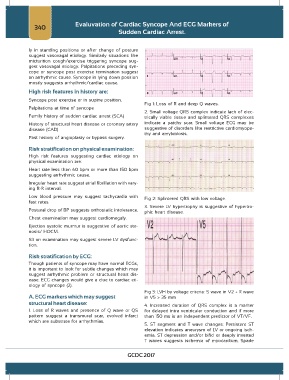
                                                                 Fig 1: Loss of R and deep Q waves.
              Palpitations at time of syncope
                                                                 2. Small voltage QRS complex indicate lack of elec-
              Family history of sudden cardiac arrest (SCA)      trically viable tissue  and splintered  QRS complexes
              History of structural heart disease or coronary artery   indicate a patchy scar.  Small  voltage  ECG may be
              disease (CAD)                                      suggestive of disorders like restrictive cardiomyopa-
                                                                 thy and amyloidosis.
              Past history of angioplasty or bypass surgery.

              Risk stratification on physical examination:
              High  risk  features suggesting  cardiac  etiology  on
              physical examination are:
              Heart rate less than 60 bpm or more than 150 bpm
              suggesting arrhythmic cause.

              Irregular heart rate suggest atrial fibrillation with vary-
              ing R-R interval.
              Low  blood  pressure  may suggest  tachycardia  with   Fig 2: Splintered QRS with low voltage.
              fast rates.
                                                                 3. Severe  LV  hypertrophy  is  suggestive  of  hypertro-
              Postural drop of BP suggests orthostatic intolerance.  phic heart disease.
              Chest examination may suggest cardiomegaly.
              Ejection systolic murmur is suggestive of aortic ste-
              nosis/ HOCM.
              S3 on examination may suggest severe LV dysfunc-
              tion.

              Risk stratification by ECG:
              Though patients of syncope may have normal ECGs,
              it is important to look for subtle changes which may
              suggest  arrhythmic problem  or  structural heart dis-
              ease. ECG changes would give a clue to cardiac eti-
              ology of syncope (2).
                                                                 Fig 3: LVH by voltage criteria: S wave in V2 + R wave
              A. ECG markers which may suggest                   in V5 > 35 mm
              structural heart disease:                          4. Increased  duration of  QRS complex  is  a marker

              1. Loss  of R waves and presence  of Q wave or  QS   for  delayed  intra ventricular  conduction  and if more
              pattern suggest  a transmural scar, evolved  infarct   than 150 ms is an independent predictor of VT/VF.
              which are substrate for arrhythmias.
                                                                 5.  ST  segment  and T  wave  changes: Persistent  ST
                                                                 elevation indicates aneurysm of LV or ongoing isch-
                                                                 emia. ST  depression  and/or bifid  or  deeply  inverted
                                                                 T  waves  suggests  ischemia of  myocardium. Spade


                                                         GCDC 2017

