


Page 387 - fbkCardioDiabetes_2017
P. 387
Strain and Strain Rate Imaging in Early Detection of Ventricular                        363
                          Systolic Dysfunction - is This The Best Investigation?


                 New Methods For Evaluation of LV Systolic           Decrease of the dimension (shortening of the wall in
                 Function                                           longitudinal  direction during systole,  or decrease  of
                                                                    the circumferential dimension during systole, as well
                  Newer echocardiographic  techniques,  such  as TDI   as thinning of the wall during diastole) is marked with
                 and deformation imaging  gives  better  understand-  a negative number  (  negative sign –)  and  increase
                 ing  and evaluation  of  the complex  mechanism  of   of the  dimension (lengthening of the  wall in a lon-
                 cardiac contraction  and relaxation.  Evaluation  of LV   gitudinal direction during diastole, or increase of the
                 longitudinal systolic dynamics has become crucial in   circumferential dimension during systole, as well as
                 the assessment  of  LV  systolic  function  and superi-  thickening of the wall during systole) is marked with
                 or value in comparison with traditional measures [4]   a positive number ( positive sign +).
                 and is  evaluated  using Tissue  Doppler  and speckle
                 tracking techniques utilizing strain (S) and strain rate
                 (SR) imaging thus giving a more detailed information   Types of Strains
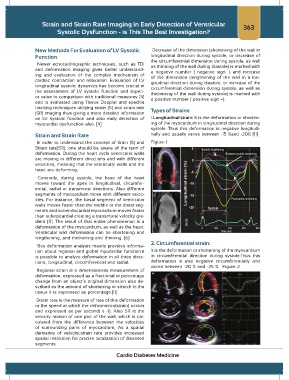
                 on LV  systolic  function  and also  early  detection of   1.Longitudinal strain: It is the deformation or shorten-
                 myocardial dysfunction also. [4]                   ing of the myocardium in longitudinal direction during
                                                                    systole .Thus this deformation  is negative longitudi-
                 Strain and Strain Rate                             nally and usually varies between -15 %and -20% [11]
                  In order to understand the concept of Srain (S) and   Figure-1
                 Strain rate(SR), one should be  aware of the term of
                 deformation. During the heart cycle ventricular walls
                 are moving in different directions and with different
                 velocities, meaning that the ventricular walls and the
                 heart are deforming.
                  Generally,  during systole,  the base of the heart
                 moves toward the  apex  in longitudinal,  circumfer-
                 ential, radial  or  transmural directions.  Also  different
                 segments of myocardium move with different veloc-
                 ities.  For  instance,  the basal segment of ventricular
                 walls moves faster than the middle or the distal seg-
                 ments and subendocardial myocardium moves faster
                 than subepicardial creating a transmural velocity gra-
                 dient [5]. The  result  of that  entire  phenomenon is  a
                 deformation of the myocardium, as well as the heart.
                 Ventricular wall  deformation can  be  shortening  and
                 lengthening, and thickening and thinning. [6]
                                                                    2. Circumferential strain:
                  This deformation analysis mainly provides informa-
                 tion about regional and global myocardial function.It   It is the deformation or shortening of the myocardium
                 is possible to analyze deformation in all three direc-  in circumferential direction during systole.Thus  this
                 tions, longitudinal, circumferential and radial.   deformation is also  negative  circumferentially and
                                                                    varies between -20 % and -25 %.  Figure 2
                  Regional strain is a dimensionless measurement of
                 deformation, expressed as a fractional or percentage
                 change from an object’s original dimension also de-
                 scribed as the amount of shortening or stretch in the
                 tissue It is expressed as percentage.[11]
                  Strain rate is the measure of rate of this deformation
                 or the speed at which the deformation(strain) occurs
                 and  expressed  as per  second(  s -1). Also  SR is the
                 velocity motion of one part of the wall, which is cal-
                 culated  from the difference  between the velocities
                 of surrounding  parts of myocardium,  As a spatial
                 derivative  of  velocity,strain rate  provides  increased
                 spatial resolution for precise localization of diseased
                 segments.

                                                    Cardio Diabetes Medicine

