


Page 392 - fbkCardioDiabetes_2017
P. 392
368                                Cardiac  MRI  vs  PET Scan


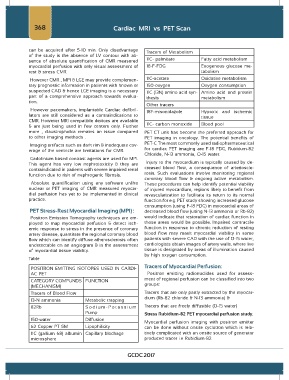
              can  be  acquired  after 5-10 min. Only disadvantage   Tracers of Metabolism
              of the  study is the  absence of LV contour  with  ab-
              sence of absolute quantification  of CMR  measured   11C- palmitate         Fatty acid metabolism
              myocardial perfusion with only visual assessment of   18-F-FDG              Exogenous glucose me-
              rest & stress CMR.                                                          tabolism
               However CMR , MPI & LGE may provide complemen-     11C-acetate             Oxidative metabolism
              tary prognostic information in patients with known or   150-oxygen          Oxygen consumption
              suspected CAD & hence LGE imaging is a necessary    11C (13N) amino acid syn- Amino acid  and protein
              part  of  a comprehensive  approach  towards  evalua-  thesis               metabolism
              tion.
                                                                  Other tracers
               However  pacemakers,  implantable  Cardiac defibril-  18F-misonidazole     Hypoxic  and  ischemic
              lators are  still considered  as a contraindications  to                    tissue
              CMR. However MRI compatible devices are available
              &  are  just being  used in few centers only. Further   11C- carbon monoxide  Blood pool
              more  , claustrophobia remains  an issue  compared   PET CT unit has become the preferred approach for
              to other imaging methods .                         PET  imaging  in  oncology.  The  potential  benefits  of
               Imaging artifacts such as dark rim & inadequate cov-  PET-C The most commonly used radiopharmaceutical
              erage of the ventricle are limitations for CMR.    for  cardiac PET  imaging  are  F-18  FDG, Rubidum-82
                                                                 Chloride, N-13 ammonia, O-15 water.
               Gadolinium based contrast agents are used for MPI.
              This  agent has very  low nephrotoxicity &  they are    Injury to the myocardium is typically caused by de-
              contraindicated in patients with severe impaired renal   creased  blood  flow, a consequence of arterioscle-
              function due to risk of nephrogenic fibrosis.      rosis.  Such  evaluations  involve monitoring regional
                                                                 coronary blood flow &  ongoing  active  metabolism.
                Absolute  quantification  using  any software  unlike   These procedures can help identify potential viability
              nuclear or  PET imaging  of CMR measured  myocar-  of injured myocardium, regions likely to benefit from
              dial perfusion  has yet to be implemented in clinical   revascularization  to facilitate its return to its normal
              practice.                                          function for e.g. PET study showing increased glucose
                                                                 consumption (using F-18 FDG) in myocardial areas of
               PET Stress-Rest Myocardial Imaging (MPI) :        decreased blood flow (using N-13 ammonia or Rb-82)
               Positron Emission Tomography techniques are em-   would indicate that restoration of cardiac function in
              ployed  to map myocardial perfusion  &  detect isch-  those areas would be possible.  Impaired  contractile
              emic response to stress in the presence of coronary   function  in response  to chronic reduction of resting
              artery disease, quantitate the regional coronary blood   blood flow may mask myocardial viability in some
              flow which can identify diffuse atherosclerosis often   patients with severe CAD with the use of O-15 water,
              undetectable on an angiogram & in the assessment   cardiologists obtain images of artery walls, where live
              of myocardial tissue viability.                    tissue is designated by areas of illumination caused
                                                                 by high oxygen consumption.
              Table

               POSITRON EMITTING  ISOTOPES USED IN  CARDI-       Tracers of Myocardial Perfusion:
               AC PET                                             Positron emitting radionuclides used for  assess-
                                                                 ment of regional perfusion can be classified into two
               CATEGORY COMPUNDS                                                     FUNCTION
               (MECHANISM)                                       groups:
               Tracers of Blood Flow                             Tracers that are only partly extracted by the myocar-
                                                                 dium (Rb-82 chloride & N-13 ammonia) &
               13-N ammonia            Metabolic trapping
               82Rb                    Sodium-Potassium          Tracers that are freely diffusible (O-15 water)
                                       Pump                      Stress Rubidium-82 PET myocardial perfusion study.
               150-water               Diffusion
                                                                 Myocardial  perfusion  imaging  with positron  emitter
               62 Copper PT SM         Lipophilicity             can  be  done without  onsite cyclotron which  is  rela-
               11C (gallium 68)  albumin  Capillary blockage     tively complicated with an onsite source of generator
               microsphere                                       produced tracer i.e Rubidium-82.


                                                         GCDC 2017

