


Page 606 - fbkCardioDiabetes_2017
P. 606
582                 Exercise and Physical Activity in Diabetes Mellitus


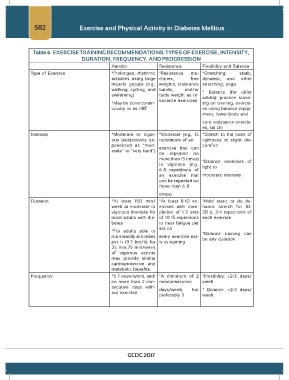
                Table 6—EXERCISE TRAINING RECOMMENDATIONS: TYPES OF EXERCISE, INTENSITY,
                                     DURATION, FREQUENCY, AND PROGRESSION

                                                  Aerobic              Resistance         Flexibility and Balance
               Type of Exercise                   *Prolonged,  rhythmic  *Resistance  ma- *Stretching:     static,
                                                  activities using large  chines,    free dynamic,   and   other
                                                  muscle groups  (e.g.,  weights, resistance  stretching; yoga
                                                  walking, cycling, and  bands,   and/or  *  Balance (for older
                                                  swimming)            body weight as  re-  adults):  practice stand-
                                                                       sistance exercises
                                                  *May be done contin-                    ing on one leg, exercis-
                                                  uously or as HIIT                       es using balance equip-
                                                                                          ment, lower-body and
                                                                                          core resistance exercis-
                                                                                          es, tai chi
               Intensity                          *Moderate  to vigor- *Moderate  (e.g., 15  *Stretch  to the  point  of
                                                  ous (subjectively  ex- repetitions of an  tightness or  slight  dis-
                                                  perienced  as  “mod-  exercise  that  can   comfort
                                                  erate” to “very hard”)
                                                                       be repeated no
                                                                       more than 15 times)   *Balance exercises  of
                                                                       to vigorous  (e.g.,   light to
                                                                       6–8  repetitions of
                                                                       an exercise  that  moderate intensity
                                                                       can be repeated no
                                                                       more than 6–8

                                                                       times)
               Duration                           *At  least 150 min/ *At  least 8–10  ex- *Hold  static  or do dy-
                                                  week at moderate to  ercises  with com- namic  stretch for  10-
                                                  vigorous intensity for  pletion of 1–3  sets  30 s;  2-4  repetitions  of
                                                  most adults with dia- of 10–15 repetitions  each exercise
                                                  betes                to near fatigue per
                                                                       set on
                                                  *For  adults able to                    *Balance training can
                                                  run steadily at 6 miles  every exercise ear-  be any duration
                                                  per  h (9.7  km/h) for  ly in training
                                                  25 min,75  min/week
                                                  of  vigorous  activity
                                                  may provide  similar
                                                  cardioprotective and
                                                  metabolic benefits
               Frequency                          *3–7 days/week, with  *A  minimum  of 2  *Flexibility:  >2-3 days/
                                                  no more than 2 con- nonconsecutive      week
                                                  secutive days with-  days/week,     but *  Balance: >2-3 days/
                                                  out exercise
                                                                       preferably 3       week


                                                         GCDC 2017

