


Page 604 - fbkCardioDiabetes_2017
P. 604
580                 Exercise and Physical Activity in Diabetes Mellitus


              of exercise. Apart from neuromuscular stability, walk-  gradually from conditioning phase and for safe tran-
              ing has accessibility, social companionship,  lack of   sition to original state.
              special equipments, easily tolerable exercise in inten-
              sity, fewer muscle skeletal and orthopedic problems  Exercise Prescription :
              of the legs, knee and feet.
                                                                 This could specifically address certain questions like
              Aerobic Exercise Recommendations :                 what type of exercise (mode), how much, (Intensity)
                                                                 how long  (duration)  and how often (frequency) and
              Aerobic exercise has been the mode of physical ac-  rate of progression  of the program  (Progression).
              tivity traditionally  recommended  for  diabetes  man-  While these are interrelated and will vary depending
              agement and  prevention. The American college  of   on the goals of physical activity in the individual pa-
              sports  medicine (ACSM)  recommends  moderate –    tient  and the patients choices, needs, back ground
              intensity training for  at least  30min/day or  5  days   and health  condition.  While imparting  the exercise
              /week  (a total of  at least  150  min/week),  vigorous   prescription  to patients with  diabetes safety rec-
              intensity training  for  at least 20min/day on 3days/  ommendation  should be  incorporated  concerning
              week  (at least  60-75 min/week).  For  patients with   the mode, frequency, duration and intensity of the
              T DM, exercise recommendations are closely aligned   advised exercise.  Timing  of medications,  food and
               1
              with those for apparently healthy people. Recommen-  glucose monitoring in relation to exercise should be
              dations for women  with  uncomplicated  gestational   discussed.
              diabetes (GDM) include engaging in 30 min of mod-
              erate intensity activity  like  brisk  walking on  most  Guidelines  and  Recommendations  for Exer-
              days of the week (150 min/week)                    cise in Diabetes:

              Each Aerobic Exercise Session Generally Has        there are  several  guidelines  and recommendation
              3 Different Phases :                               from authorities like ADA and ACSM available which
                                                                 incorporate the beneficial effect of all types of phys-
              Warm-up phase includes 5-10 min of physical activ-  ical training program  suitable for all types  of diabe-
              ity done at  a lower  intensity such  as cycling slowly.   tes  population.  Before  considering  the recommen-
              This will help to prevent muscle injury and facilitates   dations, it is better to formulate certain facts before
              a safe transition from rest  to exercise  by stretching   presenting the particular exercise like discussing the
              postural muscles,  increasing blood flow elevating   patient’s expectation, establishing the realistic goals,
              body temperature and increasing O  availability and   mode, frequency, intensity and  rate of progression
                                               2
              metabolic rate.
                                                                 of the activity  and  developing  a plan to keep  track
              Conditioning Phase                                 of progress.  Safety  considerations like  contra-indi-
                                                                 cations,  medication in relation  to exercise,  glucose
              is the most important for achieving fitness and other   monitoring, snacking, appropriate  foot wear, identi-
              goals like enhancing cardiac respiratory fitness, mus-  fication  tag or  bracelet all be accounted  for  (Tables
              cle strength and endurance or flexibility.         4 & 5)

              Cool down Phase includes at least 3-5 min of doing
              a lower-intensity activity to help the body to recover

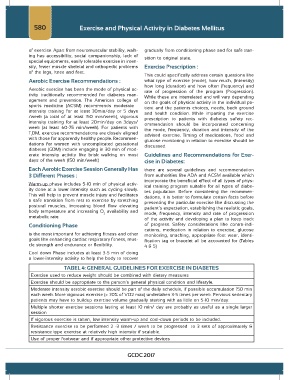
                             TABEL 4: GENERAL GUIDELINES FOR EXERCISE IN DIABETES
               Exercise used to reduce weight should be combined with dietary measures
               Exercise should be appropriate to the person’s general physical condition and lifestyle.
               Moderate intensity aerobic exercise should be part of the daily schedule, if possible accumulation 150 min
               each week. More vigorous exercise (> 70% of VO2 max) undertaken 3-5 times per week. Pervious sedentary
               patients may have to buildup exercise volume gradually starting with as little on 5-10 min/day.
               Multiple  shorter  exercise  sessions  lasting at least  10 min/  day are  probably  as useful as a single  larger
               session
               If vigorous exercise is taken, low intensity warm-up and cool-down periods to be included.
               Resistance  exercise  to  be performed  2 -3 times / week to  be progressed   to 3  sets of approximately  &
               resistance type exercise at relatively high intensity if scalable.
               Use of proper footwear and if appropriate other protective devices


                                                         GCDC 2017

