


Page 603 - fbkCardioDiabetes_2017
P. 603
Cardio Diabetes Medicine 2017 579
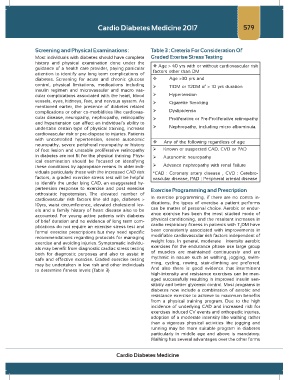
Screening and Physical Examinations : Table 3 : Creteria For Consideration Of
Most individuals with diabetes should have complete Graded Exerise Stress Testing
history and physical examination done under the Age > 40 yrs with or without cardiovascular risk
guidance of a health care provider, paying particular factors other than DM
attention to identify any long term complications of
diabetes. Screening for acute and chronic glucose Age >30 yrs and
control, physical limitations, medications including T1DM or T2DM of > 10 yrs duration
insulin regimen and microvasaular and macro vas-
cular complications associated with the heart, blood Hypertension
vessels, eyes, kidneys, feet, and nervous system. As Cigarette Smoking
mentioned earlier, the presence of diabetes related
complications or other co-morbidities like cardiovas- Dyslipidemia
cular disease, neuropathy, nephropathy, retinopathy Proliferative or Pre-Proliferative retinopathy
and hypertension can affect an individual’s ability to
undertake certain type of physical training, increase Nephropathy, including micro albuminuia.
cardiovascular risk or pre-dispose to injuries. Patients
with uncontrolled hypertension, severe autonomic Any of the following regardless of age
neuropathy, severe peripheral neuropathy or history
of foot lesion and unstable proliferative retinopathy Known or suspected CAD, CVD or PAD
in diabetes are not fit for the physical training. Phys- Autonomic neuropathy
ical examination should be focused on identifying
these conditions by appropriate means. In older indi- Advance nephropathy with renal failure
viduals particularly those with the increased CAD risk *CAD : Coronary artery disease , CVD : Cerebro-
factors, a graded exercise stress test will be helpful vascular disease, PAD : Peripheral arterial disease
to identify the under lying CAD, an exaggerated hy-
pertension response to exercise and post exercise Exercise Programming and Prescription
orthostatic hypotension. The elevated number of
cardiovascular risk factors like old age, diabetes > In exercise programming, if there are no contra in-
10yrs, waist circumference, elevated cholesterol lev- dications, the types of exercise a patient performs
els and a family history of heart disease also to be can be matter of personal choice. Aerobic or endur-
accounted. For young active patients with diabetes ance exercise has been the most studied mode of
of brief duration and no evidence of long term com- physical conditioning, and the resultant increases in
plications do not require an exercise stress test and cardio respiratory fitness in patients with T DM have
2
formal exercise prescriptions but they need specific been consistently associated with improvements in
recommendations regarding protocols for managing modifiable cardiovascular risk factors independent of
exercise and avoiding injuries. Symptomatic individu- weight loss. In general, moderate – intensity aerobic
als may benefit from diagnostic cardiac stress testing exercises for the endurance phase use large group
both for diagnostic purposes and also to assist in of muscles are maintained continuously and are
safe and effective exercise. Graded exercise testing rhythmic in nature such as walking, jogging, swim-
may be undertaken in low risk and other individuals ming, cycling, rowing, stair-climbing are preferred.
to determine fitness levels (Table 3) And also there is good evidence that intermittent
high-intensity and resistance exercises can be man-
aged successfully resulting in improved insulin sen-
sitivity and better glycemic control. Most programs in
diabetes now include a combination of aerobic and
resistance exercise to achieve to maximum benefits
from a physical training program. Due to the high
incidence of underlying CAD and increased risk for
exercises induced CV events and orthopedic injuries,
adoption of a moderate intensity like walking rather
than a vigorous physical activities like jogging and
running may be more suitable program in diabetes
particularly in middle age and above is mandatory.
Walking has several advantages over the other forms
Cardio Diabetes Medicine

