


Page 421 - Critical Care Nursing Demystified
P. 421
406        CRITICAL CARE NURSING  DeMYSTIFIED


                               Check the patient’s oral cavity. Is the tongue large, smooth, and beefy red?
                            Is the mouth inflamed? Both of these conditions can be seen in iron-deficiency
                            anemias. Is there easy bleeding of the mucous membranes? Are there white,
                            patchy areas that can be invasion of the mucous membranes by thrush in a
                            patient with low white cell counts?
                               Can you see an enlarged spleen or liver? Examine the lymph nodes for swell-
                            ing; you will be palpating these areas next.


                            Palpation

                            Palpate the patient’s peripheral pulses. Thrombus formation can cause dimin-
                            ished blood flow to the extremities, but a pulse should be present. Is there
                            peripheral edema; is it pitting or nonpitting?
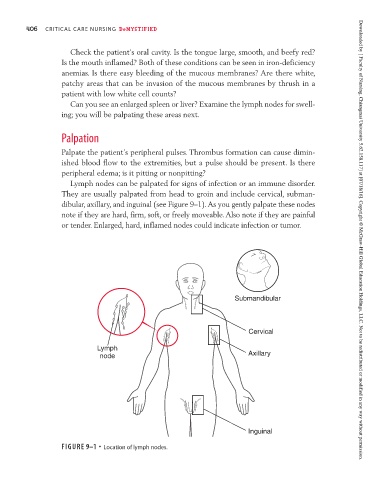
                               Lymph nodes can be palpated for signs of infection or an immune disorder.
                            They are usually palpated from head to groin and include cervical, subman-
                            dibular, axillary, and inguinal (see Figure 9–1). As you gently palpate these nodes
                            note if they are hard, firm, soft, or freely moveable. Also note if they are painful
                            or tender. Enlarged, hard, inflamed nodes could indicate infection or tumor.        Downloaded by [ Faculty of Nursing, Chiangmai University 5.62.158.117] at [07/18/16]. Copyright © McGraw-Hill Global Education Holdings, LLC. Not to be redistributed or modified in any way without permission.


                                                                             Submandibular


                                                                                 Cervical

                                      Lymph
                                       node                                      Axillary


                                                                                 Inguinal

                            FIGURE 9–1  •  Location of lymph nodes.

