


Page 422 - Critical Care Nursing Demystified
P. 422
Chapter 9  CARE OF THE PATIENT WITH CRITICAL HEMATOLOGIC NEEDS        407


                               Percussion

                               Percussion of the liver and spleen can be done to determine enlargement. Nor-
                               mally the liver can be palpated under the right lower rib cage when the patient
                               takes a deep breath. The spleen is located under the left costal margin and is
                               only palpable when it is greatly enlarged.


                               Auscultation
                               Listen to the patient’s heart sounds. Are they regular; do you hear any extra or
                               skipped beats? Next, take the BP on both arms; a lower BP and hypotension
                               can be caused by extreme blood loss. Listen to the abdomen for bowel sounds.
                               Remember to do inspection and auscultation of the abdomen before percussion
                               and palpation. Patients with high-pitched, loud bowel sounds can have an intes-
                               tinal obstruction caused by lymphomas.

                       Collaborative Diagnostic and Laboratory Tools


                               Laboratory Tests

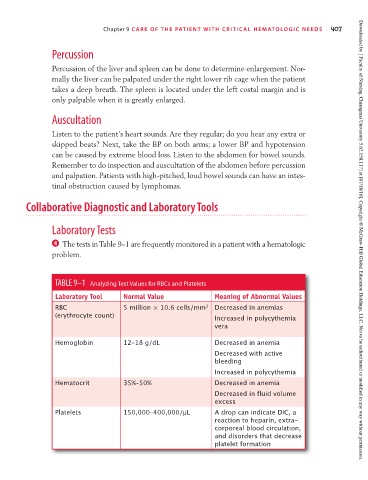
                               4    The tests in Table 9–1 are frequently monitored in a patient with a hematologic   Downloaded by [ Faculty of Nursing, Chiangmai University 5.62.158.117] at [07/18/16]. Copyright © McGraw-Hill Global Education Holdings, LLC. Not to be redistributed or modified in any way without permission.
                               problem.


                               TABLE 9–1  Analyzing Test Values for RBCs and Platelets
                               Laboratory Tool     Normal Value             Meaning of Abnormal Values
                               RBC                 5 million × 10.6 cells/mm 3  Decreased in anemias
                               (erythrocyte count)                          Increased in polycythemia
                                                                            vera

                               Hemoglobin          12–18 g/dL               Decreased in anemia
                                                                            Decreased with active
                                                                            bleeding
                                                                            Increased in polycythemia
                               Hematocrit          35%–50%                  Decreased in anemia
                                                                            Decreased in fluid volume
                                                                            excess
                               Platelets           150,000–400,000/μL       A drop can indicate DIC, a
                                                                            reaction to heparin, extra-
                                                                            corporeal blood circulation,
                                                                            and disorders that decrease
                                                                            platelet formation

