


Page 426 - Critical Care Nursing Demystified
P. 426
Chapter 9  CARE OF THE PATIENT WITH CRITICAL HEMATOLOGIC NEEDS        411


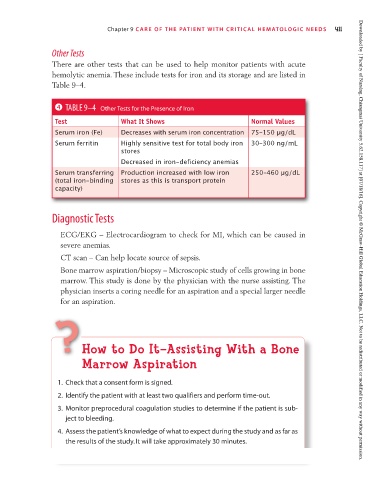
                               Other Tests
                               There are other tests that can be used to help monitor patients with acute
                               hemolytic anemia. These include tests for iron and its storage and are listed in
                               Table 9–4.


                                4  TABLE 9–4  Other Tests for the Presence of Iron
                               Test               What It Shows                       Normal Values
                               Serum iron (Fe)    Decreases with serum iron concentration  75–150 μg/dL
                               Serum ferritin     Highly sensitive test for total body iron  30–300 ng/mL
                                                  stores
                                                  Decreased in iron-deficiency anemias
                               Serum transferring  Production increased with low iron   250–460 μg/dL
                               (total iron-binding  stores as this is transport protein
                               capacity)


                               Diagnostic Tests

                                 ECG/EKG – Electrocardiogram to check for MI, which can be caused in
                                 severe anemias.                                                                    Downloaded by [ Faculty of Nursing, Chiangmai University 5.62.158.117] at [07/18/16]. Copyright © McGraw-Hill Global Education Holdings, LLC. Not to be redistributed or modified in any way without permission.
                                 CT scan – Can help locate source of sepsis.
                                 Bone marrow aspiration/biopsy – Microscopic study of cells growing in bone
                                 marrow. This study is done by the physician with the nurse assisting. The
                                 physician inserts a coring needle for an aspiration and a special larger needle
                                 for an aspiration.

                                       H ?  How to Do It—Assisting With a Bone


                                         o
                                                       o I
                                                                   s
                                           w t
                                                               As
                                                 o D
                                                           t—
                                       Marrow Aspiratio
                                       Marrow Aspiration
                                1.  Check that a consent form is signed.
                                1 .    Check that a c onsent  f orm is si g ned .
                                2.  Identify the patient with at least two qualifiers and perform time-out.
                                          the patient with at least tw
                                2.
                                                               o qu
                                  Identi
                                       fy
                                                                   a
                                                edur
                                                          ulation stu
                                                         g
                                                    al c
                                                        a
                                                       o
                                 .

                                                                   d
                                3.  Monitor preprocedural coagulation studies to determine if the patient is sub-
                                3
                                  Monit
                                              o
                                               c
                                           epr
                                       o
                                        r pr
                                  j ject to bleeding.
                                        bl
                                            di
                                4.  Assess the patient’s knowledge of what to expect during the study and as far as
                                  the results of the study. It will take approximately 30 minutes.

