


Page 425 - Critical Care Nursing Demystified
P. 425
410        CRITICAL CARE NURSING  DeMYSTIFIED


                              NURSING ALERT

                              The nurse should assess the number of band neutrophils in any patient suspected of
                              having an infection. An increase greater than 5% is called a shift-to-the-left, indicat-
                              ing the proliferation of immature granulocytes in response to bacterial infection.


                            Coagulation Studies
                            Because the patient can develop bleeding disorders from hematologic problems,
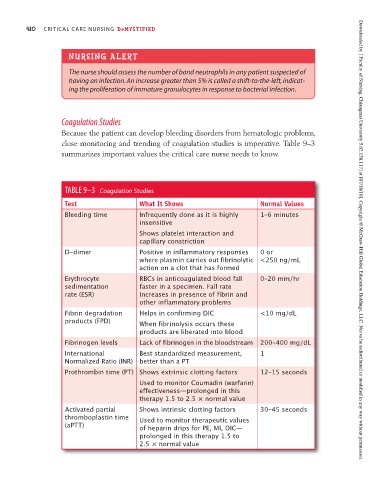
                            close monitoring and trending of coagulation studies is imperative. Table 9–3
                            summarizes important values the critical care nurse needs to know.


                             TABLE 9–3  Coagulation Studies

                             Test                 What It Shows                     Normal Values
                             Bleeding time        Infrequently done as it is highly   1–6 minutes
                                                  insensitive
                                                  Shows platelet interaction and
                                                  capillary constriction                                        Downloaded by [ Faculty of Nursing, Chiangmai University 5.62.158.117] at [07/18/16]. Copyright © McGraw-Hill Global Education Holdings, LLC. Not to be redistributed or modified in any way without permission.
                             D-dimer              Positive in inflammatory responses   0 or
                                                  where plasmin carries out fibrinolytic  < 250 ng/mL
                                                  action on a clot that has formed
                             Erythrocyte          RBCs in anticoagulated blood fall   0–20 mm/hr
                             sedimentation        faster in a specimen. Fall rate
                             rate (ESR)           increases in presence of fibrin and
                                                  other inflammatory problems
                             Fibrin degradation   Helps in confirming DIC           <10 mg/dL
                             products (FPD)       When fibrinolysis occurs these
                                                  products are liberated into blood
                             Fibrinogen levels    Lack of fibrinogen in the bloodstream  200–400 mg/dL
                             International        Best standardized measurement,    1
                             Normalized Ratio (INR)  better than a PT
                             Prothrombin time (PT) Shows extrinsic clotting factors  12–15 seconds
                                                  Used to monitor Coumadin (warfarin)
                                                  effectiveness—prolonged in this
                                                  therapy 1.5 to 2.5 × normal value
                             Activated partial    Shows intrinsic clotting factors  30–45 seconds
                             thromboplastin time   Used to monitor therapeutic values
                             (aPTT)               of heparin drips for PE, MI, DIC—
                                                  prolonged in this therapy 1.5 to
                                                  2.5 × normal value

