


Page 423 - Critical Care Nursing Demystified
P. 423
408        CRITICAL CARE NURSING  DeMYSTIFIED


                              NURSING ALERT

                              A drop in hemoglobin below 10 g/dL or a trend downward from baseline should be
                              reported to the physician. A sudden drop can indicate bleeding, and a gradual drop
                              can point to anemia.


                              NURSING ALERT
                              A decrease in platelets below 30,000 warns the nurse that bleeding, especially intrac-
                              ranial, can occur. Institute bleeding precautions and notify the physician ASAP!


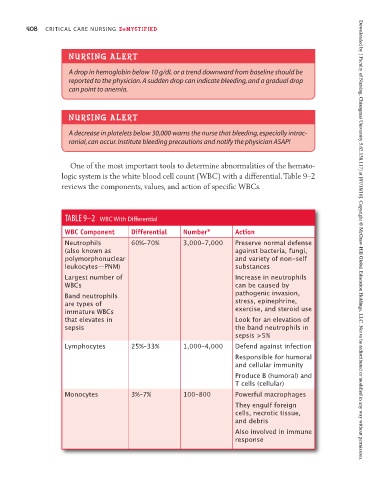
                               One of the most important tools to determine abnormalities of the hemato-
                            logic system is the white blood cell count (WBC) with a differential. Table 9–2
                            reviews the components, values, and action of specific WBCs.


                             TABLE 9–2  WBC With Differential
                             WBC Component      Differential  Number *       Action
                             Neutrophils        60%–70%       3,000–7,000    Preserve normal defense            Downloaded by [ Faculty of Nursing, Chiangmai University 5.62.158.117] at [07/18/16]. Copyright © McGraw-Hill Global Education Holdings, LLC. Not to be redistributed or modified in any way without permission.
                             (also known as                                  against bacteria, fungi,
                             polymorphonuclear                               and variety of non-self
                             leukocytes—PNM)                                 substances
                             Largest number of                               Increase in neutrophils
                             WBCs                                            can be caused by
                             Band neutrophils                                pathogenic invasion,
                             are types of                                    stress, epinephrine,
                             immature WBCs                                   exercise, and steroid use
                             that elevates in                                Look for an elevation of
                             sepsis                                          the band neutrophils in
                                                                             sepsis >5%
                             Lymphocytes        25%–33%       1,000–4,000    Defend against infection
                                                                             Responsible for humoral
                                                                             and cellular immunity
                                                                             Produce B (humoral) and
                                                                             T cells (cellular)
                             Monocytes          3%–7%         100–800        Powerful macrophages
                                                                             They engulf foreign
                                                                             cells, necrotic tissue,
                                                                             and debris
                                                                             Also involved in immune
                                                                             response

