


Page 427 - Critical Care Nursing Demystified
P. 427
412        CRITICAL CARE NURSING  DeMYSTIFIED


                              5.  Identify the medications the patient is taking. Aspirin, anticoagulants, and other
                                medications can increase bleeding tendencies.
                              6.  Check the IV site for patency for delivery of medications.
                              7.  Administer any preprocedural medications like antianxiety and systemic
                                opiates, if protocol. Request medications if not.
                              8.  Perform baseline vital signs.

                              9.  Prepare the patient, assisting him or her into a fetal position if the posterior iliac
                                crest is used.

                              After the Procedure
                              1.  Monitor/record VS and status of procedural site according to protocols, usually
                                every 15 minutes for the first hour, then every hour for the next 4 to 8 hours.
                              2.  Assess the patient’s ability to swallow prior to allowing to eat if premedication
                                was given to prevent aspiration.
                              3.  Observe for delayed hypersensitivity reactions like urticaria, itching, tachycardia,
                                and hypertension.
                              4.  Report any excessive bleeding at the aspiration site.

                              5.  Support the patient, recognizing that anxiety can result pending test results.  Downloaded by [ Faculty of Nursing, Chiangmai University 5.62.158.117] at [07/18/16]. Copyright © McGraw-Hill Global Education Holdings, LLC. Not to be redistributed or modified in any way without permission.


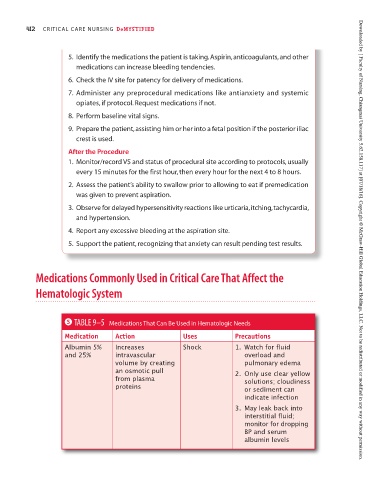
                     Medications Commonly Used in Critical Care That Affect the

                     Hematologic System


                              5   TABLE 9–5  Medications That Can Be Used in Hematologic Needs

                             Medication    Action             Uses           Precautions
                             Albumin 5%    Increases          Shock          1.  Watch for fluid
                             and 25%       intravascular                       overload and
                                           volume by creating                  pulmonary edema
                                           an osmotic pull                   2.  Only use clear yellow
                                           from plasma                         solutions; cloudiness
                                           proteins                            or sediment can
                                                                               indicate infection
                                                                             3.  May leak back into
                                                                               interstitial fluid;
                                                                               monitor for dropping
                                                                               BP and serum
                                                                               albumin levels

