


Page 139 - Color_Atlas_of_Physiology_5th_Ed._-_A._Despopoulos_2003
P. 139
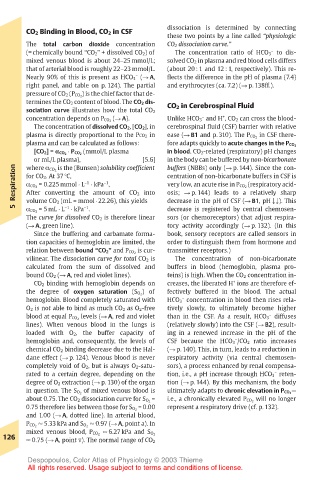
CO 2 Binding in Blood, CO 2 in CSF  dissociation is determined by connecting
                                       these two points by a line called “physiologic
       The  total  carbon  dioxide  concentration  CO 2 dissociation curve.”
       (= chemically bound “CO 2” + dissolved CO 2) of  The concentration ratio of HCO 3 to dis-
                                                              –
       mixed venous blood is about 24–25 mmol/L;  solved CO 2 in plasma and red blood cells differs
       that of arterial blood is roughly 22–23 mmol/L.  (about 20 : 1 and 12 : 1, respectively). This re-
       Nearly 90% of this is present as HCO 3 (! A,  flects the difference in the pH of plasma (7.4)
                                –
       right panel, and table on p. 124). The partial  and erythrocytes (ca. 7.2) (! p. 138ff.).
       pressure of CO 2 (P CO 2 ) is the chief factor that de-
       termines the CO 2 content of blood. The CO 2 dis-
                                       CO 2 in Cerebrospinal Fluid
       sociation curve illustrates how the total CO 2
       concentration depends on P CO 2 (! A).  Unlike HCO 3 and H , CO 2 can cross the blood-
                                                   +
                                              –
         The concentration of dissolved CO 2, [CO 2], in  cerebrospinal fluid (CSF) barrier with relative
       plasma is directly proportional to the PCO 2 in  ease (! B1 and p. 310). The P CO 2 in CSF there-
       plasma and can be calculated as follows:  fore adapts quickly to acute changes in the P CO 2
         [CO 2] = α CO 2 ! P CO 2 (mmol/L plasma  in blood. CO 2-related (respiratory) pH changes
         or mL/L plasma),        [5.6]  in the body can be buffered by non-bicarbonate
       where α CO 2 is the (Bunsen) solubility coefficient
                                       buffers (NBBs) only (! p. 144). Since the con-
    Respiration  for CO 2. At 37 !C,  –1  ! kPa ,  centration of non-bicarbonate buffers in CSF is
       α CO 2 = 0.225 mmol ! L
                                       very low, an acute rise in P CO 2 (respiratory acid-
                        –1
                                       osis; ! p. 144) leads to a relatively sharp
       After converting the amount of CO 2 into
       volume CO 2 (mL = mmol ! 22.26), this yields
    5  α CO 2 = 5 mL ! L –1  ! kPa .   decrease in the pH of CSF (! B1, pH""). This
                                       decrease is registered by central chemosen-
                    –1
       The curve for dissolved CO 2 is therefore linear  sors (or chemoreceptors) that adjust respira-
       (! A, green line).              tory activity accordingly (! p. 132). (In this
         Since the buffering and carbamate forma-  book, sensory receptors are called sensors in
       tion capacities of hemoglobin are limited, the  order to distinguish them from hormone and
       relation between bound “CO 2” and P CO 2 is cur-  transmitter receptors.)
       vilinear. The dissociation curve for total CO 2 is  The  concentration  of  non-bicarbonate
       calculated from the sum of dissolved and  buffers in blood (hemoglobin, plasma pro-
       bound CO 2 (! A, red and violet lines).  teins) is high. When the CO 2 concentration in-
         CO 2 binding with hemoglobin depends on  creases, the liberated H ions are therefore ef-
                                                     +
       the degree of oxygen saturation (S O 2 ) of  fectively buffered in the blood. The actual
                                          –
       hemoglobin. Blood completely saturated with  HCO 3 concentration in blood then rises rela-
       O 2 is not able to bind as much CO 2 as O 2-free  tively slowly, to ultimately become higher
       blood at equal P CO 2 levels (! A, red and violet  than in the CSF. As a result, HCO 3 diffuses
                                                              –
       lines). When venous blood in the lungs is  (relatively slowly) into the CSF (! B2), result-
       loaded with O 2, the buffer capacity of  ing in a renewed increase in the pH of the
       hemoglobin and, consequently, the levels of  CSF because the HCO 3 /CO 2 ratio increases
                                                      –
       chemical CO 2 binding decrease due to the Hal-  (! p. 140). This, in turn, leads to a reduction in
       dane effect (! p. 124). Venous blood is never  respiratory activity (via central chemosen-
       completely void of O 2, but is always O 2-satu-  sors), a process enhanced by renal compensa-
                                                               –
       rated to a certain degree, depending on the  tion, i.e., a pH increase through HCO 3 reten-
       degree of O 2 extraction (! p. 130) of the organ  tion (! p. 144). By this mechanism, the body
       in question. The S O 2 of mixed venous blood is  ultimately adapts to chronic elevation in P CO 2 —
       about 0.75. The CO 2 dissociation curve for S O 2 =  i.e., a chronically elevated P CO 2 will no longer
       0.75 therefore lies between those for S O 2 = 0.00  represent a respiratory drive (cf. p. 132).
       and 1.00 (! A, dotted line). In arterial blood,
       P CO 2 ! 5.33 kPa and S O 2 ! 0.97 (! A, point a). In
  126  mixed venous blood, P CO 2 ! 6.27 kPa and S O 2
       ! 0.75 (! A, point V). The normal range of CO 2
       Despopoulos, Color Atlas of Physiology © 2003 Thieme
       All rights reserved. Usage subject to terms and conditions of license.

