


Page 255 - Color_Atlas_of_Physiology_5th_Ed._-_A._Despopoulos_2003
P. 255
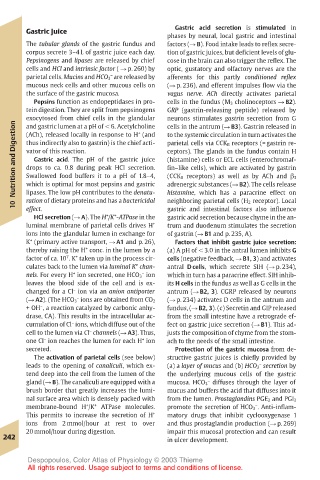
Gastric Juice                    Gastric acid secretion is stimulated in
                                       phases by neural, local gastric and intestinal
       The tubular glands of the gastric fundus and  factors (! B). Food intake leads to reflex secre-
       corpus secrete 3–4 L of gastric juice each day.  tion of gastric juices, but deficient levels of glu-
       Pepsinogens and lipases are released by chief  cose in the brain can also trigger the reflex. The
       cells and HCl and intrinsic factor ( ! p. 260) by  optic, gustatory and olfactory nerves are the
                          –
       parietal cells. Mucins and HCO 3 are released by  afferents for this partly conditioned reflex
       mucous neck cells and other mucous cells on  (! p. 236), and efferent impulses flow via the
       the surface of the gastric mucosa.  vagus nerve. ACh directly activates parietal
         Pepsins function as endopeptidases in pro-  cells in the fundus (M 3 cholinoceptors ! B2).
       tein digestion. They are split from pepsinogens  GRP (gastrin-releasing peptide) released by
       exocytosed from chief cells in the glandular  neurons stimulates gastrin secretion from G
    Nutrition and Digestion  drops to ca. 0.8 during peak HCl secretion.  parietal cells via CCK B receptors (= gastrin re-
       and gastric lumen at a pH of ! 6. Acetylcholine
                                       cells in the antrum (! B3). Gastrin released in
                                +
       (ACh), released locally in response to H (and
                                       to the systemic circulation in turn activates the
       thus indirectly also to gastrin) is the chief acti-
                                       ceptors). The glands in the fundus contain H
       vator of this reaction.
         Gastric acid. The pH of the gastric juice
                                       (histamine) cells or ECL cells (enterochromaf-
                                       fin–like cells), which are activated by gastrin
       Swallowed food buffers it to a pH of 1.8–4,
                                       (CCK B receptors) as well as by ACh and ! 3
       which is optimal for most pepsins and gastric
                                       histamine, which has a paracrine effect on
                                       neighboring parietal cells (H 2 receptor). Local
       ration of dietary proteins and has a bactericidal
    10  lipases. The low pH contributes to the denatu-  adrenergic substances (! B2). The cells release
       effect.
                                       gastric and intestinal factors also influence
                           +
         HCl secretion (! A). The H /K -ATPase in the  gastric acid secretion because chyme in the an-
                         +
       luminal membrane of parietal cells drives H +  trum and duodenum stimulates the secretion
       ions into the glandular lumen in exchange for  of gastrin (! B1 and p. 235, A).
        +
       K (primary active transport, ! A1 and p. 26),  Factors that inhibit gastric juice secretion:
                    +
       thereby raising the H conc. in the lumen by a  (a) A pH of ! 3.0 in the antral lumen inhibits G
                  +
       factor of ca. 10 . K taken up in the process cir-  cells (negative feedback, ! B1, 3) and activates
                7
                                +
       culates back to the lumen via luminal K chan-  antral D cells, which secrete SIH (! p. 234),
       nels. For every H ion secreted, one HCO 3 ion  which in turn has a paracrine effect. SIH inhib-
                                 –
                 +
       leaves the blood side of the cell and is ex-  its H cells in the fundus as well as G cells in the
                 –
       changed for a Cl ion via an anion antiporter  antrum (! B2, 3). CGRP released by neurons
                  –
       (! A2). (The HCO 3 ions are obtained from CO 2  (! p. 234) activates D cells in the antrum and
       + OH , a reaction catalyzed by carbonic anhy-  fundus, (! B2, 3). (c) Secretin and GIP released
          –
       drase, CA). This results in the intracellular ac-  from the small intestine have a retrograde ef-
                 –
       cumulation of Cl ions, which diffuse out of the  fect on gastric juice secretion (! B1). This ad-
                     –
       cell to the lumen via Cl channels (! A3). Thus,  justs the composition of chyme from the stom-
       one Cl ion reaches the lumen for each H ion  ach to the needs of the small intestine.
                                 +
           –
       secreted.                        Protection of the gastric mucosa from de-
         The activation of parietal cells (see below)  structive gastric juices is chiefly provided by
       leads to the opening of canaliculi, which ex-  (a) a layer of mucus and (b) HCO 3 secretion by
                                                           –
       tend deep into the cell from the lumen of the  the underlying mucous cells of the gastric
       gland (! B). The canaliculi are equipped with a  mucosa. HCO 3 diffuses through the layer of
                                                –
       brush border that greatly increases the lumi-  mucus and buffers the acid that diffuses into it
       nal surface area which is densely packed with  from the lumen. Prostaglandins PGE 2 and PGI 2
                                                          –
       membrane-bound H /K +  ATPase molecules.  promote the secretion of HCO 3 . Anti-inflam-
                    +
       This permits to increase the secretion of H +  matory drugs that inhibit cyclooxygenase 1
       ions from 2 mmol/hour at rest to over  and thus prostaglandin production (! p. 269)
       20 mmol/hour during digestion.  impair this mucosal protection and can result
  242                                  in ulcer development.
       Despopoulos, Color Atlas of Physiology © 2003 Thieme
       All rights reserved. Usage subject to terms and conditions of license.

