


Page 69 - Color_Atlas_of_Physiology_5th_Ed._-_A._Despopoulos_2003
P. 69
Motor End-plate                 “force”  (= E m –E Na,K;  ! p. 32 ff.)  becomes
                                       smaller when E m is less negative.
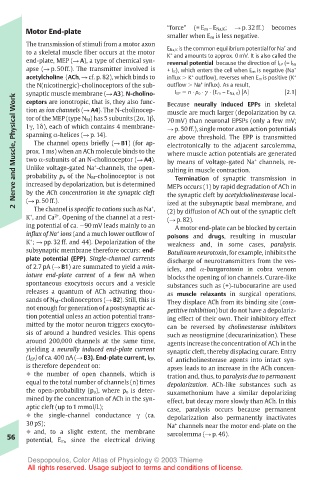
       The transmission of stimuli from a motor axon             +
       to a skeletal muscle fiber occurs at the motor  E Na,K is the common equilibrium potential for Na and
                                       +
                                       K and amounts to approx. 0 mV. It is also called the
       end-plate, MEP (! A), a type of chemical syn-
                                       reversal potential because the direction of I EP (= I Na
       apse (! p. 50ff.). The transmitter involved is  + I K), which enters the cell when E m is negative (Na +
       acetylcholine (ACh, ! cf. p. 82), which binds to  influx " K outflow), reverses when E m is positive (K +
                                            +
                                              +
       the N(nicotinergic)-cholinoceptors of the sub-  outflow " Na influx). As a result,
                                        I EP # n ! p o ! γ ! (E m – E Na, K) [A]
                                                                 [2.1]
       synaptic muscle membrane (! A3). N-cholino-  Because neurally induced EPPs in skeletal
    Nerve and Muscle, Physical Work  1γ, 1δ), each of which contains 4 membrane-  70 mV) than neuronal EPSPs (only a few mV;
       ceptors are ionotropic, that is, they also func-
       tion as ion channels (! A4). The N-cholinocep-
                                       muscle are much larger (depolarization by ca.
       tor of the MEP (type N M) has 5 subunits (2α, 1",
                                       ! p. 50 ff.), single motor axon action potentials
       spanning α-helices (! p. 14).
                                       are above threshold. The EPP is transmitted
         The channel opens briefly (! B1) (for ap-
                                       electrotonically to the adjacent sarcolemma,
       prox. 1 ms) when an ACh molecule binds to the
                                       where muscle action potentials are generated
       two α-subunits of an N-cholinoceptor (! A4).
                                       by means of voltage-gated Na channels, re-
                                                          +
       Unlike voltage-gated Na -channels, the open-
                      +
                                       sulting in muscle contraction.
       probability p o of the N M-cholinoceptor is not
                                        Termination of synaptic transmission in
       by the ACh concentration in the synaptic cleft
                                       the synaptic cleft by acetylcholinesterase local-
       (! p. 50 ff.).
                                       ized at the subsynaptic basal membrane, and
    2  increased by depolarization, but is determined +  MEPs occurs (1) by rapid degradation of ACh in
         The channel is specific to cations such as Na ,
                                       (2) by diffusion of ACh out of the synaptic cleft
        +
             2+
       K , and Ca . Opening of the channel at a rest-  (! p. 82).
       ing potential of ca. !90 mV leads mainly to an  A motor end-plate can be blocked by certain
              +
       influx of Na ions (and a much lower outflow of  poisons and drugs, resulting in muscular
        +
       K ; ! pp. 32 ff. and 44). Depolarization of the  weakness and, in some cases, paralysis.
       subsynaptic membrane therefore occurs: end-  Botulinum neurotoxin, for example, inhibits the
       plate potential (EPP). Single-channel currents  discharge of neurotransmitters from the ves-
       of 2.7 pA (! B1) are summated to yield a min-  icles, and α-bungarotoxin in cobra venom
       iature end-plate current of a few nA when  blocks the opening of ion channels. Curare-like
       spontaneous exocytosis occurs and a vesicle  substances such as (+)-tubocurarine are used
       releases a quantum of ACh activating thou-  as muscle relaxants in surgical operations.
       sands of N M-cholinoceptors (! B2). Still, this is  They displace ACh from its binding site (com-
       not enough for generation of a postsynaptic ac-  petitive inhibition) but do not have a depolariz-
       tion potential unless an action potential trans-  ing effect of their own. Their inhibitory effect
       mitted by the motor neuron triggers exocyto-  can be reversed by cholinesterase inhibitors
       sis of around a hundred vesicles. This opens  such as neostigmine (decurarinization). These
       around 200,000 channels at the same time,  agents increase the concentration of ACh in the
       yielding a neurally induced end-plate current  synaptic cleft, thereby displacing curare. Entry
       (I EP) of ca. 400 nA (! B3). End-plate current, I EP,  of anticholinesterase agents into intact syn-
       is therefore dependent on:      apses leads to an increase in the ACh concen-
       ! the number of open channels, which is  tration and, thus, to paralysis due to permanent
       equal to the total number of channels (n) times  depolarization. ACh-like substances such as
       the open-probability (p o), where p o is deter-  suxamethonium have a similar depolarizing
       mined by the concentration of ACh in the syn-  effect, but decay more slowly than ACh. In this
       aptic cleft (up to 1 mmol/L);   case, paralysis occurs because permanent
       ! the single-channel conductance γ (ca.  depolarization also permanently inactivates
       30 pS);                         Na channels near the motor end-plate on the
                                        +
       ! and, to a slight extent, the membrane  sarcolemma (! p. 46).
   56  potential, E m, since the electrical driving
       Despopoulos, Color Atlas of Physiology © 2003 Thieme
       All rights reserved. Usage subject to terms and conditions of license.

