


Page 117 - Hall et al (2015) Principles of Critical Care-McGraw-Hill
P. 117
CHAPTER 13: Assessment of Severity of Illness   85


                        100%                                              poorer the reliability of the system. Intraobserver reliability can be mea-
                                                                          sured using a variety of techniques, and is expressed on a range between
                        90%                                               0 (measurement involves nothing but error) and 1 (no variable error). A
                                                                          reliability coefficient of greater than 0.7 (suggesting that no more than 30%
                        80%                                               of the score is due to error) has been used as a statistical standard of rea-
                       True positive rate (sensitivity) (%)  60%  A       Mortality is dependent not only on measured physiologic derangements
                                                                          sonable relaibility.  The kappa statistic measures interobserver reliability.
                                                                                      14
                        70%
                                                                           Content validity reflects the comprehensiveness of the model.
                                                                                                                            14
                                                                          and underlying health status, but may also be influenced by factors that
                                                                          are difficult to quantify, such as duration of organ system failure before
                        50%
                                                                          treatment was instituted, staffing of an ICU, time of day of admission to
                                  https://kat.cr/user/tahir99/
                                                                          ICU, and whether the admission was planned or unplanned, among oth-
                        40%
                                                                          ers. In general, as the number of variables increase in a scoring system, the
                        30%
                                                                          be inclusion of more variables that are easily collated from the large com-
                        20%   B                                           reliability and ease of capturing the data decrease. The exception would
                                                                          puterized clinical information systems used in most ICUs. In other words,
                              C
                                                                          this computerization of ICU variables could decrease the complexity pro-
                        10%  D                                            duced by use of large numbers of patient variables in a severity of illness
                                                                          scoring system. Also, recording errors and transcription errors can be
                         0%
                           0% 10% 20% 30% 40% 50% 60% 70% 80% 90% 100%    decreased by ICU computerization driving the data for severity of illness
                                    False positive rate (1-specificity) (%)  scoring systems. Nonetheless, the inclusion of many variables (overfit-
                                                                          ting) may actually reduce the performance of the model because some of
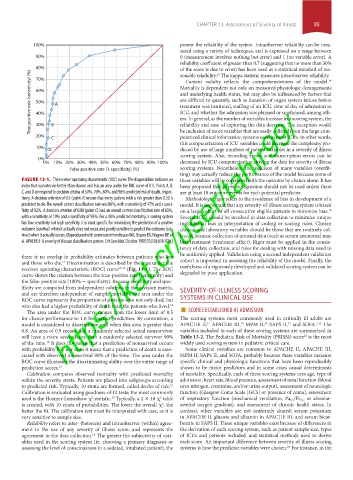
                    FIGURE 13-1.  The receiver operating characteristic (ROC) curve. The diagonal line indicates an   these variables will be correlated with the outcome by chance alone. It has
                    index that operates no better than chance and has an area under the ROC curve of 0.5. Points A, B,   been proposed that stepwise regression should not be used unless there
                    C, and D correspond to decision criteria of 50%, 70%, 80%, and 90% predicted risk of death, respec-  are at least 10 outcome events for each potential predictor.
                    tively. A decision criterion of 0.5 (point A) means that every patient with a risk greater than 0.50 is   Methodologic rigor refers to the avoidance of bias in development of a
                    predicted to die. The overall correct classification rate was 86%, with a sensitivity of 47% and a speci-  model. It is important that any severity-of-illness scoring system is based
                    ficity of 92%. A decision criterion of 0.80 (point C) had an overall correct classification rate of 83%,   on a large cohort of all consecutive eligible patients to minimize bias.
                                                                                                                            14
                    with a sensitivity of 19% and a specificity of 93%. For a 90% predicted mortality, a scoring system   Several ICUs should be involved in data collection to minimize unique
                    has low sensitivity but high specificity. It is most specific for minimizing the prediction of a positive   institutional bias in interpretation of coding or scoring rules. Chosen
                    outcome (survival) when it actually does not occur, and poorly sensitive to predict the outcome (sur-  clinical and laboratory variables should be those that are routinely col-
                    vival) when it actually occurs. (Reproduced with permission from Knaus WA, Draper EA, Wagner DP, et   lected, because collection of unusual data (such as serum ammonia) may
                    al. APACHE II: A severity of disease classification system. Crit Care Med. October 1985;13(10):818-829.)  bias treatment (treatment effect). Rigor must be applied in the consis-
                                                                          tency of data collection, and rules for dealing with missing data need to
                                                                          be uniformly applied. Validation using a second independent validation
                    there is no overlap in probability estimates between patients who live
                    and those who die.  Discrimination is described by the area under the   cohort is important in assessing the reliability of the model. Finally, the
                                 15
                    receiver operating characteristic (ROC) curve 15,16  (Fig. 13-1). The ROC   usefulness of a rigorously developed and validated scoring system can be
                    curve shows the relation between the true-positive rate (sensitivity) and   degraded by poor application.
                    the false-positive rate (100% - specificity). Because sensitivity and spec-
                    ificity are computed from independent columns in the decision matrix,
                    and are therefore independent of sample mortality, the area under the   SEVERITY-OF-ILLNESS SCORING
                    ROC curve represents the proportion of patients who not only died, but   SYSTEMS IN CLINICAL USE
                     The area under the ROC curve ranges from the lower limit of 0.5   ■
                    who also had a higher probability of death than the patients who lived. 14  SCORES ESTABLISHED AT ADMISSION
                    for chance performance to 1.0 for perfect prediction. By convention, a   The scoring systems most commonly used in critically ill adults are
                                                                                                              21
                                                                                                                        7,22
                                                                                   17
                    model is considered to discriminate well when this area is greater than   APACHE II,  APACHE III,  MPM II,  SAPS II,  and SOFA.  The
                                                                                              19
                                                                                                      20
                    0.8. An area of 0.9 means that a randomly selected actual nonsurvivor   variables included in each of these scoring systems are summarized in
                    will have a more severe score than a randomly selected survivor 90%   Table 13-2. The Pediatric Risk of Mortality (PRISM) score  is the most
                                                                                                                    23
                    of the time.  It does not mean that a prediction of nonsurvival occurs   widely used scoring system in pediatric critical care.
                            12
                    with probability 0.9, nor does it mean that a prediction of death is asso-  Some  clinical  variables  are  common  to  APACHE  II,  APACHE  III,
                    ciated with observed nonsurvival 90% of the time. The area under the   MPM II, SAPS II, and SOFA, probably because these variables measure
                    ROC curve illustrates the discriminating ability over the entire range of   specific clinical and physiologic functions that have been reproducibly
                    prediction scores. 15                                 shown to be major predictors and in some cases causal determinants
                     Calibration  compares  observed  mortality with predicted  mortality   of mortality. Specifically, each of these scoring systems uses age, type of
                    within the severity strata. Patients are placed into subgroups according   admission, heart rate, blood pressure, assessment of renal function (blood
                    to predicted risk. Typically, 10 strata are formed, called deciles of risk.    urea nitrogen, creatinine, and/or urine output), assessment of neurologic
                                                                      15
                    Calibration is evaluated using goodness-of-fit tests; the most commonly   function (Glasgow Coma Scale [GCS] or presence of coma), assessment
                    used is the Hosmer-Lemeshow χ  statistic.  Typically, a 2 × 10 χ  table   of respiratory function (mechanical ventilation, Pa O 2 /Fi O 2 , or alveolar-
                                                  18
                                           2
                                                                   2
                                                                   2
                    is created, with 10 strata of probabilities. The lower the overall χ , the   arterial oxygen gradient), and assessment of chronic health status. In
                    better the fit. The calibration test must be interpreted with care, as it is   contrast, other variables are not uniformly shared: serum potassium
                    very sensitive to sample size.                        in APACHE II, glucose and albumin in APACHE III, and serum bicar-
                     Reliability refers to inter- (between) and intraobserver (within) agree-  bonate in SAPS II. These unique variables exist because of differences in
                    ment in the use of any severity of illness score, and represents the   the derivation of each scoring system, such as patient sample size, types
                      agreement in the data collection.  The greater the subjectivity of vari-  of  ICUs  and  patients  included,  and  statistical  methods used  to  derive
                                            14
                    ables used in the scoring system (ie, choosing a primary diagnosis or   each score. An important difference between severity of illness scoring
                    assessing the level of consciousness in a sedated, intubated patient), the   systems is how the predictor variables were chosen.  For instance, in the
                                                                                                              24
            Section01.indd   85                                                                                        1/22/2015   9:37:24 AM

