


Page 113 - Hall et al (2015) Principles of Critical Care-McGraw-Hill
P. 113
CHAPTER 12: Rapid Response Teams  81


                                          100
                                                              AM round                PM round
                                           90
                                         Number of MET calls per half hour  70  Observations
                                           80
                                           60
                                           50
                                           40
                                           30
                                           20
                                                   Decreased
                                           10
                                           0      observations
                                               1    3    5    7    9    11   13   15   17   19   21   23
                                                                     Time of day (hours)

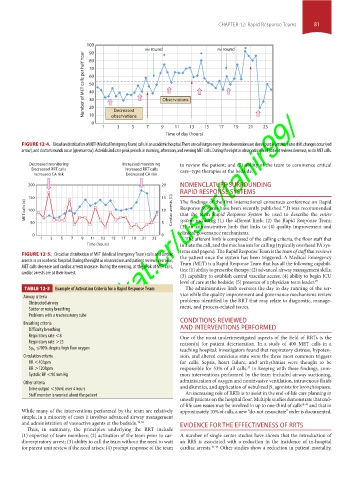
                    FIGURE 12-4.  Circadian distribution of MET (Medical Emergency Team) calls in an academic hospital. There are call surges every time observations are done (purple arrow), nurse shift changes occur (red
                    arrow), and doctor’s rounds occur (green arrow). Asterisks indicate peak periods in morning, afternoon, and evening MET calls. During the night as observations and patient reviews decrease, so do MET calls.

                      Decreased monitoring            Increased monitoring  to review the patient; and (5) ability of the team to commence critical
                       Decreased RRT calls             Increased RRT calls  care–type therapies at the bedside.
                        Increased CA risk              Decreased CA risk
                      200                                          20     NOMENCLATURE SURROUNDING
                                                                          RAPID RESPONSE SYSTEMS
                      150                                          15     The findings of the first international consensus conference on Rapid
                     MET calls (   )  100                          10  Cardiac arrests (   )  Response Systems have been recently published.  It was recommended
                                                                                                             27
                                                                          that the term  Rapid Response System be used to describe the  entire
                       50                                          5      system including (1) the afferent limb; (2) the Rapid Response Team;
                                                                          (3)  an  administrative  limb  that  links  to  (4)  quality  improvement  and
                                                                          clinical governance mechanisms.
                       0          https://kat.cr/user/tahir99/
                                                                   0
                          1  3   5  7   9  11  13  15  17  19  21  23      The afferent limb is composed of the calling criteria, the floor staff that
                                          Time (hours)                      initiate the call, and the mechanism for calling (typically overhead PA sys-
                                                                          tems and pagers). The Rapid Response Team is the team of staff that reviews
                    FIGURE 12-5.  Circadian distribution of MET (Medical Emergency Team) calls and cardiac   the patient once the system has been triggered. A Medical Emergency
                    arrests in an academic hospital. During the night as observations and patient reviews decrease,   Team (MET) is a Rapid Response Team that has all the following capabili-
                    MET calls decrease and cardiac arrests increase. During the evening, at the peak of MET calls,   ties: (1) ability to prescribe therapy; (2) advanced airway management skills;
                    cardiac arrests are at their lowest.
                                                                          (3) capability to establish central vascular access; (4) ability to begin ICU
                                                                          level of care at the bedside; (5) presence of a physician team leader. 27
                      TABLE 12-3    Example of Activation Criteria for a Rapid Response Team  The administrative limb oversees the day to day running of the ser-
                                                                          vice while the quality improvement and governance mechanisms review
                    Airway criteria                                       problems identified by the RRT that may relate to diagnostic, manage-
                      Obstructed airway
                      Stridor or noisy breathing                          ment, and process-related issues.
                      Problems with a tracheostomy tube
                    Breathing criteria                                    CONDITIONS REVIEWED
                      Difficulty breathing                                AND INTERVENTIONS PERFORMED
                      Respiratory rate <8                                 One of the most underinvestigated aspects of the field of RRTs is the
                      Respiratory rate >25                                reason(s) for patient deterioration. In a study of 400 MET calls in a
                         ≤90% despite high flow oxygen
                      Sp O 2                                              teaching hospital, investigators found that respiratory distress, hypoten-
                    Circulation criteria                                  sion, and altered conscious state were the three most common triggers
                      HR <40 bpm                                          for calls. Sepsis, heart failure, and arrhythmias were thought to be
                                                                                                37
                      HR >120 bpm                                         responsible for 53% of all calls.  In keeping with these findings, com-
                      Systolic BP <90 mm Hg                               mon interventions performed by the team included airway suctioning,
                    Other criteria                                        administration of oxygen and noninvasive ventilation, intravenous fluids
                      Urine output <50 mL over 4 hours                    and diuretics, and application of nebulized β  agonists for bronchospasm.
                                                                                                         2
                      Staff member is worried about the patient            An increasing role of RRTs is to assist in the end-of-life care planning in
                                                                          unwell patients on the hospital floor. Multiple studies demonstrate that end-
                                                                          of-life care issues may be involved in up to one-third of calls 38-40  and that in
                    While many of the interventions performed by the team are relatively   approximately 10% of calls, a new “do-not-resuscitate” order is documented.
                    simple, in a minority of cases it involves advanced airway management
                    and administration of vasoactive agents at the bedside. 34,36  EVIDENCE FOR THE EFFECTIVENESS OF RRTS
                     Thus, in summary, the principles underlying the RRT include
                    (1) expertise of team members; (2) activation of the team prior to car-  A number of single center studies have shown that the introduction of
                    diorespiratory arrest; (3) ability to call the team without the need to wait   an RRS is associated with a reduction in the incidence of in-hospital
                    for parent unit review if the need arises; (4) prompt response of the team   cardiac arrests. 41-44  Other studies show a reduction in patient mortality,


            Section01.indd   81                                                                                        1/22/2015   9:37:19 AM

