


Page 116 - Hall et al (2015) Principles of Critical Care-McGraw-Hill
P. 116
84      PART 1: An Overview of the Approach to and Organization of Critical Care


                                                                       dysfunction  over  time  to  enhance  sensitivity,  specificity,  positive  and
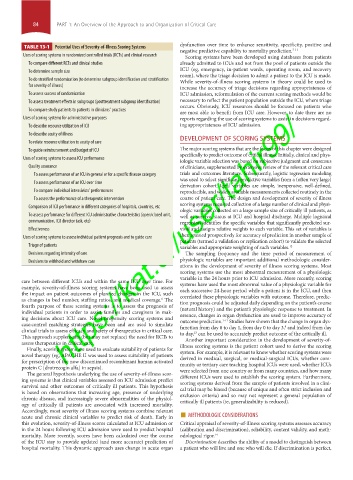
                   TABLE 13-1    Potential Uses of Severity-of-Illness Scoring Systems
                                                                       negative predictive capability to mortality prediction. 7-11
                  Uses of scoring systems in randomized controlled trials (RCTs) and clinical research  Scoring systems have been developed using databases from patients
                    To compare different RCTs and clinical studies     already admitted to ICUs and not from the pool of patients outside the
                    To determine sample size                           ICU (eg, emergency, in-patient wards, operating room, and recovery
                                                                       room), where the triage decision to admit a patient to the ICU is made.
                    To do stratified randomization (to determine subgroup identification and stratification   While severity-of-illness scoring systems in theory could be used to
                    for severity of illness)
                                                                       increase the accuracy of triage decisions regarding appropriateness of
                    To assess success of randomization                 ICU admission, reformulation of the current scoring methods would be
                    To assess treatment effects in subgroups (posttreatment subgroup identification)  necessary to reflect the patient population outside the ICU, where triage
                                                                       occurs. Obviously, ICU resources should be focused on patients who
                                https://kat.cr/user/tahir99/
                    To compare study patients to patients in clinicians’ practices
                                                                       are most able to benefit from ICU care. However, to date there are no
                  Uses of scoring systems for administrative purposes  reports regarding the use of scoring systems to assist in decisions regard-
                    To describe resource utilization of ICU            ing appropriateness of ICU admission.
                    To describe acuity of illness
                    To relate resource utilization to acuity of care   DEVELOPMENT OF SCORING SYSTEMS
                    To guide reimbursement and budget of ICU           The major scoring systems that are the focus of this chapter were designed
                                                                       specifically to predict outcome of critical illness. Initially, clinical and phys-
                  Uses of scoring systems to assess ICU performance
                                                                       iologic variable selection was based on subjective judgment and consensus
                    Quality assurance                                  of clinicians, supplemented by extensive review of the relevant critical care
                     To assess performance of an ICU in general or for a specific disease category  trials and outcomes literature. Subsequently, logistic regression modeling
                                                                       was used to select significant predictive variables from a (often very large)
                     To assess performance of an ICU over time         derivation cohort. Ideal variables are simple, inexpensive, well-defined,
                     To compare individual intensivists’ performances  reproducible, and widely available measurements collected routinely in the
                     To assess the performance of a therapeutic intervention  course of patient care. The design and development of severity of illness
                                                                       scoring systems required collection of a large number of clinical and physi-
                    Comparison of ICU performance in different categories of hospitals, countries, etc
                                                                       ologic variables collected on a large sample size of critically ill patients, as
                    To assess performance for different ICU administrative characteristics (open/closed unit,    well as survival status at ICU and hospital discharge. Multiple logistical
                    communication, ICU director task, etc)             regression identifies the specific variables that significantly predicted sur-
                    Effectiveness                                      vival and assigns relative weights to each variable. This set of variables is
                                                                       then retested prospectively for accuracy of prediction in another sample of
                  Uses of scoring systems to assess individual patient prognosis and to guide care  patients (termed a validation or replication cohort) to validate the selected
                    Triage of patients                                 variables and appropriate weighting of such variables. 12
                    Decisions regarding intensity of care                The sampling frequency and the time period of measurement of
                    Decisions to withhold and withdraw care            physiologic variables are important additional methodologic consider-
                                                                       ations in the development of severity of illness scoring systems. Most
                                                                       scoring systems use the most abnormal measurement of a physiologic
                                                                       variable in the 24 hours prior to ICU admission. More recently, scoring
                 care between different ICUs and within the same ICU over time. For   systems have used the most abnormal value of a physiologic variable for
                 example, severity-of-illness scoring systems have been used to assess   each successive 24-hour period while a patient is in the ICU, and then
                 the impact on patient outcomes of planned changes in the ICU, such   correlated these physiologic variables with outcome. Therefore, predic-
                                                                 6
                 as changes in bed number, staffing ratios, and medical coverage.  The   tion prognosis could be adjusted daily depending on the patient’s course
                 fourth purpose of these scoring systems is to assess the prognosis of   (natural history) and the patient’s physiologic response to treatment. In
                 individual patients in order to assist families and caregivers in mak-  essence, changes in organ dysfunction are used to improve accuracy of
                 ing decisions about ICU care. Novel propensity scoring systems and   outcome prediction. 7-11  Studies have shown that the change in organ dys-
                 case:control matching strategies have been and are used to simulate   function from day 0 to day 1, from day 0 to day 3,  and indeed from day
                                                                                                           9
                 clinical trials to assess efficacy and safety of therapeutics in critical care.   to day,  can be used to accurately predict outcome of the critically ill.
                                                                            13
                 This approach supplements (but may not replace) the need for RCTs to   Another important consideration in the development of severity-of-
                 assess therapeutics in critical care.                 illness scoring systems is the patient cohort used to derive the scoring
                   Finally, scoring systems are used to evaluate suitability of patients for
                 novel therapy (eg, APACHE II was used to assess suitability of patients   system. For example, it is relevant to know whether scoring systems were
                                                                       derived in medical, surgical, or medical-surgical ICUs, whether com-
                 for prescription of the now discontinued recombinant human activated   munity or tertiary care teaching hospital ICUs were used, whether ICUs
                 protein C [drotrecogin alfa] in sepsis).              were selected from one country or from many countries, and how many
                   The general hypothesis underlying the use of severity-of-illness scor-
                 ing systems is that clinical variables assessed on ICU admission predict   different ICUs were used to establish the scoring system. Furthermore,
                                                                       scoring systems derived from the sample of patients involved in a clini-
                 survival and other outcomes of critically ill patients. This hypothesis   cal trial may be biased (because of unique and often strict inclusion and
                 is based on observations that increasing age, presence of underlying   exclusion criteria)  and  so  may  not  represent a  general  population  of
                 chronic disease, and increasingly severe abnormalities of the physiol-  critically ill patients (ie, generalizability is reduced).
                 ogy of critically ill patients are associated with increased mortality.
                 Accordingly, most severity of illness scoring systems combine relevant     ■
                 acute and chronic clinical variables to predict risk of death. Early in   METHODOLOGIC CONSIDERATIONS
                 this evolution, severity-of-illness scores calculated at ICU admission or   Critical appraisal of severity-of-illness scoring systems assesses accuracy
                 in the 24 hours following ICU admission were used to predict hospital   (calibration and discrimination), reliability, content validity, and meth-
                 mortality. More recently, scores have been calculated over the course   odological rigor. 14
                 of the ICU stay to provide updated (and more accurate) prediction of   Discrimination describes the ability of a model to distinguish between
                 hospital mortality. This dynamic approach uses change in acute organ   a patient who will live and one who will die. If discrimination is perfect,


            Section01.indd   84                                                                                        1/22/2015   9:37:23 AM

