


Page 114 - Hall et al (2015) Principles of Critical Care-McGraw-Hill
P. 114
82      PART 1: An Overview of the Approach to and Organization of Critical Care


                 particularly in surgical patients.  Importantly, some of these hospitals   60
                                        45
                 have demonstrated that these benefits can be sustained over a prolonged
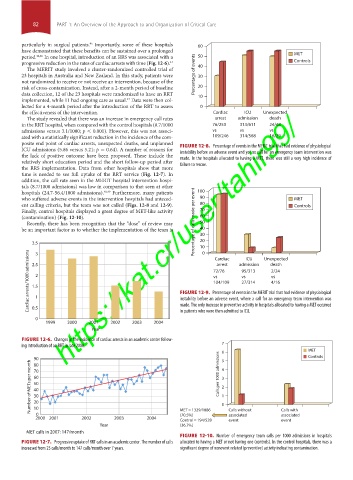
                 period. 44,46  In one hospital, introduction of an RRS was associated with a   50            MET
                 progressive reduction in the rates of cardiac arrests with time (Fig. 12-6). 44              Controls
                   The MERIT study involved a cluster-randomized controlled trial of   40
                 23 hospitals in Australia and New Zealand. In this study, patients were   Percentage of events  30
                 not randomized to receive or not receive an intervention, because of the
                 risk of cross-contamination. Instead, after a 2-month period of baseline   20
                 data collection, 12 of the 23 hospitals were randomized to have an RRT
                 implemented, while 11 had ongoing care as usual.  Data were then col-  10
                                                     47
                 lected for a 4-month period after the introduction of the RRT to assess   0
                                https://kat.cr/user/tahir99/
                 the effectiveness of the intervention.                            Cardiac   ICU    Unexpected
                   The study revealed that there was an increase in emergency call rates   arrest  admission  death
                 in the RRT hospital, when compared with the control hospitals (8.7/1000   76/250  313/611  24/48
                 admissions versus 3.1/1000; p < 0.001). However, this was not associ-  vs  vs        vs
                 ated with a statistically significant reduction in the incidence of the com-  109/246  314/568  16/29
                 posite end point of cardiac arrests, unexpected deaths, and unplanned
                 ICU admissions (5.86 versus 5.21; p = 0.64). A number of reasons for   FIGURE 12-8.  Percentage of events in the MERIT trial that had evidence of physiological
                                                                       instability before an adverse event and yet no call for an emergency team intervention was
                 the  lack  of positive  outcome  have  been  proposed.  These  include  the
                 relatively short education period and the short follow-up period after   made. In the hospitals allocated to having a MET, there was still a very high incidence of
                                                                       failure to rescue.
                 the  RRS implementation.  Data  from other  hospitals show  that more
                 time is needed to see full uptake of the RRT service (Fig. 12-7). In
                 addition, the call rate seen in the MERIT hospital intervention hospi-
                 tals (8.7/1000 admissions) was low in comparison to that seen at other
                 hospitals (24.7-56.4/1000 admissions). 48,49  Furthermore, many patients   100
                 who suffered adverse events in the intervention hospitals had anteced-  90                   MET
                 ent calling criteria, but the team was not called (Figs. 12-8 and 12-9).     80              Controls
                 Finally, control hospitals displayed a great degree of MET-like activity   70
                 (contamination) (Fig. 12-10).                                60
                   Recently, there has been recognition that the “dose” of review may   Percentage of calls made per event  50
                 be an important factor as to whether the implementation of the team is   40
                                                                              30
                     3.5 3                                                    20 0  Cardiac   ICU   Unexpected
                                                                              10
                    Cardiac arrests/1000 admissions  2.5 2 1           FIGURE 12-9.  Percentage of events in the MERIT trial that had evidence of physiological
                                                                                           admission
                                                                                                      death
                                                                                    arrest
                                                                                            95/313
                                                                                                      2/24
                                                                                   72/76
                                                                                   vs
                                                                                                      vs
                                                                                            vs
                                                                                            27/314
                                                                                                      4/16
                                                                                   104/109
                     1.5
                                                                       instability before an adverse event, where a call for an emergency team intervention was
                     0.5
                                                                       in patients who were then admitted to ICU.
                      0                                                made. The only increase in preventive activity in hospitals allocated to having a MET occurred
                         1999    2000   2001    2002   2003   2004
                                         Year
                 FIGURE 12-6.  Changes in the incidence of cardiac arrests in an academic center follow-
                 ing introduction of an RRT in late 2000.                            7
                                                                                     6                             MET
                     90                                                              5 4                           Controls
                    Number of METs per month  60                                    Calls per 1000 admissions  3 2 1
                     80
                     70
                     50
                     40
                     30
                     20
                     10
                      0
                                                                                                          associated
                                                                                        associated
                                                                       (70.5%)
                      2000 2001       2002       2003       2004       MET = 1329/1886  0  Calls without  Calls with
                                                                                        event
                                                                                                          event
                                                                       Control = 194/528
                                            Year                       (36.7%)
                   MET calls in 2007: 147/month
                                                                       FIGURE 12-10.  Number of emergency team calls per 1000 admissions in hospitals
                 FIGURE 12-7.  Progressive uptake of RRT calls in an academic center. The number of calls   allocated to having a MET or not having one (controls). In the control hospitals, there was a
                 increased from 25 calls/month to 147 calls/month over 7 years.  significant degree of nonevent related (preventive) activity indicating contamination.


            Section01.indd   82                                                                                        1/22/2015   9:37:22 AM

