


Page 239 - Hall et al (2015) Principles of Critical Care-McGraw-Hill
P. 239
CHAPTER 21: Glycemic Control  143


                                                                       Liver
                                                                           — Gluconeogenesis
                                     Glucose production
                                                                           — Glycogenolysis: kidney/muscle


                                                    Glucagon
                                                    Epinephrine             Hyperglycemia
                                                    Cortisol
                                                    Cytokines


                                                       Insulin-mediated uptake (GLUT-4)    Noninsulin-mediated uptake
                                   Glucose uptake    — Post-receptor signaling defect  (GLUT-1)
                                                     —  Muscle glycogen


                                                                          Oxidative metabolism
                                   Glucose use
                                                                          Nonoxidative metabolism

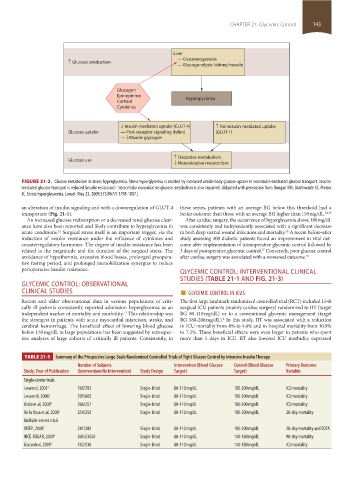
                    FIGURE 21-2.  Glucose metabolism in stress hyperglycemia. Stress hyperglycemia is marked by increased whole-body glucose uptake in noninsulin-mediated glucose transport. Insulin-
                    mediated glucose transport is reduced (insulin resistance). Intracellular nonoxidative glucose metabolism is also impaired. (Adapted with permission from Dungan KM, Braithwaite SS, Preiser
                    JC. Stress hyperglycaemia. Lancet. May 23, 2009;373(9677):1798-1807.)

                    an alteration of insulin signaling and with a downregulation of GLUT-4   these series, patients with an average BG below this threshold had a
                    transporters (Fig. 21-1).                             better outcome than those with an average BG higher than 150 mg/dL. 14,15
                     An increased glucose reabsorption or a decreased renal glucose clear-  After cardiac surgery, the occurrence of hyperglycemia above 180 mg/dL
                    ance have also been reported and likely contribute to hyperglycemia in   was consistently and independently associated with a significant decrease
                    acute conditions.  Surgical stress itself is an important trigger, via the   in both deep sternal wound infections and mortality.  A recent before-after
                                                                                                              16
                                12
                    induction of  insulin  resistance under the  influence  of cytokines and   study assessing 300 diabetic patients found an improvement in vital out-
                    counterregulatory hormones. The degree of insulin resistance has been   come after implementation of intraoperative glycemic control followed by
                    related to the magnitude and the duration of the surgical stress. The   3 days of postoperative glycemic control.  Conversely, poor glucose control
                                                                                                     17
                    avoidance of hypothermia, excessive blood losses, prolonged preopera-  after cardiac surgery was associated with a worsened outcome. 18
                    tive fasting period, and prolonged immobilization synergize to reduce
                    perioperative insulin resistance.                     GLYCEMIC CONTROL: INTERVENTIONAL CLINICAL
                                                                          STUDIES (TABLE 21-1 AND FIG. 21-3)
                    GLYCEMIC CONTROL: OBSERVATIONAL
                    CLINICAL STUDIES                                          ■  GLYCEMIC CONTROL IN ICUS
                    Recent and older observational data in various populations of criti-  The first large landmark randomized controlled trial (RCT) included 1548
                    cally ill patients consistently reported admission hyperglycemia as an   surgical ICU patients (mainly cardiac surgery) randomized to IIT (target
                    independent marker of mortality and morbidity.  This relationship was   BG 80-110 mg/dL) or to a conventional glycemic management (target
                                                      13
                    the strongest in patients with acute myocardial infarction, stroke, and   BG 180-200 mg/dL).  In this study, IIT was associated with a reduction
                                                                                        2
                    cerebral hemorrhage. The beneficial effect of lowering blood glucose   in ICU mortality from 8% to 4.6% and in-hospital mortality from 10.9%
                    below 150 mg/dL in large populations has been suggested by retrospec-  to 7.2%. These beneficial effects were even larger in patients who spent
                    tive analyses of large cohorts of critically ill patients. Consistently, in   more than 5 days in ICU. IIT also lowered ICU morbidity expressed


                      TABLE 21-1    Summary of the Prospective Large-Scale Randomized Controlled Trials of Tight Glucose Control by Intensive Insulin Therapy
                                       Number of Subjects               Intervention (Blood Glucose    Control (Blood Glucose   Primary Outcome
                    Study, Year of Publication  (Intervention/No Intervention)  Study Design  Target)  Target)  Variable
                    Single-center trials
                    Leuven I, 2001 2   765/783              Single-blind  80-110 mg/dL      180-200 mg/dL     ICU mortality
                    Leuven II, 2006 3  595/605              Single-blind  80-110 mg/dL      180-200 mg/dL     ICU mortality
                    Arabi et al, 2008 4  266/257            Single-blind  80-110 mg/dL      180-200 mg/dL     ICU mortality
                    De la Rosa et al, 2008 5  254/250       Single-blind  80-110 mg/dL      180-200 mg/dL     28-day mortality
                    Multiple-center trials
                    VISEP, 2008   6    247/289              Single-blind  80-110 mg/dL      180-200 mg/dL     28-day mortality and SOFA
                    NICE-SUGAR, 2009 8  3054/3050           Single-blind  80-110 mg/dL      140-180 mg/dL     90-day mortality
                    Glucontrol, 2009 7  542/536             Single-blind  80-110 mg/dL      140-180 mg/dL     ICU mortality


            section02.indd   143                                                                                       1/13/2015   2:05:00 PM

