


Page 244 - Hall et al (2015) Principles of Critical Care-McGraw-Hill
P. 244
148     PART 2: General Management of the Patient


                 thoracic surgery). There is controversy over the benefits of epidural   doses of sedative and analgesic medications administered to critically ill
                 versus intravenous fentanyl  analgesia. Some studies have  reported   patients. As such, the RASS and SAS are preferable over the traditional
                 similar outcomes when these two strategies are compared,  whereas   Ramsay Sedation Score.
                                                             35
                 others have reported more effective analgesia with thoracic epidural   The evaluation of sedation adequacy remains an individual bedside
                 fentanyl. 36,37  In thoracic surgery patients, epidural fentanyl has been   maneuver. The nurse’s input is critical because he or she often will notice
                 associated with better preservation of respiratory function compared   changes from an optimal level of sedation. Armed with validated seda-
                 with intravenous fentanyl. These salutary effects may be related to the   tion scales, clinicians may strive to administer sedatives and analgesics
                 catheter being located near the source of pain.       to more concrete, reportable levels. Ideally, one would prefer a patient
                                                                       whose  indications  for  sedation  as  outlined  earlier  are  met  yet  who
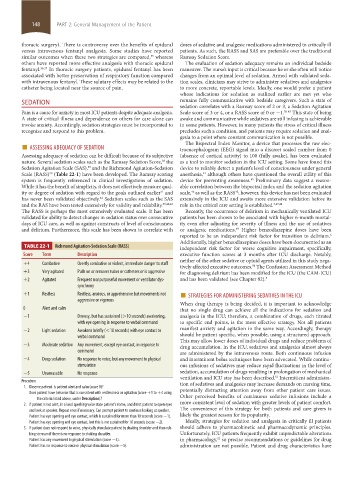
                 SEDATION                                              remains fully communicative with bedside caregivers. Such a state of
                                                                       sedation correlates with a Ramsay score of 2 or 3, a Sedation Agitation
                 Pain is a cause for anxiety in most ICU patients despite adequate analgesia.    Scale score of 3 or 4, or a RASS score of 0 or −1. 38-43  This state of being
                 A state of critical illness and dependence on others for care alone can   awake and communicative while sedatives are still infusing is achievable
                 invoke anxiety. Accordingly, sedation strategies must be incorporated to   in some patients. However, in many patients the stress of critical illness
                 recognize and respond to this problem.                precludes such a condition, and patients may require sedation and anal-
                                                                       gesia to a point where constant communication is not possible.
                     ■  ASSESSING ADEQUACY OF SEDATION                 troencephalogram (EEG) signal into a discreet scaled number from 0
                                                                         The Bispectral Index Monitor, a device that processes the raw elec-
                 Assessing adequacy of sedation can be difficult because of its subjective   (absence of cortical activity) to 100 (fully awake), has been evaluated
                 nature. Several sedation scales such as the Ramsay Sedation Score,  the   as a tool to monitor sedation in the ICU setting. Some have found this
                                                                 38
                 Sedation Agitation Scale (SAS),  and the Richmond Agitation-Sedation   device to reliably detect a patient’s level of consciousness under general
                                        39
                 Scale (RASS)  (Table 22-1) have been developed. The Ramsay scoring   anesthesia,  although others have questioned the overall utility of this
                                                                               44
                           40
                 system is frequently referenced in clinical investigations of sedation.   device for preventing awareness.  Preliminary data suggest a reason-
                                                                                               45
                 While it has the benefit of simplicity, it does not effectively measure qual-  able correlation between the bispectral index and the sedation agitation
                 ity or degree of sedation with regard to the goals outlined earlier  and   scale,  as well as the RASS ; however, this device has not been evaluated
                                                                 41
                                                                           46
                                                                                          43
                 has never been validated objectively.  Sedation scales such as the SAS   extensively in the ICU and awaits more extensive validation before its
                                            42
                 and the RAS have been tested extensively for validity and reliability. 39,40,43    role in the critical care setting is established. 7,47,48
                 The RASS is perhaps the most extensively evaluated scale. It has been   Recently, the occurrence of delirium in mechanically ventilated ICU
                 validated for ability to detect changes in sedation status over consecutive   patients has been shown to be associated with higher 6-month mortal-
                 days of ICU care, as well as against constructs of level of consciousness   ity even after adjusting for severity of illness and the use of sedatives
                 and delirium. Furthermore, this scale has been shown to correlate with   or analgesic medications.  Higher benzodiazepine doses have been
                                                                                          49
                                                                       reported to be an independent risk factor for transition to delirium.
                                                                                                                          6
                                                                       Additionally, higher benzodiazepines doses have been documented as an
                   TABLE 22-1    Richmond Agitation-Sedation Scale (RASS)  independent risk factor for worse cognitive impairment, specifically,
                  Score  Term       Description                        executive function scores at 3 months after ICU discharge. Notably,
                                                                       neither of the other sedative or opioid agents utilized in this study nega-
                  +4    Combative   Overtly combative or violent, immediate danger to staff
                                                                       tively affected executive outcomes.  The Confusion Assessment Method
                                                                                                50
                  +3    Very agitated  Pulls on or removes tubes or catheters or is aggressive  for diagnosing delirium has been modified for the ICU (the CAM-ICU)
                  +2    Agitated    Frequent nonpurposeful movement or ventilator dys-  and has been validated (see Chapter 82). 5
                                    synchrony
                  +1    Restless    Restless, anxious, or apprehensive but movements not      ■  STRATEGIES FOR ADMINISTERING SEDATIVES IN THE ICU
                                    aggressive or vigorous
                                                                       When drug therapy is being decided, it is important to acknowledge
                  0     Alert and calm                                 that  no  single  drug  can  achieve  all  the  indications  for  sedation  and
                  −1                Drowsy, but has sustained (>10 seconds) awakening,   analgesia in the ICU; therefore, a combination of drugs, each titrated
                                    with eye opening in response to verbal command  to specific end points, is the most effective strategy. Not all patients
                                                                       manifest anxiety and agitation in the same way. Accordingly, therapy
                  −2    Light sedation  Awakens briefly (<10 seconds) with eye contact to
                                    verbal command                     should be patient specific, when possible, using a structured approach.
                                                                       This may allow lower doses of individual drugs and reduce problems of
                  −3    Moderate sedation Any movement, except eye contact, in response to    drug accumulation. In the ICU, sedatives and analgesics almost always
                                    command                            are administered by the intravenous route. Both continuous infusion
                  −4    Deep sedation  No response to voice, but any movement to physical    and intermittent bolus techniques have been advocated. While continu-
                                    stimulation                        ous infusions of sedatives may reduce rapid fluctuations in the level of
                  −5    Unarousable  No response                       sedation, accumulation of drugs resulting in prolongation of mechanical
                                                                       ventilation and ICU stay has been described.  Intermittent administra-
                                                                                                        51
                 Procedure                                             tion of sedatives and analgesics may increase demands on nursing time,
                   1.  Observe patient. Is patient alert and calm (score 0)?  potentially distracting attention away from other patient care issues.
                    Does patient have behavior that is consistent with restlessness or agitation (score +1 to +4 using   Other perceived benefits of continuous sedative infusions include a
                      the criteria listed above, under Description)?
                   2.  If patient is not alert, in a loud speaking voice state patient’s name, and direct patient to open eyes   more consistent level of sedation with greater levels of patient comfort.
                    and look at speaker. Repeat once if necessary. Can prompt patient to continue looking at speaker.  The convenience of this strategy for both patients and care givers is
                    Patient has eye opening and eye contact, which is sustained for more than 10 seconds (score −1).  likely the greatest reason for its popularity.
                    Patient has eye opening and eye contact, but this is not sustained for 10 seconds (score −2).  Ideally, strategies for sedation and analgesia in critically ill patients
                   3.  If patient does not respond to voice, physically stimulate patient by shaking shoulder and then rub-  should adhere to pharmacokinetic and pharmacodynamic principles.
                    bing sternum if there is no response to shaking shoulder.  Unfortunately, ICU patients frequently exhibit unpredictable alterations
                                                                                    52
                    Patient has any movement to physical stimulation (score −4).  in pharmacology,  so precise recommendations or guidelines for drug
                    Patient has no response to voice or physical stimulation (score −5).  administration are not possible. Patient and drug characteristics have


            section02.indd   148                                                                                       1/13/2015   2:05:03 PM

