


Page 248 - Hall et al (2015) Principles of Critical Care-McGraw-Hill
P. 248
152     PART 2: General Management of the Patient


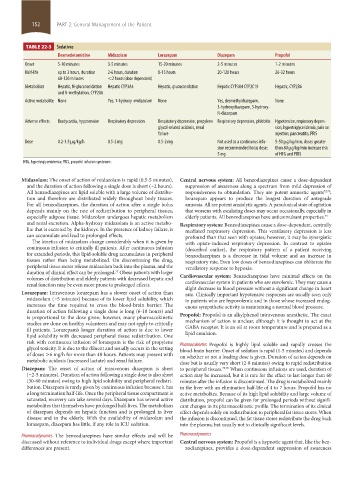
                    TABLE 22-3    Sedatives
                              Dexmedetomidine  Midazolam        Lorazepam           Diazepam            Propofol
                  Onset       5-10 minutes     3-5 minutes      15-20 minutes       2-5 minutes         1-2 minutes
                  Half-life   up to 3 hours, duration    2-6 hours, duration    8-15 hours  20-120 hours  26-32 hours
                              60-120 minutes   <2 hours (dose dependent)
                  Metabolism  Hepatic, N-glucuronidation  Hepatic CYP3A4  Hepatic, glucuronidation  Hepatic CYP3A4 CYP2C19  Hepatic, CYP2B6
                              and N-methylation, CYP2A6
                  Active metabolite None       Yes, 1-hydroxy -midazolam  None      Yes, desmethyldiazepam,   None
                                                                                    3-hydroxydiazepam, 3-hydroxy-
                                                                                    N-diazepam
                  Adverse effects  Bradycardia, hypotension  Respiratory depression  Respiratory depression, propylene   Respiratory depression, phlebitis Hypotension, respiratory depres-
                                                                glycol-related acidosis, renal          sion, hypertriglyceridemia, pain on
                                                                failure                                 injection, pancreatitis, PRIS
                  Dose        0.2-1.5 μg/kg/h  0.5-2 mg         0.5-2 mg            Not used as a continuous infu-  5-50 μg/kg/min, doses greater
                                                                                    sion recommended bolus dose:   than 80 μg/kg/min increase risk
                                                                                    5 mg                of HTG and PRIS
                  HTG, hypertriglyceridemia; PRIS, propofol infusion syndrome.


                 Midazolam: The onset of action of midazolam is rapid (0.5-5 minutes),   Central nervous system:  All benzodiazepines  cause a dose-dependent
                   and the duration of action following a single dose is short (~2 hours).   suppression of awareness along a spectrum from mild depression of
                   All benzodiazepines are lipid soluble with a large volume of distribu-  responsiveness to obtundation. They are potent amnestic agents 72,73 ;
                   tion and therefore are distributed widely throughout body tissues.   lorazepam  appears  to  produce  the  longest  duration  of  antegrade
                   For all benzodiazepines, the duration of action after a single bolus     amnesia. All are potent anxiolytic agents. A paradoxical state of agitation
                   depends mainly on the rate of redistribution to peripheral tissues,   that worsens with escalating doses may occur occasionally, especially in
                   especially adipose tissue. Midazolam undergoes hepatic metabolism   elderly patients. All benzodiazepines have anticonvulsant properties. 74
                   and renal excretion. Alpha-hydroxy midazolam is an active metabo-  Respiratory system: Benzodiazepines cause a dose-dependent, centrally
                   lite that is excreted by the kidneys. In the presence of kidney failure, it   mediated respiratory depression. This ventilatory depression is less
                   can accumulate and lead to prolonged effects.         profound than that seen with opiates; however, it may be synergistic
                     The kinetics of midazolam change considerably when it is given by   with opiate-induced respiratory depression. In contrast to opiates
                   continuous infusion to critically ill patients. After continuous infusion   (described earlier), the respiratory pattern of a patient receiving
                   for extended periods, this lipid-soluble drug accumulates in peripheral   benzodiazepines is a decrease in tidal volume and an increase in
                   tissues rather than being metabolized. On discontinuing the drug,   respiratory rate. Even low doses of benzodiazepines can obliterate the
                   peripheral tissue stores release midazolam back into the plasma, and the   ventilatory response to hypoxia.
                   duration of clinical effect can be prolonged.  Obese patients with larger
                                                 57
                   volumes of distribution and elderly patients with decreased hepatic and   Cardiovascular system: Benzodiazepines have minimal effects on the
                   renal function may be even more prone to prolonged effects.  cardiovascular system in patients who are euvolemic. They may cause a
                                                                         slight decrease in blood pressure without a significant change in heart
                 Lorazepam: Intravenous lorazepam has a slower onset of action than   rate. Clinically important hypotensive responses are usually seen only
                   midazolam (~5 minutes) because of its lower lipid solubility, which   in patients who are hypovolemic and in those whose increased endog-
                   increases  the  time  required  to cross  the blood-brain barrier. The   enous sympathetic activity is maintaining a normal blood pressure.
                   duration of action following a single dose is long (6-10 hours) and
                   is proportional to the dose given; however, many pharmacokinetic   Propofol: Propofol is an alkylphenol intravenous anesthetic. The exact
                   studies are done on healthy volunteers and may not apply to critically   mechanism of action is unclear, although it is thought to act at the
                   ill  patients. Lorazepam’s longer duration of action is due to lower   GABA receptor. It is an oil at room temperature and is prepared as a
                   lipid solubility with decreased peripheral tissue redistribution. One   lipid emulsion.
                   risk with continuous infusion of lorazepam is the risk of propylene   Pharmacokinetics  Propofol is highly lipid soluble and rapidly crosses the
                   glycol toxicity. It is due to the diluent and usually occurs in the setting   blood-brain barrier. Onset of sedation is rapid (1-5 minutes) and depends
                   of doses >6 mg/h for more than 48 hours. Patients may present with   on whether or not a loading dose is given. Duration of action depends on
                   metabolic acidosis (increased lactate) and renal failure.  dose but is usually very short (2-8 minutes) owing to rapid redistribution
                 Diazepam: The onset of  action of intravenous diazepam is short     to peripheral tissues. 75,76  When continuous infusions are used, duration of
                   (~2-5 minutes). Duration of action following a single dose is also short   action may be increased, but it is rare for the effect to last longer than 60
                   (30-60 minutes) owing to high lipid solubility and peripheral redistri-  minutes after the infusion is discontinued. The drug is metabolized mainly
                   bution. Diazepam is rarely given by continuous infusion because it has   in the liver with an elimination half-life of 4 to 7 hours. Propofol has no
                   a long termination half-life. Once the peripheral tissue compartment is   active metabolites. Because of its high lipid solubility and large volume of
                   saturated, recovery can take several days. Diazepam has several active   distribution, propofol can be given for prolonged periods without signifi-
                   metabolites that themselves have prolonged half-lives. The metabolism   cant changes in its pharmacokinetic profile. The termination of its clinical
                   of diazepam depends on hepatic function and is prolonged in liver   effect depends solely on redistribution to peripheral fat tissue stores. When
                   disease and in the elderly. With the availability of midazolam and   the infusion is discontinued, the fat tissue stores redistribute the drug back
                   lorazepam, diazepam has little, if any role in ICU sedation.  into the plasma, but usually not to clinically significant levels.
                 Pharmacodynamics  The benzodiazepines have similar effects and will be   Pharmacodynamics
                 discussed without reference to individual drugs except where important   Central nervous system: Propofol is a hypnotic agent that, like the ben-
                 differences are present.                                zodiazepines, provides a dose-dependent suppression of awareness


            section02.indd   152                                                                                       1/13/2015   2:05:05 PM

