


Page 247 - Hall et al (2015) Principles of Critical Care-McGraw-Hill
P. 247
CHAPTER 22: Pain Control, Sedation, and Use of Muscle Relaxants  151


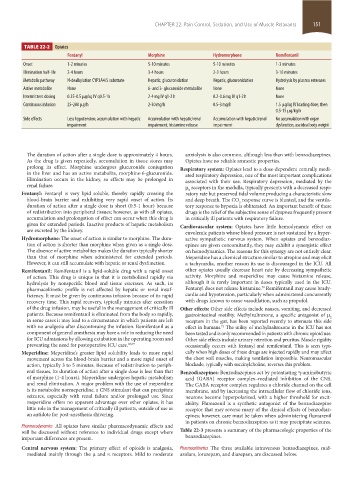
                      TABLE 22-2    Opiates
                                   Fentanyl                    Morphine              Hydromorphone        Remifentanil
                    Onset          1-2 minutes                 5-10 minutes          5-10 minutes         1-3 minutes
                    Elimination half-life  2-4 hours           3-4 hours             2-3 hours            3-10 minutes
                    Metabolic pathway  N-dealkylation CYP3A4/5 substrate  Hepatic, glucuronidation  Hepatic, glucuronidation  Hydrolysis by plasma esterases
                    Active metabolite  None                    6- and 3- glucuronide metabolite  None     None
                    Intermittent dosing  0.35-0.5 μg/kg IV q0.5-1h  2-4 mg IV q1-2 h  0.2-0.6 mg IV q1-2 h  None
                    Continuous infusion  25-200 μg/h           2-30 mg/h             0.5-3 mg/h           1.5 μg/kg IV loading dose; then
                                                                                                          0.5-15 μg/kg/h
                    Side effects   Less hypotension; accumulation with hepatic   Accumulation with hepatic/renal    Accumulation with hepatic/renal    No accumulation with organ
                                   impairment                  impairment, histamine release  impairment  dysfunction, use ideal body weight


                     The duration of action after a single dose is approximately 4 hours.   anxiolysis is also common, although less than with benzodiazepines.
                     As the drug is given repeatedly, accumulation in tissue stores may   Opiates have no reliable amnestic properties.
                     prolong its effect. Morphine undergoes glucuronide conjugation   Respiratory system: Opiates lead to a dose-dependent centrally medi-
                     in the liver and has an active metabolite, morphine-6-glucuronide.   ated respiratory depression, one of the most important complications
                     Elimination occurs in the kidney, so effects may be prolonged in   associated with their use. Respiratory depression, mediated by the
                     renal failure.                                        μ  receptors in the medulla, typically presents with a decreased respi-
                                                                            2
                    Fentanyl: Fentanyl is very lipid soluble, thereby rapidly crossing the   ratory rate but preserved tidal volume producing a characteristic slow
                     blood-brain  barrier  and  exhibiting  very  rapid  onset  of  action.  Its   and deep breath. The CO  response curve is blunted, and the ventila-
                                                                                              2
                     duration of action after a single dose is short (0.5-1 hour) because   tory response to hypoxia is obliterated. An important benefit of these
                     of redistribution into peripheral tissues; however, as with all opiates,   drugs is the relief of the subjective sense of dyspnea frequently present
                     accumulation and prolongation of effect can occur when this drug is   in critically ill patients with respiratory failure.
                     given for extended periods. Inactive products of hepatic metabolism   Cardiovascular system: Opiates have little hemodynamic effect on
                     are excreted by the kidney.                           euvolemic patients whose blood pressure is not sustained by a hyper-
                    Hydromorphone: The onset of action is similar to morphine. The dura-  active sympathetic nervous system. When opiates and benzodiaz-
                     tion of action is shorter than morphine when given as a single dose.   epines are given concomitantly, they may exhibit a synergistic effect
                     The absence of active metabolites makes the duration typically shorter   on hemodynamics. The reasons for this synergy are not entirely clear.
                     than that of morphine when administered for extended periods.   Meperidine has a chemical structure similar to atropine and may elicit
                     However, it can still accumulate with hepatic or renal dysfunction.  a tachycardia, another reason its use is discouraged in the ICU. All
                    Remifentanil: Remifentanil is a lipid-soluble drug with a rapid onset   other opiates usually decrease heart rate by decreasing sympathetic
                     of  action.  This  drug  is  unique  in  that  it  is  metabolized  rapidly  via   activity. Morphine and meperidine may cause histamine release,
                     hydrolysis by nonspecific blood and tissue esterases. As such, its   although it is rarely important in doses typically used in the ICU.
                                                                                                     70
                     pharmacokinetic profile is not affected by hepatic or renal insuf-  Fentanyl does not release histamine.  Remifentanil may cause brady-
                     ficiency. It must be given by continuous infusion because of its rapid   cardia and hypotension, particularly when administered concurrently
                     recovery time. This rapid recovery, typically minutes after cessation   with drugs known to cause vasodilation, such as propofol.
                     of the drug infusion, may be useful in the management of critically ill   Other effects: Other side effects include nausea, vomiting, and decreased
                     patients. Because remifentanil is eliminated from the body so rapidly,   gastrointestinal motility. Methylnaltrexone, a specific antagonist of  μ
                                                                                                                             2
                     in some cases it may lead to a circumstance in which patients are left   receptors  in the  gut, has been reported  recently to  attenuate this  side
                     with no analgesia after discontinuing the infusion. Remifentanil as a   effect in humans.  The utility of methylnaltrexone in the ICU has not
                                                                                        71
                     component of general anesthesia may have a role in reducing the need   been tested and is only recommended in patients with chronic opioid use.
                     for ICU admissions by allowing extubation in the operating room and   Other side effects include urinary retention and pruritus. Muscle rigidity
                     preventing the need for postoperative ICU care. 68,69  occasionally occurs with fentanyl and remifentanil. This is seen typi-
                    Meperidine: Meperidine’s greater lipid solubility leads to more rapid   cally when high doses of these drugs are injected rapidly and may affect
                     movement across the blood-brain barrier and a more rapid onset of   the chest wall muscles, making ventilation impossible. Neuromuscular
                     action, typically 3 to 5 minutes. Because of redistribution to periph-  blockade, typically with succinylcholine, reverses this problem.
                     eral tissues, its duration of action after a single dose is less than that   Benzodiazepines: Benzodiazepines act by potentiating γ-aminobutyric
                     of morphine (1-4 hours). Meperidine undergoes hepatic metabolism   acid (GABA) receptor complex–mediated inhibition of the CNS.
                     and renal elimination. A major problem with the use of meperidine   The GABA receptor complex regulates a chloride channel on the cell
                     is its metabolite normeperidine, a CNS stimulant that can precipitate   membrane, and by increasing the intracellular flow of chloride ions,
                     seizures, especially with renal failure and/or prolonged use. Since   neurons become hyperpolarized, with a higher threshold for excit-
                     meperidine  offers  no apparent advantage  over  other opiates,  it  has   ability. Flumazenil is a synthetic antagonist of the benzodiazepine
                     little role in the management of critically ill patients, outside of use as   receptor that may reverse many of the clinical effects of benzodiaz-
                     an antidote for post-anesthesia shivering.            epines; however, care must be taken when administering flumazenil
                                                                           in patients on chronic benzodiazepines as it may precipitate seizures.
                    Pharmacodynamics  All opiates have similar pharmacodynamic effects and
                    will  be  discussed  without  reference  to  individual  drugs  except  where   Table 22-3 presents a summary of the pharmacologic properties of the
                    important differences are present.                     benzodiazepines.
                    Central nervous system: The primary effect of opioids is analgesia,   Pharmacokinetics  The three available intravenous benzodiazepines, mid-
                     mediated mainly through the μ and κ receptors. Mild to moderate   azolam, lorazepam, and diazepam, are discussed below.


            section02.indd   151                                                                                       1/13/2015   2:05:05 PM

