


Page 269 - Hall et al (2015) Principles of Critical Care-McGraw-Hill
P. 269
CHAPTER 25: Cardiopulmonary Resuscitation  173


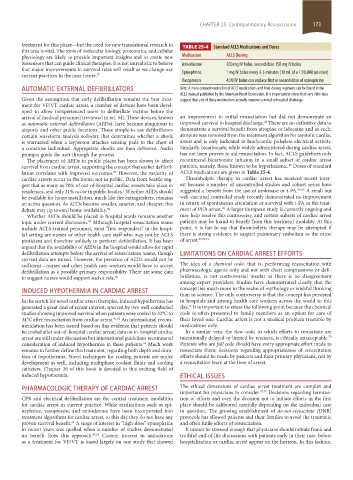
                    treatment for this phase—but the need for new translational research in     TABLE 25-4    Standard ACLS Medications and Doses
                    this area is vital. The tools of molecular biology, proteomics, and cellular
                    physiology are likely to provide important insights and to create new   Medication  ACLS Dosing
                    biosensors that can guide clinical therapies. It is not unrealistic to believe   Amiodarone  300 mg IV bolus, second dose 150 mg IV bolus
                    that major improvements in survival rates will result as we change our   Epinephrine  1 mg IV bolus every 3-5 minutes (10 mL of a 1:10,000 solution)
                    current practices in the near future. 57
                                                                          Vasopressin    40 U IV bolus can replace first or second dose of epinephrine
                    AUTOMATIC EXTERNAL DEFIBRILLATORS                     Note: A more comprehensive list of ACLS medications and their dosing regimens can be found in the
                                                                          ACLS manual published by the American Heart Association. It is important to stress that very little data
                    Given the assumption that early defibrillation remains the best treat-  suggest that any of these medications actually improve survival to hospital discharge.
                    ment for VF/VT cardiac arrest, a number of devices have been devel-
                    oped to allow inexperienced users to defibrillate victims before the
                    arrival of medical personnel (reviewed in ref. 54). These devices, known   an  improvement  in  initial  resuscitation  but  did  not  demonstrate  an
                                                                                                      44
                    as automatic external defibrillators (AEDs), have become ubiquitous in   improved survival to hospital discharge.  There are no definitive data to
                    airports and other public locations. These simple-to-use defibrillators   demonstrate a survival benefit from atropine or lidocaine and as such,
                    contain waveform analysis software that determines whether a shock   atropine was removed from the treatment algorithm for asystolic cardiac
                    is warranted when a layperson attaches sensing pads to the chest of   arrest and is only indicated in bradycardic pulseless electrical activity.
                    a comatose individual. Appropriate shocks are then delivered. Audio   Similarly, bicarbonate, while widely administered during cardiac arrest,
                    prompts guide the user through the process.           has not been proven to aid resuscitation. In fact, ACLS guidelines only
                     The placement of AEDs in public places has been shown to affect   recommend bicarbonate infusion in a small subset of cardiac arrest
                                                                                                               15
                    survival from cardiac arrest, supporting the concept that earlier defibril-  patients, namely, those known to be hyperkalemic.  Doses of standard
                    lation correlates with improved outcomes.  However, the majority of   ACLS medications are given in Table 25-4.
                                                   57
                    cardiac arrests occur in the home, not in public. Data from Seattle sug-  Thrombolytic therapy in cardiac arrest has received recent inter-
                    gest that as many as 70% of out-of-hospital cardiac arrests take place in   est because a number of uncontrolled studies and cohort series have
                    residences, and only 21% occur in public locales.  Whether AEDs should   suggested a benefit from the use of urokinase or t-PA. 66-68  A small but
                                                      1
                    be available for home installation, much like fire extinguishers, remains   well-executed controlled study recently demonstrated no improvement
                    an active question. As AEDs become smaller, smarter, and cheaper, this   in return of spontaneous circulation or survival with t-PA in the treat-
                                                                                        69
                    debate may tip toward home availability. 58           ment of PEA arrest.  A larger European study is currently ongoing and
                     Whether AEDs should be placed in hospital wards remains another   may help resolve this controversy, and certain subsets of cardiac arrest
                    topic under current discussion.  Although hospital resuscitation teams   patients may be found to benefit from this treatment modality. At this
                                          59
                    include ACLS-trained personnel, most “first responders” in the hospi-  point, it is fair to say that thrombolytic therapy may be attempted if
                    tal setting are nurses or other health care staff who may not be ACLS   there is strong evidence to suspect pulmonary embolism as the cause
                    proficient and therefore unlikely to perform defibrillation. It has been   of arrest. 65,70,71
                    argued that the availability of AEDs in the hospital would allow for rapid
                    defibrillation attempts before the arrival of resuscitation teams, though  LIMITATIONS ON CARDIAC ARREST EFFORTS
                    current data are mixed. However, the presence of AEDs would not be
                    sufficient—nurses and other health care workers would have to accept   The idea of a  chemical  code, that is, performing resuscitation with
                    defibrillation as a possible primary responsibility. There are some data   pharmacologic agents only and not with chest compressions or defi-
                    to suggest nurses would support such a role. 60       brillation, is not controversial insofar as there is no disagreement
                                                                          among expert providers. Studies have demonstrated clearly that the
                    INDUCED HYPOTHERMIA IN CARDIAC ARREST                 concept lies much more in the realm of mythology or wishful thinking
                                                                          than in science. The only controversy is that the concept has persisted
                    In the search for novel cardiac arrest therapies, induced hypothermia has   in hospitals and among health care workers across the world to this
                                                                            72
                    generated a great deal of recent interest, spurred by two well-conducted   day.  It is important to stress the following point because the chemical
                    studies showing improved survival when patients were cooled to 32°C to   code is often presented to family members as an option for care of
                    34°C after resuscitation from cardiac arrest. 61,62  An international recom-  their loved one: Cardiac arrest is not a medical problem treatable by
                    mendation has been issued based on this evidence that patients should   medications only.
                    be cooled after out-of-hospital cardiac arrest; data on in-hospital cardiac   In a similar vein, the  slow code, in which efforts to resuscitate are
                    arrest are still under discussion but international guidelines recommend   intentionally delayed or limited by rescuers, is ethically unacceptable.
                                                                                                                            73
                                                             63
                    consideration of induced hypothermia in these patients.  Much work   Patients who are full code should have every appropriate effort made to
                    remains to further define this treatment, regarding both depth and dura-  resuscitate them; decisions regarding appropriateness of resuscitation
                    tion of hypothermia. Novel techniques for cooling patients are under   efforts should be made by patients and their primary physicians, not by
                    development as well, including multiphase coolant fluids and cooling   a resuscitation team at the time of arrest.
                    catheters. Chapter 26 of this book is devoted to this exciting field of
                    induced hypothermia.                                  ETHICAL ISSUES
                    PHARMACOLOGIC THERAPY OF CARDIAC ARREST               The ethical dimensions of cardiac arrest treatment are complex and
                                                                          important for physicians to consider. 74,75  Decisions regarding termina-
                    CPR and electrical defibrillation are the central treatment modalities   tion of efforts and even the decision not to initiate efforts in the first
                    for cardiac arrest in current practice. While medications such as epi-  place should be calibrated carefully depending on the individual case
                    nephrine, vasopressin, and amiodarone have been incorporated into   in question. The growing establishment of  do-not-resuscitate (DNR)
                    treatment algorithms for cardiac arrest, to this day they do not have any   protocols has allowed patients and their families to avoid the traumatic
                    proven survival benefit.  A surge of interest in “high-dose” epinephrine   and often futile efforts of resuscitation.
                                     64
                    in recent years was quelled when a number of studies demonstrated   It cannot be stressed enough that physicians should initiate frank and
                    no benefit from this approach. 43,65  Current interest in amiodarone   truthful end-of-life discussions with patients early in their care, before
                    as a treatment for VF/VT is  based largely  on one study that  showed   hospitalization or cardiac arrest appear on the horizon. In this fashion,


            section02.indd   173                                                                                       1/13/2015   2:05:13 PM

