


Page 272 - Hall et al (2015) Principles of Critical Care-McGraw-Hill
P. 272
176     PART 2: General Management of the Patient


                 after resuscitation from cardiac arrest, as measured at autopsy in       Intra-arrest        Postarrest
                 patients who died within days of undergoing resuscitative measures.
                                                                    44
                 Widespread evidence from animals also supports the notion that apop-         1                  3
                 tosis  is  activated  after  reperfusion. 25,45   Hypothermia  may  inhibit  this
                 process. Proteolysis of the cytoskeletal protein fodrin, a characteristic   No-flow
                 step in the apoptotic pathway, is inhibited by hypothermia to 32°C in a           Intra-arrest
                 rat brain IR model.  The process of apoptosis is an active one, requiring          low flow
                               46
                 protein synthesis and enzymatic activity, both of which may be inhibited   Cardiac  cooling  ROSC or
                 by lower temperatures. While some data suggest that the degree of apop-  Blood  arrest        bypass
                 tosis can be reduced by hypothermia, the topic certainly deserves more   flow        2
                 investigation in animal models.
                                                                                                CPR
                 HYPOTHERMIA IN CARDIAC ARREST
                 Cardiac arrest is a highly mortal condition that leads to at least 300,000
                 deaths each year in the United States alone.  Survival from cardiac arrest
                                                47
                 remains dismal some 50 years after introduction of chest compressions           Time
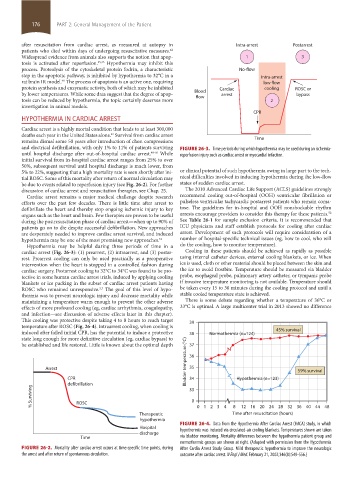
                 and electrical defibrillation, with only 1% to 11% of patients surviving   FIGURE 26-3.  Time periods during which hypothermia may be used during an ischemia-
                 until hospital discharge after out-of-hospital cardiac arrest. 48-50  While   reperfusion injury such as cardiac arrest or myocardial infaction.
                 initial survival from in-hospital cardiac arrest ranges from 25% to over
                 50%, subsequent survival until hospital discharge is much lower, from
                 5% to 22%, suggesting that a high mortality rate is seen shortly after ini-  or clinical potential of such hypothermia owing in large part to the tech-
                 tial ROSC. Some of this mortality after return of normal circulation may   nical difficulties involved in inducing hypothermia during the low-flow
                 be due to events related to reperfusion injury (see Fig. 26-2). For further   states of sudden cardiac arrest.
                 discussion of cardiac arrest and resuscitation therapies, see Chap. 25.  The 2010 Advanced Cardiac Life Support (ACLS) guidelines strongly
                   Cardiac  arrest  remains  a  major  medical  challenge  despite  research   recommend cooling out-of-hospital (OOH) ventricular fibrillation or
                 efforts over the past few decades. There is little time after arrest to   pulseless ventricular tachycardic postarrest patients who remain coma-
                 defibrillate the heart and thereby stop ongoing ischemic injury to key   tose. The guidelines for in-hospital and OOH nonshockable rhythm
                                                                                                                          52
                 organs such as the heart and brain. Few therapies are proven to be useful   arrests encourage providers to consider this therapy for these patients.
                 during the postresuscitation phase of cardiac arrest—when up to 90% of   See  Table 26-1 for sample exclusion criteria. It is recommended that
                 patients go on to die despite successful defibrillation. New approaches   ICU physicians and staff establish protocols for cooling after cardiac
                 are desperately needed to improve cardiac arrest survival, and induced   arrest. Development of such protocols will require consideration of a
                 hypothermia may be one of the most promising new approaches. 51  number of hospital-specific technical issues (eg, how to cool, who will
                   Hypothermia may be helpful during three periods of time in a    do the cooling, how to monitor temperature).
                 cardiac arrest (Fig. 26-3): (1) prearrest, (2) intraarrest, and (3) postar-  Cooling  in  these  patients  should  be  achieved  as  rapidly  as  possible
                 rest. Prearrest cooling can only be used practically as a preoperative   using internal catheter devices, external cooling blankets, or ice. When
                 intervention when the heart is stopped in a controlled fashion during   ice is used, cloth or other material should be placed between the skin and
                 cardiac surgery. Postarrest cooling to 32°C to 34°C was found to be pro-  the ice to avoid frostbite. Temperature should be measured via  bladder
                 tective in some human cardiac arrest trials, induced by applying cooling   probe, esophageal probe, pulmonary artery catheter, or tympanic probe
                 blankets or ice packing in the subset of cardiac arrest patients having   if invasive temperature monitoring is not available. Temperature should
                 ROSC who remained unresponsive.  The goal of this level of hypo-  be taken every 15 to 30 minutes during the cooling protocol and until a
                                            2,3
                 thermia was to prevent neurologic injury and decrease mortality while   stable cooled temperature state is achieved.
                 maintaining a temperature warm enough to prevent the other adverse   There is some debate regarding whether a temperature of 36°C or
                 effects of more profound cooling (eg, cardiac arrhythmia, coagulopathy,   33°C is optimal. A large multicenter trial in 2013 showed no difference
                 and infection—see discussion of adverse effects later in this chapter).
                 This cooling was protective despite taking 4 to 8 hours to reach target   39
                 temperature after ROSC (Fig. 26-4). Intraarrest cooling, when cooling is
                 induced after failed initial CPR, has the potential to induce a protective   38  Normothermia (n=124)  45% survival
                 state long enough for more definitive circulation (eg, cardiac bypass) to
                 be established and life restored. Little is known about the optimal depth   37

                                                                          36
                         Arrest                                          Bladder temperature (°C)  35          59% survival
                                 CPR                                      34              Hypothermia (n=123)
                                 defibrillation                           33
                     % Surviving    ROSC                                   0

                                                                                            1216 20 24 28 32 36 40 44 48
                                                                                         8
                                                         Therapeutic         0  1 2 34   Time after resuscitation (hours)
                                                         hypothermia
                                                                       FIGURE 26-4.  Data from the Hypothermia After Cardiac Arrest (HACA) study, in which
                                                         Hospital      hypothermia was induced via circulated-air cooling blankets. Temperatures shown are taken
                                                         discharge
                                     Time                              via bladder monitoring. Mortality differences between the hypothermia patient group and
                                                                       normothermic groups are shown at right. (Adapted with permission from the Hypothermia
                 FIGURE 26-2.  Mortality after cardiac arrest occurs at time-specific time points, during   After Cardia Arrest Study Group. Mild therapeutic hypothermia to improve the neurologic
                 the arrest and after return of spontaneous circulation.  outcome after cardiac arrest. N Engl J Med. February 21, 2002;346(8):549-556.)


            section02.indd   176                                                                                       1/13/2015   2:05:15 PM

