


Page 271 - Hall et al (2015) Principles of Critical Care-McGraw-Hill
P. 271
CHAPTER 26: Therapeutic Hypothermia  175


                    hypothermia was in the setting of malignancy. In 1939, Fay and col-  hypothermic protection include modulation of transcription and/or
                    leagues treated patients with metastatic carcinoma, with the goal of both   translation, suppression of reactive oxygen species (ROS) production,
                                                       13
                    pain reduction and retardation of tumor growth.  While hypothermia   and inhibition of programmed cell death, or apoptosis. The mechanisms
                    to 32°C for 24 hours did not prove effective for the stated goals, it was   by which cooling protects tissues may overlap as well. For example, the
                    considered well tolerated. 13                         effect of hypothermia on cellular metabolism may lead indirectly to
                     A decade later, Wilfred Bigelow studied the induction of hypothermia   modulation of programmed cell death, and cooling may have a direct
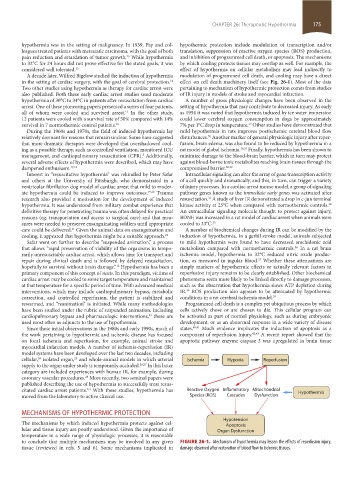
                    in the setting of cardiac surgery, with the goal of cerebral protection.    effect on cell death machinery itself (see Fig. 26-1). Most of the data
                                                                      14
                    Two other studies using hypothermia as therapy for cardiac arrest were   pertaining to mechanism of hypothermic protection comes from studies
                    also  published. Both these early cardiac arrest  studies  used moderate   of IR injury in models of stroke and myocardial infarction.
                    hypothermia of 30°C to 34°C in patients after resuscitation from cardiac   A number of gross physiologic changes have been observed in the
                    arrest. One of these pioneering papers presented a series of four patients,   setting of hypothermia that may contribute to decreased injury. As early
                    all of whom were cooled and survived arrest.  In the other study,    as 1954 it was noted that hypothermia induced by ice water immersion
                                                       15
                    12 patients were cooled with a survival rate of 50% compared with 14%   could lower cerebral oxygen consumption in dogs by approximately
                    survival in 7 normothermic control patients. 16       7% per 1°C drop in temperature.  Other studies have demonstrated that
                                                                                                 29
                     During the 1960s and 1970s, the field of induced hypothermia lay   mild hypothermia in rats improves postischemic cerebral blood flow
                    relatively dormant for reasons that remain unclear. Some have suggested   disturbances.  Another marker of general physiologic injury after reper-
                                                                                   30
                    that more dramatic therapies were developed that overshadowed cool-  fusion, brain edema, was also found to be reduced by hypothermia in a
                    ing as a possible therapy, such as controlled ventilation, monitored ICU   rat model of global ischemia. 30,31  Finally, hypothermia has been shown to
                    management, and cardiopulmonary resuscitation (CPR).  Additionally,   minimize damage to the blood-brain barrier, which in turn may protect
                                                             5
                    several adverse effects of hypothermia were described, which may have   against blood-borne toxic metabolites reaching brain tissues through the
                    dampened enthusiasm. 17,18                            compromised barrier. 30,32
                     Interest in “resuscitative hypothermia” was rekindled by Peter Safar   Intracellular signaling can alter the array of gene transcription activity
                    and others at the University of Pittsburgh, who demonstrated in a   of a cell quickly and dramatically, and this, in turn, can trigger a variety
                    ventricular fibrillation dog model of cardiac arrest that mild to moder-  of injury processes. In a cardiac arrest mouse model, a group of signaling
                    ate  hypothermia  could  be  induced  to  improve  outcomes. 19,20   Trauma   pathway genes known as the immediate early genes was activated after
                    research also provided a motivation for the development of induced   resuscitation.  A study of liver IR demonstrated a drop in c-jun terminal
                                                                                   33
                                                                                                                            34
                    hypothermia. It was understood from military combat experience that   kinase activity at 25°C when compared with normothermic controls.
                    definitive therapy for penetrating trauma was often delayed for practical   An extracellular signaling molecule thought to protect against injury,
                    reasons (eg, transportation and access to surgical care) and that mea-  BDNF, was increased in a rat model of cardiac arrest when animals were
                    sures were needed to preserve exsanguinating soldiers until appropriate   cooled to 33°C. 35
                    care could be delivered.  Given the animal data on exsanguination and   A number of biochemical changes during IR can be modified by the
                                     21
                    cooling, it appeared that hypothermia might be a suitable approach. 22  induction of hypothermia. In a gerbil stroke model, animals subjected
                     Safar went on further to describe “suspended animation,” a process   to mild hypothermia were found to have decreased arachidonic acid
                    that allows “rapid preservation of viability of the organisms in tempo-  metabolism compared with normothermic controls.  In a rat brain
                                                                                                                 36
                    rarily unresuscitable cardiac arrest, which allows time for transport and   ischemia model, hypothermia to 32°C reduced nitric oxide produc-
                    repair during clinical death and is followed by delayed resuscitation,   tion, as measured in jugular blood.  Whether these attenuations are
                                                                                                    37
                    hopefully to survival without brain damage.”  Hypothermia has been a   simply markers of hypothermic effects or actually relevant factors in
                                                    12
                    primary component of this concept of stasis. In this paradigm, victims of   reperfusion injury remains to be clearly established. Other biochemical
                    cardiac arrest may be cooled to some target temperature and maintained   phenomena seem more likely to be linked directly to damage processes,
                    at that temperature for a specific period of time. With advanced medical   such as the observation that hypothermia slows ATP depletion during
                    interventions, which may include cardiopulmonary bypass, metabolic   IR.  ROS production also appears to be attenuated by hypothermic
                                                                            38
                    correction, and controlled reperfusion, the patient is stabilized and   conditions in a rat cerebral ischemia model. 39
                    rewarmed, and “reanimation” is initiated. While many methodologies   Programmed cell death is a complex yet ubiquitous process by which
                    have been studied under the rubric of suspended animation, including   cells actively chose or are chosen to die. This cellular program can
                    cardiopulmonary bypass and pharmacologic interventions,  these are   be  activated  as  part  of  normal  physiology,  such  as  during  embryonic
                                                               23
                    used most often as adjuncts to the use of hypothermia.  development, or as an abnormal response in a wide variety of disease
                     Since these initial observations in the 1980s and early 1990s, much of   states. 40,41  Much evidence implicates the induction of apoptosis as a
                    the work pertaining to hypothermia and ischemic disease has focused   component of reperfusion injury. 42,43  A recent report showed that the
                    on focal ischemia and reperfusion, for example, animal stroke and   apoptotic pathway enzyme caspase 3 was upregulated in brain tissue
                    myocardial infarction models. A number of ischemia-reperfusion (IR)
                    model systems have been developed over the last two decades, including
                    cellular,  isolated organ,  and whole-animal models in which arterial   Ischemia  Hypoxia  Reperfusion
                         24
                                      25
                    supply to the organ under study is temporarily occluded. 26,27  In this latter
                    category are included experiences with human IR, for example, during
                    coronary vascular procedures.  More recently, two seminal papers were
                                         28
                    published describing the use of hypothermia to successfully treat resus-
                                          2,3
                    citated cardiac arrest patients.  With these studies, hypothermia has   Reactive Oxygen Inflammatory Mitochondrial  Hypothermia
                    moved from the laboratory to active clinical use.        Species (ROS)  Cascades  Dysfunction
                    MECHANISMS OF HYPOTHERMIC PROTECTION
                                                                                        Hypotension
                    The mechanisms by which induced hypothermia protects against cel-    Apoptosis
                    lular and tissue injury are poorly understood. Given the importance of   Organ Dysfunction
                    temperature in a wide range of physiologic processes, it is reasonable
                    to conclude that multiple mechanisms may be involved in any given   FIGURE 26-1.  Mechanism of hypothermia may lessen the effects of reperfusion injury,
                    tissue (reviewed in refs. 5 and 6). Some mechanisms implicated in   damage observed after restoration of blood flow to ischemic tissues.


            section02.indd   175                                                                                       1/13/2015   2:05:14 PM

