


Page 288 - Hall et al (2015) Principles of Critical Care-McGraw-Hill
P. 288
192     PART 2: General Management of the Patient


                                                                       pulmonary vasculature and a longer length of catheter. Therefore, in the
                                                                       Ppw tracing, the  a wave usually appears after the QRS complex, and
                                                                       the v wave is seen after the T wave (see Fig. 28-7). When referenced
                                                                       to the ECG, the v wave of the Ppw tracing occurs later than the Ppa
                                                                         systolic pressure wave. An appreciation of the latter concept is critical
                                                                       when tracings are being analyzed to ensure that balloon inflation has
                                                                       resulted in an acceptable transition from Ppa to Ppw and to detect the
                                                              j point  presence of a “giant” v wave in the Ppw tracing (see below).
                                                                         For the Ppw to accurately represent Pla, it is essential that the tip of
                                                       A               the inflated catheter lie free within the vessel lumen. Obstruction to flow
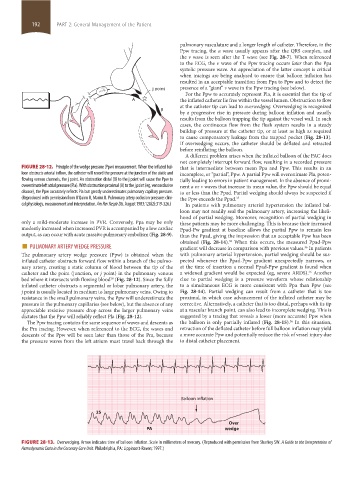
                                                                       at the catheter tip can lead to overwedging. Overwedging is recognized
                                                                 B
                                                                       by a progressive rise in pressure during balloon inflation and usually
                                                                       results from the balloon trapping the tip against the vessel wall. In such
                                                                       cases, the continuous flow from the flush system results in a steady
                                                                       buildup of pressure at the catheter tip, or at least as high as required
                                                                       to cause compensatory leakage from the trapped pocket (Fig. 28-13).
                                                                       If  overwedging  occurs,  the  catheter  should  be  deflated  and  retracted
                                                                       before reinflating the balloon.
                                                                         A different problem arises when the inflated balloon of the PAC does
                                                                       not completely interrupt forward flow, resulting in a recorded pressure
                 FIGURE 28-12.  Principle of the wedge pressure (Ppw) measurement. When the inflated bal-  that is intermediate between mean Ppa and Ppw. This results in an
                 loon obstructs arterial inflow, the catheter will record the pressure at the junction of the static and   incomplete, or “partial”, Ppw. A partial Ppw will overestimate Pla, poten-
                 flowing venous channels, the j point. An obstruction distal (B) to the j point will cause the Ppw to   tially leading to errors in patient management. In the absence of promi-
                 overestimate left atrial pressure (Pla). With obstruction proximal (A) to the j point (eg, venoocclusive   nent a or v waves that increase its mean value, the Ppw should be equal
                 disease), the Ppw accurately reflects Pla but greatly underestimates pulmonary capillary pressure.   to or less than the Ppad. Partial wedging should always be suspected if
                 (Reproduced with permission from O’Quinn R, Marini JJ. Pulmonary artery occlusion pressure: clini-  the Ppw exceeds the Ppad. 35
                 cal physiology, measurement and interpretation. Am Rev Respir Dis. August 1983;128(2):319-326.)  In patients with pulmonary arterial hypertension the inflated bal-
                                                                       loon may not readily seal the pulmonary artery, increasing the likeli-
                                                                       hood of partial wedging. Moreover, recognition of partial wedging in
                 only a mild-moderate increase in PVR. Conversely, Ppa may be only   these patients may be more challenging. This is because their increased
                 modestly increased when increased PVR is accompanied by a low cardiac   Ppad-Pw gradient at baseline allows the partial Ppw to remain less
                 output, as can occur with acute massive pulmonary  embolism (Fig. 28-9).  than the Ppad, giving the impression that an acceptable Ppw has been
                     ■  PULMONARY ARTERY WEDGE PRESSURE                obtained (Fig. 28-14).  When this occurs, the measured Ppad-Ppw
                                                                                        36
                                                                       gradient will decrease in comparison with previous values.  In patients
                                                                                                                  36
                 The pulmonary artery wedge pressure (Ppw) is obtained when the   with pulmonary arterial hypertension, partial wedging should be sus-
                 inflated catheter obstructs forward flow within a branch of the pulmo-  pected whenever the Ppad-Ppw gradient unexpectedly narrows, or
                 nary artery, creating a static column of blood between the tip of the   at the time of insertion a normal Ppad-Ppw gradient is found when
                 catheter and the point (junction, or j point) in the pulmonary venous   a widened gradient would be expected (eg, severe ARDS).  Another
                                                                                                                   36
                 bed where it intersects with flowing blood  (Fig. 28-12). Since the fully   clue to partial wedging is a pressure waveform whose relationship
                                                20
                 inflated catheter obstructs a segmental or lobar pulmonary artery, the    to a simultaneous ECG is more consistent with Ppa than Ppw (see
                 j point is usually located in medium to large pulmonary veins. Owing to   Fig.  28-14). Partial wedging can result from a catheter that is too
                 resistance in the small pulmonary veins, the Ppw will underestimate the   proximal, in which case advancement of the inflated catheter may be
                 pressure in the pulmonary capillaries (see below), but the absence of any   corrective. Alternatively, a catheter that is too distal, perhaps with its tip
                 appreciable resistive pressure drop across the larger pulmonary veins   at a  vascular branch point, can also lead to incomplete wedging. This is
                 dictates that the Ppw will reliably reflect Pla (Fig. 28-12).  suggested by a tracing that reveals a lower (more accurate) Ppw when
                   The Ppw tracing contains the same sequence of waves and descents as    the balloon is only partially inflated (Fig. 28-15).  In this situation,
                                                                                                             36
                 the Pra tracing. However, when referenced to the ECG, the waves and   retraction of the deflated catheter before full balloon inflation may yield
                 descents of the Ppw will be seen later than those of the Pra, because   a more accurate Ppw and potentially reduce the risk of vessel injury due
                 the pressure waves from the left atrium must travel back through the   to distal catheter placement.


                                                                        Balloon inflation

                                           25
                                                                                        Over
                                                            PA                        wedge

                 FIGURE 28-13.  Overwedging. Arrow indicates time of balloon inflation. Scale in millimeters of mercury. (Reproduced with permission from Sharkey SW. A Guide to the Interpretation of
                 Hemodynamic Data in the Coronary Care Unit. Philadelphia, PA: Lippincott-Raven; 1997.)


            section02.indd   192                                                                                       1/13/2015   2:05:33 PM

