


Page 287 - Hall et al (2015) Principles of Critical Care-McGraw-Hill
P. 287
CHAPTER 28: Interpretation of Hemodynamic Waveforms  191


                                           II          0.5-20 Hz


                                            1 mV


                                           PAP [mm Hg]   Ppa

                                            60
                                            54
                                            48
                                            42
                                            36
                                            30
                                            24
                                            18
                                            12                                  Ppad
                                                     Whip artifact
                                             6
                                             0


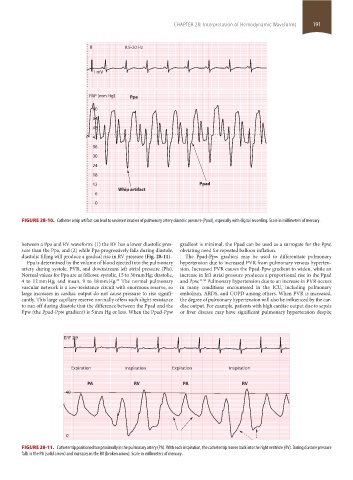
                    FIGURE 28-10.  Catheter whip artifact can lead to underestimation of pulmonary artery diastolic pressure (Ppad), especially with digital recording. Scale in millimeters of mercury.


                    between a Ppa and RV waveform: (1) the RV has a lower diastolic pres-  gradient is minimal, the Ppad can be used as a surrogate for the Ppw,
                    sure than the Ppa, and (2) while Ppa progressively falls during diastole,   obviating need for repeated balloon inflation.
                    diastolic filling will produce a gradual rise in RV pressure (Fig. 28-11).  The Ppad-Ppw gradient may be used to differentiate pulmonary
                     Ppa is determined by the volume of blood ejected into the pulmonary   hypertension due to increased PVR from pulmonary venous hyperten-
                    artery during systole, PVR, and downstream left atrial pressure (Pla).   sion. Increased PVR causes the Ppad-Ppw gradient to widen, while an
                    Normal values for Ppa are as follows: systolic, 15 to 30 mm Hg; diastolic,   increase in left atrial pressure produces a proportional rise in the Ppad
                    4 to 12 mm Hg; and mean, 9 to 18 mm Hg.  The normal pulmonary   and Ppw. 33,34  Pulmonary hypertension due to an increase in PVR occurs
                                                    29
                    vascular network is a low-resistance circuit with enormous reserve, so   in many conditions encountered in the ICU, including pulmonary
                    large increases in cardiac output do not cause pressure to rise signifi-  embolism, ARDS, and COPD among others. When PVR is increased,
                    cantly. This large capillary reserve normally offers such slight resistance   the degree of pulmonary hypertension will also be influenced by the car-
                    to run off during diastole that the difference between the Ppad and the   diac output. For example, patients with high cardiac output due to sepsis
                    Ppw (the Ppad-Ppw gradient) is 5 mm Hg or less. When the Ppad-Ppw   or liver disease may have significant pulmonary hypertension despite


                                  ERF 2.9


                                    Expiration         Inspiration     Expiration         Inspiration


                                          PA              RV               PA                  RV
                                   40


                                   0
                    FIGURE 28-11.  Catheter tip positioned too proximally in the pulmonary artery (PA). With each inspiration, the catheter tip moves back into the right ventricle (RV). During diastole pressure
                    falls in the PA (solid arrow) and increases in the RV (broken arrow). Scale in millimeters of mercury.


            section02.indd   191                                                                                       1/13/2015   2:05:32 PM

