


Page 286 - Hall et al (2015) Principles of Critical Care-McGraw-Hill
P. 286
190     PART 2: General Management of the Patient


                                        Pra
                                20
                                                     a   v
                                                       c


                                                           y
                                                       x
                                 0                              Inspiration

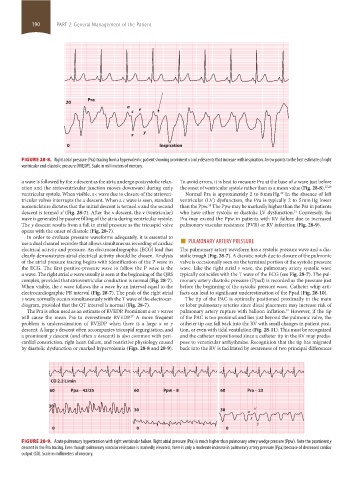
                 FIGURE 28-8.  Right atrial pressure (Pra) tracing from a hypervolemic patient showing prominent x and y descents that increase with inspiration. Arrow points to the best estimate of right
                 ventricular end-diastolic pressure (RVEDP). Scale in millimeters of mercury.

                 a wave is followed by the x descent as the atria undergo postsystolic relax-  To avoid errors, it is best to measure Pra at the base of a wave just before
                 ation and the atrioventricular junction moves downward during early     the onset of ventricular systole rather than as a mean value (Fig. 28-8). 27,28
                 ventricular systole. When visible, a c wave due to closure of the atrioven-  Normal Pra is approximately 2 to 8 mm Hg.  In the absence of left
                                                                                                         29
                 tricular valves interrupts the x descent. When a c wave is seen, standard   ventricular (LV) dysfunction, the Pra is typically 2 to 5 mm Hg lower
                 nomenclature dictates that the initial descent is termed x and the second   than the Ppw.  The Ppw may be markedly higher than the Pra in patients
                                                                                 30
                 descent is termed x’ (Fig. 28-7). After the x descent, the v (ventricular)   who have either systolic or diastolic LV dysfunction.  Conversely, the
                                                                                                              31
                 wave is generated by passive filling of the atria during ventricular systole.   Pra may exceed the Ppw in patients with RV failure due to increased
                 The y descent results from a fall in atrial pressure as the tricuspid valve   pulmonary vascular resistance (PVR) or RV infarction (Fig. 28-9).
                 opens with the onset of diastole (Fig. 28-7).
                 use a dual channel recorder that allows simultaneous recording of cardiac   ■  PULMONARY ARTERY PRESSURE
                   In order to evaluate pressure waveforms adequately, it is essential to
                 electrical activity and pressure. An electrocardiographic (ECG) lead that   The pulmonary artery waveform has a systolic pressure wave and a dia-
                 clearly demonstrates atrial electrical activity should be chosen. Analysis   stolic trough (Fig. 28-7). A dicrotic notch due to closure of the pulmonic
                 of the atrial pressure tracing begins with identification of the P wave in   valve is occasionally seen on the terminal portion of the systolic pressure
                 the ECG. The first positive-pressure wave to follow the P wave is the    wave. Like the right atrial v wave, the pulmonary artery systolic wave
                 a wave. The right atrial a wave usually is seen at the beginning of the QRS   typically coincides with the T wave of the ECG (see Fig. 28-7). The pul-
                 complex, provided that atrioventricular conduction is normal (Fig. 28-7).   monary artery diastolic pressure (Ppad) is recorded as the pressure just
                 When visible, the c wave follows the a wave by an interval equal to the   before the beginning of the systolic pressure wave. Catheter whip arti-
                 electrocardiographic PR interval (Fig. 28-7). The peak of the right atrial   facts can lead to significant underestimation of the Ppad (Fig. 28-10).
                 v wave normally occurs simultaneously with the T wave of the electrocar-  The tip of the PAC is optimally positioned proximally in the main
                 diogram, provided that the QT interval is normal (Fig. 28-7).  or lobar pulmonary arteries since distal placement may increase risk of
                   The Pra is often used as an estimate of RVEDP. Prominent a or v waves    pulmonary artery rupture with balloon inflation.  However, if the tip
                                                                                                           32
                 will cause the mean Pra to overestimate RVEDP.  A more frequent   of the PAC is too proximal and lies just beyond the pulmonic valve, the
                                                      27
                 problem is underestimation of RVEDP when there is a large  x or  y   catheter tip can fall back into the RV with small changes in patient posi-
                 descent. A large y descent often accompanies tricuspid regurgitation, and   tion, or even with tidal ventilation (Fig. 28-11). This must be recognized
                 a prominent y descent (and often x descent) is also common with peri-  and the catheter repositioned since a catheter tip in the RV may predis-
                 cardial constriction, right heart failure, and restrictive physiology caused    pose to ventricular arrhythmias. Recognition that the tip has migrated
                 by diastolic dysfunction or marked hypervolemia (Figs. 28-8 and 28-9).   back into the RV is facilitated by awareness of two principal differences


                           CO 2.2 L/min
                           60     Ppa   42/25           60        Ppw   8            60       Pra   23

                           30
                                                        30                           30       a  v
                                                                                               x
                                                                                                 y
                            0                           0                              0

                 FIGURE 28-9.  Acute pulmonary hypertension with right ventricular failure. Right atrial pressure (Pra) is much higher than pulmonary artery wedge pressure (Ppw). Note the prominent y
                 descent in the Pra tracing. Even though pulmonary vascular resistance is markedly elevated, there is only a moderate increase in pulmonary artery pressure (Ppa) because of decreased cardiac
                 output (CO). Scale in millimeters of mercury.


            section02.indd   190                                                                                       1/13/2015   2:05:31 PM

