


Page 297 - Hall et al (2015) Principles of Critical Care-McGraw-Hill
P. 297
CHAPTER 28: Interpretation of Hemodynamic Waveforms  201


                                          Pra
                                             40                             40  Pra
                                                     NSP           INSP
                                       mm Hg  20                            20

                                             0                               0
                                                          3 2


                                                      Cardiac output  L/min (delta)  1 0


                                                         −1
                                                                   +ve Resp    −ve Resp
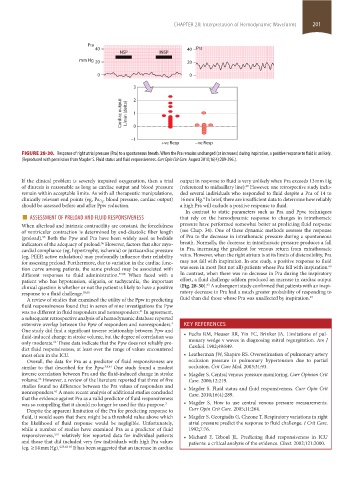
                    FIGURE 28-30.  Response of right atrial pressure (Pra) to a spontaneous breath. When the Pra remains unchanged (or increases) during inspiration, a positive response to fluid is unlikely.
                    (Reproduced with permission from Magder S. Fluid status and fluid responsiveness. Curr Opin Crit Care. August 2010;16(4):289-296.).


                    If the clinical problem is severely impaired oxygenation, then a trial   output in response to fluid is very unlikely when Pra exceeds 13 mm Hg
                    of diuresis is reasonable as long as cardiac output and blood pressure   (referenced to midaxillary line).  However, one retrospective study inclu-
                                                                                                60
                    remain within acceptable limits. As with all therapeutic manipulations,   ded several individuals who responded to fluid despite a Pra of 14 to
                                               , blood pressure, cardiac output)   16 mm Hg.  In brief, there are insufficient data to determine how reliably
                                                                                 4
                    clinically relevant end points (eg, Pa O 2
                    should be assessed before and after Ppw reduction.    a high Pra will exclude a positive response to fluid.
                        ■  ASSESSMENT OF PRELOAD AND FLUID RESPONSIVENESS  that  rely  on  the  hemodynamic  response  to  changes  in  intrathoracic
                                                                           In contrast to static parameters such as Pra and Ppw, techniques
                    When afterload and intrinsic contractility are constant, the forcefulness   pressure have performed somewhat better at predicting fluid response
                    of ventricular contraction is determined by end-diastolic fiber length   (see  Chap. 34). One of these dynamic methods assesses the response
                    (preload).  Both the Ppw and Pra have been widely used as bedside   of Pra to the decrease in intrathoracic pressure during a spontaneous
                           55
                    indicators of the adequacy of preload.  However, factors that alter myo-  breath. Normally, the decrease in intrathoracic pressure produces a fall
                                               56
                    cardial compliance (eg, hypertrophy, ischemia) or juxtacardiac pressure   in Pra, increasing the gradient for venous return from extrathoracic
                    (eg, PEEP, active exhalation) may profoundly influence their reliability   veins. However, when the right atrium is at its limits of distensibility, Pra
                    for assessing preload. Furthermore, due to variation in the cardiac func-  may not fall with inspiration. In one study, a positive response to fluid
                                                                                                                            63
                    tion curve among patients, the same preload may be associated with     was seen in most (but not all) patients whose Pra fell with inspiration.
                    different responses to fluid administration. 57,58  When faced with a   In contrast, when there was no decrease in Pra during the inspiratory
                    patient who has hypotension, oliguria, or tachycardia, the important   effort, a fluid challenge seldom produced an increase in cardiac output
                                                                                   63
                    clinical question is whether or not the patient is likely to have a positive   (Fig. 28-30).  A subsequent study confirmed that patients with an inspi-
                    response to a fluid challenge. 59,60                  ratory decrease in Pra had a much greater probability of responding to
                     A review of studies that examined the utility of the Ppw in predicting   fluid than did those whose Pra was unaffected by inspiration. 23
                    fluid responsiveness found that in seven of nine investigations the Ppw
                    was no different in fluid responders and nonresponders.  In agreement,
                                                            61
                    a subsequent retrospective analysis of a hemodynamic database reported
                    extensive overlap between the Ppw of responders and nonresponders.    KEY REFERENCES
                                                                       4
                    One study did find a significant inverse relationship between Ppw and
                    fluid-induced change in stroke volume, but the degree of correlation was     • Fuchs RM, Heuser RR, Yin FC, Brinker JA. Limitations of pul-
                                                                             monary wedge v waves in diagnosing mitral regurgitation. Am J
                    only moderate.  These data indicate that the Ppw does not reliably pre-
                              62
                    dict fluid responsiveness, at least over the range of values encountered   Cardiol. 1982;49:849.
                    most often in the ICU.                                    • Leatherman JW, Shapiro RS. Overestimation of pulmonary artery
                     Overall, the data for Pra as a predictor of fluid responsiveness are   occlusion pressure in pulmonary hypertension due to partial
                    similar to that described for the Ppw. 3,4,61  One study found a modest   occlusion. Crit Care Med. 2003;31:93.
                    inverse correlation between Pra and the fluid-induced change in stroke     • Magder S. Central venous pressure monitoring. Curr Opinion Crit
                    volume.  However, a review of the literature reported that three of five   Care. 2006;12:219.
                         62
                    studies found no difference between the Pra values of responders and     • Magder S. Fluid status and fluid responsiveness. Curr Opin Crit
                    nonresponders.  A more recent analysis of additional studies concluded   Care. 2010;16(4):289.
                               61
                    that the evidence against Pra as a valid predictor of fluid responsiveness
                    was so compelling that it should no longer be used for this purpose. 3    • Magder S. How to use central venous pressure measurements.
                     Despite the apparent limitation of the Pra for predicting response to   Curr Opin Crit Care. 2005;11:264.
                    fluid, it would seem that there might be a threshold value above which     • Magder S, Georgiadis G, Cheone T. Respiratory variations in right
                    the likelihood of fluid response would be negligible. Unfortunately,   atrial pressure predict the response to fluid challenge. J Crit Care.
                    while  a number  of studies have examined Pra as  a predictor  of fluid   1992;7:76.
                    responsiveness,   relatively  few  reported  data  for  individual  patients     • Michard  F,  Teboul  JL.  Predicting  fluid  responsiveness  in  ICU
                               3,61
                    and those that did included very few individuals with high Pra values   patients: a critical analysis of the evidence. Chest. 2002;121:2000.
                    (eg, ≥14 mm Hg). 4,23,62-65  It has been suggested that an increase in cardiac


            section02.indd   201                                                                                       1/13/2015   2:05:44 PM

