


Page 296 - Hall et al (2015) Principles of Critical Care-McGraw-Hill
P. 296
200     PART 2: General Management of the Patient


                                        A                      B
                                                                                   P


                                                               P         P                   P


                                               1 s                    1 s       PVC


                                        RA                     RA


                                                                 –25–
                                         F  F  F  F  F  F  F  F


                                                                                     Cannon
                                                                 –0–
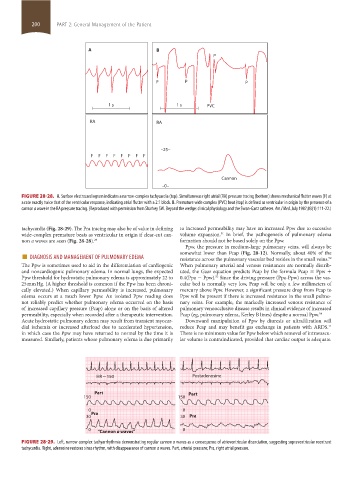
                 FIGURE 28-28.  A. Surface electrocardiogram indicates a narrow-complex tachycardia (top). Simultaneous right atrial (RA) pressure tracing (bottom) shows mechanical flutter waves (F) at
                 a rate exactly twice that of the ventricular response, indicating atrial flutter with a 2:1 block. B. Premature wide complex (PVC) beat (top) is defined as ventricular in origin by the presence of a
                 cannon a wave in the RA pressure tracing. (Reproduced with permission from Sharkey SW. Beyond the wedge: clinical physiology and the Swan-Ganz catheter. Am J Med. July 1987;83(1):111-22.)


                 tachycardia (Fig. 28-29). The Pra tracing may also be of value in defining   to increased permeability may have an increased Ppw due to excessive
                 wide-complex premature beats as ventricular in origin if clear-cut can-  volume expansion.  In brief, the pathogenesis of pulmonary edema
                                                                                     51
                 non a waves are seen (Fig. 28-28). 29                 formation should not be based solely on the Ppw.
                                                                         Ppw, the pressure in medium-large pulmonary veins, will always be
                     ■  DIAGNOSIS AND MANAGEMENT OF PULMONARY EDEMA    somewhat lower than Pcap (Fig. 28-12). Normally, about 40% of the
                                                                       resistance across the pulmonary vascular bed resides in the small veins.
                                                                                                                          52
                 The Ppw is sometimes used to aid in the differentiation of cardiogenic   When pulmonary arterial and venous resistances are normally distrib-
                 and noncardiogenic pulmonary edema. In normal lungs, the expected   uted, the Gaar equation predicts Pcap by the formula Pcap = Ppw +
                 Ppw threshold for hydrostatic pulmonary edema is approximately 22 to   0.4(Ppa − Ppw).  Since the driving pressure (Ppa-Ppw) across the vas-
                                                                                   53
                 25 mm Hg. (A higher threshold is common if the Ppw has been chroni-  cular bed is normally very low, Pcap will be only a few millimeters of
                 cally elevated.) When capillary permeability is increased, pulmonary     mercury above Ppw. However, a significant pressure drop from Pcap to
                 edema occurs at a much lower Ppw. An isolated Ppw reading does   Ppw will be present if there is increased resistance in the small pulmo-
                 not reliably predict whether pulmonary edema occurred on the basis   nary veins. For example, the markedly increased venous resistance of
                 of increased capillary pressure (Pcap) alone or on the basis of altered   pulmonary venoocclusive disease results in clinical evidence of increased
                 permeability, especially when recorded after a therapeutic intervention.   Pcap (eg, pulmonary edema, Kerley B lines) despite a normal Ppw. 54
                 Acute hydrostatic pulmonary edema may result from transient myocar-  Downward manipulation of Ppw by diuresis or ultrafiltration will
                 dial ischemia or increased afterload due to accelerated hypertension,   reduce Pcap and may benefit gas exchange in patients with ARDS.
                                                                                                                          11
                 in which case the Ppw may have returned to normal by the time it is   There is no minimum value for Ppw below which removal of intravascu-
                 measured. Similarly, patients whose pulmonary edema is due primarily   lar volume is contraindicated, provided that cardiac output is adequate.


                                           HR ~ 150                        Postadenosine


                                          Part                            Part
                                      150                              150
                                        0                               0
                                       30 Pra                          30  Pra
                                        0  “Cannon a waves”             0

                 FIGURE 28-29.  Left, narrow complex tachyarrhythmia demonstrating regular cannon a waves as a consequence of atrioventricular dissociation, suggesting supraventricular reentrant
                 tachycardia. Right, adenosine restores sinus rhythm, with disappearance of cannon a waves. Part, arterial pressure; Pra, right atrial pressure.


            section02.indd   200                                                                                       1/13/2015   2:05:43 PM

