


Page 292 - Hall et al (2015) Principles of Critical Care-McGraw-Hill
P. 292
196     PART 2: General Management of the Patient


                                           30
                                                  CVP


                                           15


                                         mm Hg  0                      Expiration
                                          30
                                                  IAP

                                          15


                                           0

                                         30
                                             CVP
                                         15


                                        mm Hg  30 0
                                             IAP

                                         15
                                                     Inspiration           Expiration
                                         0

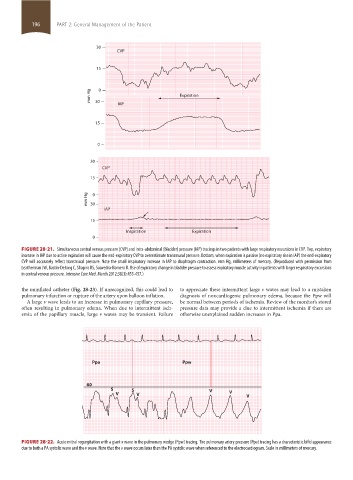
                 FIGURE 28-21.  Simultaneous central venous pressure (CVP) and intra-abdominal (bladder) pressure (IAP) tracings in two patients with large respiratory excursions in CVP. Top, expiratory
                 increase in IAP due to active expiration will cause the end-expiratory CVP to overestimate transmural pressure. Bottom, when expiration is passive (no expiratory rise in IAP) the end-expiratory
                 CVP will accurately reflect transmural pressure. Note the small inspiratory increase in IAP to diaphragm contraction. mm Hg, millimeters of mercury. (Reproduced with permission from
                 Leatherman JW, Bastin-DeJong C, Shapiro RS, Saavedra-Romero R. Use of expiratory change in bladder pressure to assess expiratory muscle activity in patients with larger respiratory excursions
                 in central venous pressure. Intensive Care Med. March 2012;38(3):453-457.)

                 the uninflated catheter (Fig. 28-23). If unrecognized, this could lead to   to appreciate these intermittent large v waves may lead to a mistaken
                 pulmonary infarction or rupture of the artery upon balloon inflation.  diagnosis of noncardiogenic pulmonary edema, because the Ppw will
                   A large v wave leads to an increase in pulmonary capillary pressure,   be normal between periods of ischemia. Review of the monitor’s stored
                 often resulting in pulmonary edema. When due to intermittent isch-  pressure data may provide a clue to intermittent ischemia if there are
                 emia  of  the papillary  muscle, large  v  waves may  be  transient.  Failure   otherwise unexplained sudden increases in Ppa.


                                         Ppa                            Ppw


                                       60
                                                S      S                         V
                                                 V      V                               V     V


                 FIGURE 28-22.  Acute mitral regurgitation with a giant v wave in the pulmonary wedge (Ppw) tracing. The pulmonary artery pressure (Ppa) tracing has a characteristic bifid appearance
                 due to both a PA systolic wave and the v wave. Note that the v wave occurs later than the PA systolic wave when referenced to the electrocardiogram. Scale in millimeters of mercury.


            section02.indd   196                                                                                       1/13/2015   2:05:38 PM

