


Page 294 - Hall et al (2015) Principles of Critical Care-McGraw-Hill
P. 294
198     PART 2: General Management of the Patient


                                         II         0.5-40 Hz

                                         1 mV


                                         30     Ppw
                                         24
                                         18
                                         12
                                          6
                                          0


                                                                            AO
                                                                  LA


                                                                             LV


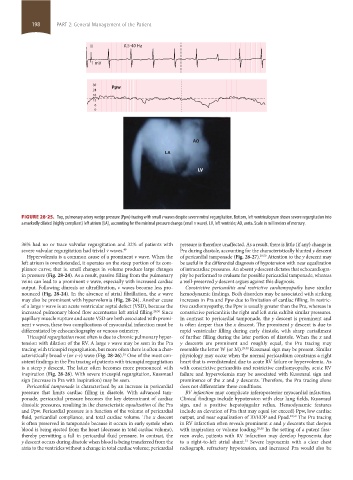
                 FIGURE 28-25.  Top, pulmonary artery wedge pressure (Ppw) tracing with small v waves despite severe mitral regurgitation. Bottom, left ventriculogram shows severe regurgitation into
                 a markedly dilated (highly compliant) left atrium (LA), accounting for the minimal pressure change (small v wave). LV, left ventricle; AO, aorta. Scale in millimeters of mercury.


                 36%  had  no  or  trace  valvular  regurgitation  and  32%  of  patients  with   pressure is therefore unaffected. As a result, there is little (if any) change in
                 severe valvular regurgitation had trivial v waves. 49  Pra during diastole, accounting for the characteristically blunted y descent
                   Hypervolemia is a common cause of a prominent v wave. When the   of pericardial tamponade (Fig. 28-27). 29,50  Attention to the y descent may
                 left atrium is overdistended, it operates on the steep portion of its com-  be useful in the differential diagnosis of hypotension with near equalization
                 pliance curve; that is. small changes in volume produce large changes   of intracardiac pressures. An absent y descent dictates that echocardiogra-
                 in pressure (Fig. 28-24). As a result, passive filling from the pulmonary   phy be performed to evaluate for possible pericardial tamponade, whereas
                 veins can lead to a prominent v wave, especially with increased cardiac   a well-preserved y descent argues against this diagnosis.
                 output. Following diuresis or ultrafiltration, v waves become less pro-  Constrictive pericarditis and restrictive cardiomyopathy have similar
                 nounced (Fig. 28-24). In the absence of atrial fibrillation, the a wave   hemodynamic findings. Both disorders may be associated with striking
                 may also be prominent with hypervolemia (Fig. 28-24). Another cause   increases in Pra and Ppw due to limitation of cardiac filling. In restric-
                 of a large v wave is an acute ventricular septal defect (VSD), because the   tive cardiomyopathy, the Ppw is usually greater than the Pra, whereas in
                 increased pulmonary blood flow accentuates left atrial filling. 29,50  Since   constrictive pericarditis the right and left atria exhibit similar pressures.
                 papillary muscle rupture and acute VSD are both associated with promi-  In contrast to pericardial tamponade, the y descent is prominent and
                 nent v waves, these two complications of myocardial infarction must be   is often deeper than the x descent. The prominent y descent is due to
                 differentiated by echocardiography or venous oximetry.  rapid ventricular filling during early diastole, with sharp curtailment
                   Tricuspid regurgitation most often is due to chronic pulmonary hyper-  of further filling during the later portion of diastole. When the x and
                 tension with dilation of the RV. A large v wave may be seen in the Pra   y descents are prominent and roughly equal, the Pra tracing may
                 tracing with tricuspid regurgitation, but more often there is often a char-  resemble the letter W (or M). 29,50  Kussmaul sign may be present. Similar
                 acteristically broad v (or c-v) wave (Fig. 28-26).  One of the most con-  physiology may occur when the normal pericardium constrains a right
                                                    29
                 sistent findings in the Pra tracing of patients with tricuspid regurgitation   heart that is overdistended due to acute RV failure or hypervolemia. As
                 is a steep y descent. The latter often becomes more pronounced with   with constrictive pericarditis and restrictive cardiomyopathy, acute RV
                 inspiration (Fig. 28-26). With severe tricuspid regurgitation, Kussmaul   failure and hypervolemia may be associated with Kussmaul sign and
                 sign (increase in Pra with inspiration) may be seen.  prominence of the x and y descents. Therefore, the Pra tracing alone
                   Pericardial tamponade is characterized by an increase in pericardial   does not differentiate these conditions.
                 pressure that limits cardiac filling in diastole. With advanced tam-  RV infarction may complicate inferoposterior myocardial infarction.
                 ponade, pericardial pressure becomes the key determinant of cardiac     Clinical findings include hypotension with clear lung fields, Kussmaul
                 diastolic pressures, resulting in the characteristic equalization of the Pra   sign, and a positive hepatojugular reflux. Hemodynamic features
                 and Ppw. Pericardial pressure is a function of the volume of pericardial   include an elevation of Pra that may equal (or exceed) Ppw, low cardiac
                 fluid, pericardial compliance, and total cardiac volume. The  x descent   output, and near equalization of RVEDP and Ppad. 29,50  The Pra tracing
                 is often preserved in tamponade because it occurs in early systole when   in RV infarction often reveals prominent x and y descents that deepen
                 blood is being ejected from the heart (decrease in total cardiac volume),   with inspiration or volume loading. 29,50  In the setting of a patent fora-
                 thereby permitting a fall in pericardial fluid pressure. In contrast, the     men ovale, patients with RV infarction may develop hypoxemia due
                 y descent occurs during diastole when blood is being transferred from the   to a right-to-left atrial shunt.  Severe hypoxemia with a clear chest
                                                                                             51
                 atria to the ventricles without a change in total cardiac volume; pericardial   radiograph, refractory hypotension, and increased Pra would also be


            section02.indd   198                                                                                       1/13/2015   2:05:41 PM

