


Page 419 - Hall et al (2015) Principles of Critical Care-McGraw-Hill
P. 419
CHAPTER 36: Cardiac Arrhythmias, Pacing, Cardioversion, and Defibrillation in the Critical Care Setting  289


                    Supraventricular Tachycardia:  The therapeutic approach to the manage-    TABLE 36-9    Indications for Cardiac Pacing
                    ment of SVT is illustrated in Figure 36-7. 16,26  Vagal maneuvers (carotid
                    sinus massage or Valsalva maneuver) may terminate AV node reentry or   Acquired AV Block
                    reciprocating tachycardia involving a bypass tract. Adenosine is the initial     Class I  Symptomatic permanent or intermittent AV block
                    drug of choice for regular narrow complex SVT although  β-blockers,      Symptomatic second degree AV block
                    verapamil, and diltiazem are also effective. Oral  antiarrhythmic drug
                    therapy may be required to prevent recurrent SVT (Table 36-4). Infre-    Atrial flutter or fibrillation with advanced symptomatic
                    quently, synchronized electrical cardioversion may be required. Catheter   AV block
                    ablation is an effective cure for AV node reentrant tachycardias, acces-    Class II  Asymptomatic complete AV block with ventricular rate
                    sory pathways or atrial tachycardias.  Multifocal atrial tachycardias may   <40 bpm
                                              58
                    be difficult to suppress or to achieve rate control pharmacologically and   Asymptomatic type II second degree AV block
                    then main goal is treatment of the underlying condition (such as COPD).
                    Implantation of a ventricular pacemaker followed by a total AV junction   Post Myocardial Infarction
                    ablation is may be an effective treatment option, for atrial tachycardias     Class I  Persistent complete heart block
                    unresponsive to pharmacologic treatment. 54                              Persistent type II second-degree AV block
                                                                            Class II         Newly acquired BBB with transient high grade AV or
                    BRADYARRHYTHMIAS                                                         complete heart block
                    Disorders of impulse formation or conduction may cause bradyarrhyth-     Newly acquired BBB with first degree AV block
                    mias. Sinus node dysfunction characterized by sinus bradycardia, sino-   Newly acquired bifascicular BBB
                    atrial exit block and/or sinus arrest causing symptomatic bradycardia is   Chronic Bifascicular Block
                    the most common indication for permanent cardiac pacing.  AV block,
                                                               59
                    either permanent or intermittent is the second most common cause for     Class I  Symptomatic patients with fascicular block and inter-
                    permanent cardiac pacing.                                                mittent high grade AV or complete heart block
                        ■  EVALUATION OF THE PATIENT WITH BRADYARRHYTHMIAS                   Symptomatic patients with bifascicular block and HV
                                                                                             interval prolongation (>100 ms) or block distal to the His
                    The initial evaluation of the patient with a documented bradyarrhythmia   bundle at rates <100 bpm
                    should include a thorough history (if the patient is able to communicate) and     Class II  Symptomatic with bifascicular block and no identifiable
                    physical examination with a focus on detecting structural heart disease. A   cause of syncope
                    12-lead ECG and rhythm strips documenting the bradyarrhythmia should     Asymptomatic with bifascicular block and intermittent
                    be reviewed. If clinically appropriate, such as an elderly patient with syn-  type II second degree AV block
                    cope, carotid sinus massage should be performed to look for carotid sinus
                    hypersensitivity unless contraindicated, that is, carotid bruits or prior stroke.   Sinus Node Dysfunction
                    Cardiac hemodynamic data during the arrhythmia, if available, should      Class I  Sinus node dysfunction with symptoms of bradycardia
                    be reviewed. Any drugs likely contributing to the bradyarrhythmia        with or without required drug therapy
                    should be identified and drug levels determined if appropriate (eg, digi-  Symptomatic sinus bradycardia
                    talis). Laboratory tests should include cardiac enzymes (CK or troponin).
                    An echocardiogram should be performed to determine the presence of       Symptomatic chronotropic incompetence
                    structural heart disease and to assess ventricular function.    Class II  Sinus bradycardia <40-50 bpm or asystole >3 seconds
                        ■  GENERAL PRINCIPLES OF TREATMENT                                   and  suggested symptoms not documented to be due to
                                                                                             bradycardia
                    In the ICU patient with hemodynamically significant persistent brady-  Hypersensitive Carotid Sinus
                    cardia, transcutaneous pacing should be commenced until a temporary   Class I  Recurrent syncope and asystole or heart block >3 sec-
                    pacemaker can be inserted. Placement of a transvenous electrode cathe-   onds during carotid sinus massage or clear-cut clinical
                    ter can usually be accomplished at the bedside via the internal jugular or   situation suggestive of a vasoinhibitory response
                    subclavian route using a flotation pacing catheter. Fluoroscopy may be   Class II  Recurrent syncope without clear clinical setting but
                    required for positioning the pacing electrode if adequate pacing thresh-  abnormal response to carotid sinus massage
                    olds cannot be achieved. If the bradyarrhythmia is transient, temporary
                    pacing may not be required and the risk/benefit of this intervention   AV, atrioventricular; BBB, bundle branch block.
                    needs to be considered. Any reversible causes should be identified and   Class I: condition where there is general consensus that a pacing system is indicated.
                    corrected. Drugs contributing to bradycardia should be discontinued.   Class II: condition where there is consensus that a pacing system might be beneficial.
                    Second-degree AV block or complete heart block  following an inferior   See reference 59.
                    myocardial infarction may not be persistent. If the bradyarrhythmia
                    does not resolve, permanent cardiac pacing may be required. The indi-
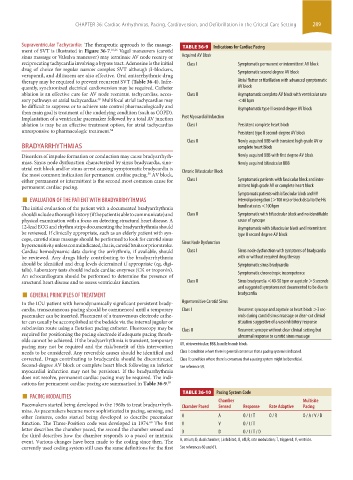
                    cations for permanent cardiac pacing are summarized in Table 36-9. 59
                        ■  PACING MODALITIES                                TABLE 36-10    Pacing System Code

                    Pacemakers started being developed in the 1960s to treat bradyarrhyth-  Chamber Paced  Chamber   Response  Rate Adaptive  Multisite
                                                                                       Sensed
                                                                                                                   Pacing
                    mias. As pacemakers became more sophisticated in pacing, sensing, and
                    other features, codes started being developed to describe pacemaker   A  A  O / I / T  O / R   O / A / V / D
                    function. The Three-Position code was developed in 1974.  The first   V  V  O / I / T
                                                               60
                    letter describes the chamber paced, the second the chamber sensed and   D  D  O / I / T / D
                    the third describes how the chamber responds to a paced or intrinsic
                    event. Various changes have been made to the coding since then. The   A, atrium; D, dual chamber; I, inhibited; O, off; R, rate modulation; T, triggered; V, ventricle.
                    currently used coding system still uses the same definitions for the first    See references 60 and 61.


            section03.indd   289                                                                                       1/23/2015   2:07:14 PM

