


Page 435 - Hall et al (2015) Principles of Critical Care-McGraw-Hill
P. 435
CHAPTER 37: Myocardial Ischemia  305


                                                                   UA/NSTEMI
                                                         ASA 325 mg, ECG, cardiac biomarkers
                                                                                   hemodynamic or electrical instability
                                                                                   ECG, cardiac biomarkers
                                                                 Risk stratification  ongoing or recurrent chest pain
                                                                                   cardiac risk factors


                                                          Low       Medium      High

                                      No or few cardiac risk factors,  At least 2 cardiac risk factors  Several cardiac risk factors,
                                        CP atypical or resolved                     ongoing CP, dynamic ECG
                                       biomarkers/ECG normal  non-specific ECG changes  changes, ↑cardiac biomarkers


                                        Discharge, asa    β-blocker, UFH or enoxaparin  β-blocker, UFH or enoxaparin
                                          β-blocker        LD clopidogrel or prasugrel  LD clopidogrel or prasugrel
                                      outpatient stress test
                                                           Trop -       Trop +
                                                          CP resolved  recurrent CP    Cardiac catheterization
                                                                                       +/- upstream GP IIb/IIIa
                                                                                           antagonist
                                       No refractory CP  48 hr observation  + Refractory CP
                                      Non-invasive evaluation


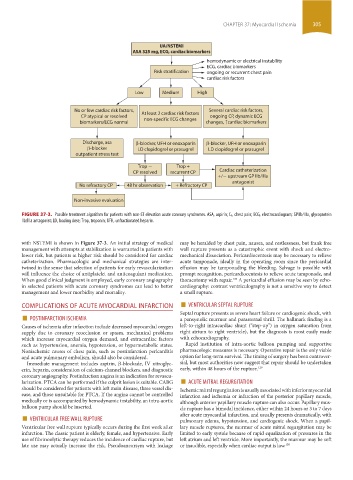
                    FIGURE 37-3.  Possible treatment algorithm for patients with non-ST elevation acute coronary syndromes. ASA, aspirin; C P, chest pain; ECG, electrocardiogram; GPIIb/IIIa, glycoprotein
                    IIb/IIIa antagonist; LD, loading dose; Trop, troponin; UFH, unfractionated heparin.


                    with NSTEMI is shown in Figure 37-3. An initial strategy of medical   may be heralded by chest pain, nausea, and restlessness, but frank free
                    management with attempts at stabilization is warranted in patients with   wall  rupture  presents  as  a  catastrophic  event  with  shock  and  electro-
                    lower risk, but patients at higher risk should be considered for cardiac   mechanical dissociation. Pericardiocentesis may be necessary to relieve
                    catheterization. Pharmacologic and mechanical strategies are inter-  acute  tamponade,  ideally  in  the  operating  room  since  the  pericardial
                    twined in the sense that selection of patients for early revascularization   effusion may be tamponading the bleeding. Salvage is possible with
                    will influence the choice of antiplatelet and anticoagulant medication.   prompt recognition, pericardiocentesis to relieve acute tamponade, and
                    When good clinical judgment is employed, early coronary angiography   thoracotomy with repair.  A pericardial effusion may be seen by echo-
                                                                                            128
                    in selected patients with acute coronary syndromes can lead to better   cardiography: contrast ventriculography is not a sensitive way to detect
                    management and lower morbidity and mortality.         a small rupture.
                    COMPLICATIONS OF ACUTE MYOCARDIAL INFARCTION  ■         VENTRICULAR SEPTAL RUPTURE

                        ■  POSTINFARCTION ISCHEMIA                        Septal rupture presents as severe heart failure or cardiogenic shock, with
                                                                          a pansystolic murmur and parasternal thrill. The hallmark finding is a
                    Causes of ischemia after infarction include decreased myocardial oxygen    left-to-right intracardiac shunt (“step-up”) in oxygen saturation from
                    supply due to coronary reocclusion or spasm, mechanical problems   right atrium to right ventricle), but the diagnosis is most easily made
                    which increase myocardial oxygen demand, and extracardiac factors   with echocardiography.
                    such as hypertension, anemia, hypotension, or hypermetabolic states.   Rapid  institution of  intra-aortic balloon pumping  and supportive
                    Nonischemic causes of chest pain, such as postinfarction pericarditis   pharmacologic measures is necessary. Operative repair is the only viable
                    and acute pulmonary embolism, should also be considered.  option for long-term survival. The timing of surgery has been controver-
                     Immediate  management  includes  aspirin,  β-blockade,  IV  nitroglyc-  sial, but most authorities now suggest that repair should be undertaken
                    erin, heparin, consideration of calcium-channel blockers, and diagnostic   early, within 48 hours of the rupture. 129
                    coronary angiography. Postinfarction angina is an indication for revascu-    ■
                    larization. PTCA can be performed if the culprit lesion is suitable. CABG   ACUTE MITRAL REGURGITATION
                    should be considered for patients with left main disease, three vessel dis-  Ischemic mitral regurgitation is usually associated with inferior  myocardial
                    ease, and those unsuitable for PTCA. If the angina cannot be controlled   infarction and ischemia or infarction of the posterior papillary muscle,
                    medically or is accompanied by hemodynamic instability, an intra-aortic   although anterior papillary muscle rupture can also occur. Papillary mus-
                    balloon pump should be inserted.                      cle rupture has a bimodal incidence, either within 24 hours or 3 to 7 days
                        ■  VENTRICULAR FREE WALL RUPTURE                  after acute myocardial infarction, and usually presents dramatically, with
                                                                          pulmonary edema, hypotension, and cardiogenic shock. When a papil-
                    Ventricular free wall rupture typically occurs during the first week after   lary muscle ruptures, the murmur of acute mitral regurgitation may be
                    infarction. The classic patient is elderly, female, and hypertensive. Early   limited to early systole because of rapid equalization of pressures in the
                    use of fibrinoolytic therapy reduces the incidence of cardiac rupture, but   left atrium and left ventricle. More importantly, the murmur may be soft
                    late use may actually increase the risk. Pseudoaneursym with leakage   or inaudible, especially when cardiac output is low. 130


            section03.indd   305                                                                                       1/23/2015   2:07:22 PM

