


Page 436 - Hall et al (2015) Principles of Critical Care-McGraw-Hill
P. 436
306     PART 3: Cardiovascular Disorders


                   Echocardiography is extremely useful in the differential diagnosis,       Myocardial dysfunction
                 which includes free wall rupture, ventricular septal rupture, and infarct
                 extension with pump failure. Hemodynamic monitoring with pulmo-           Systolic        Diastolic
                 nary artery catheterization may also be helpful. Management includes
                 afterload reduction with nitroprusside and intra-aortic balloon pumping               ↑ LVEDP
                 as temporizing measures. Inotropic or vasopressor therapy may also be   ↓ Cardiac output  Pulmonary congestion
                 needed to support cardiac output and blood pressure. Definitive therapy,   ↓ Stroke volume
                 however, is surgical valve repair or replacement, which should be under-
                 taken as soon as possible since clinical deterioration can be sudden. 130-132  ↓ Systemic  Hypotension
                     ■  RIGHT VENTRICULAR INFARCTION                   perfusion      ↓ Coronary  Hypoxemia

                 Right ventricular infarction occurs in up to 30% of patients with infe-  perfusion
                 rior infarction and is clinically significant in 10%.  The combination   pressure
                                                      133
                 of a clear chest x-ray with jugular venous distention in a patient with   Compensatory
                 an inferior wall MI should lead to the suspicion of a coexisting right   vasoconstriction;  Ischemia
                 ventricular infarct. The diagnosis is substantiated by demonstration   Fluid retention         Progressive
                 of  ST  segment  elevation  in the  right  precordial  leads  (V   to  V )  or                 myocardial
                                                                 5R
                                                           3R
                 by characteristic hemodynamic findings on right heart catheterization                          dysfunction
                 (elevated right atrial and right ventricular end-diastolic pressures with
                 normal  to  low pulmonary  artery  occlusion  pressure  and low  cardiac                         Death
                 output). Echocardiography can demonstrate depressed right ventricu-
                 lar contractility.  Patients with cardiogenic shock on the basis of right   FIGURE 37-4.  The “downward spiral” in cardiogenic shock. Stroke volume and cardiac
                             18
                 ventricular infarction have a better prognosis than those with left-sided   output fall with left ventricular (LV) dysfunction, producing hypotension and tachycardia that
                 pump failure.  This may be due in part to the fact that right ventricular   reduce coronary blood flow. Increasing ventricular diastolic pressure reduces coronary blood
                           133
                 function tends to return to normal over time with supportive therapy,    flow, and increased wall stress elevates myocardial oxygen requirements. All of these factors
                                                                   134
                 although such therapy may need to be prolonged.       combine to worsen ischemia. The falling cardiac output also compromises systemic perfusion.
                   In patients with right ventricular infarction, right ventricular preload   Compensatory mechanisms include sympathetic stimulation and fluid retention to increase
                 should be maintained with fluid administration. In some cases, however,   preload. These mechanisms can actually worsen cardiogenic shock by increasing myocardial
                 fluid resuscitation may increase pulmonary capillary occlusion pres-  oxygen demand and afterload. Thus, a vicious circle can be established. LVEDP, left ventricular
                 sure but may not increase cardiac output, and overdilation of the right   end-diastolic pressure. Adapted with permission from Hollenberg SM, Kavinsky CJ, Parrillo JE.
                 ventricle can compromise left ventricular filling and cardiac output.    Cardiogenic shock. Ann Intern Med. July 6, 1999;131(1):47-59.
                                                                   134
                 Inotropic therapy with dobutamine may be more effective in increasing
                 cardiac output in some patients, and monitoring with serial echocardio-
                 grams may also be useful to detect right ventricular overdistention.    Initial Management:  Maintenance of adequate oxygenation and venti-
                                                                   134
                 Maintenance of atrioventricular synchrony is also important in these   lation are critical. Many patients require intubation and mechanical
                 patients to optimize right ventricular filling.  For patients with continued   ventilation, if only to reduce the work of breathing and facilitate
                                                18
                 hemodynamic instability, intra-aortic balloon pumping may be useful,   sedation and stabilization before cardiac catheterization. Electrolyte
                 particularly because elevated right ventricular pressures and volumes   abnormalities should be corrected, and morphine (or fentanyl if
                 increase wall stress and oxygen consumption and decrease right coronary   systolic pressure is compromised) used to relieve pain and anxiety,
                 perfusion pressure, exacerbating right ventricular ischemia.  thus reducing excessive sympathetic activity and decreasing oxygen
                   Reperfusion of the occluded coronary artery is also crucial. A study   demand,  preload,  and  afterload.  Arrhythmias  and  heart  block  may
                 using direct angioplasty demonstrated that restoration of normal flow   have major effects on cardiac output, and should be corrected
                 resulted in dramatic recovery of right ventricular function and a mor-  promptly with antiarrhythmic drugs, cardioversion, and/or pacing.
                 tality rate of only 2%, whereas unsuccessful reperfusion was associated   The  initial  approach  to  the  hypotensive  patient  should  include
                 with persistent hemodynamic compromise and a mortality of 58%. 135  careful  fluid  resuscitation  unless  frank  pulmonary  edema  is  present.
                                                                       Patients are commonly diaphoretic and relative hypovolemia may be
                     ■  CARDIOGENIC SHOCK                              present in as many as 20% of patients with cardiogenic shock. Fluid
                                                                       infusion is best initiated with boluses (usually 250-500 cc) titrated
                 Epidemiology and Pathophysiology:  Cardiogenic shock, resulting either   to clinical end points of heart rate, urine output and blood pressure.
                 from left ventricular pump failure or from mechanical complications,   Ischemia produces diastolic as well as systolic dysfunction, and thus
                 represents the leading cause of in-hospital death after myocardial   elevated  filling  pressures  may  be  necessary  to  maintain  stroke  vol-
                 infarction.  Despite advances in management of heart failure and   ume in patients with cardiogenic shock. Patients who do not respond
                         13
                 acute myocardial infarction, until very recently, clinical outcomes in   rapidly to initial fluid boluses or those with poor physiologic reserve
                 patients with cardiogenic shock have been frustratingly poor, with   should be considered for invasive hemodynamic monitoring. Optimal
                                                         136
                 reported mortality rates ranging from 50% to 80%.  Patients may   filling pressures vary from patient to patient; hemodynamic monitor-
                 have cardiogenic shock at initial presentation, but shock often evolves   ing can be used to construct a Starling curve at the bedside, identifying
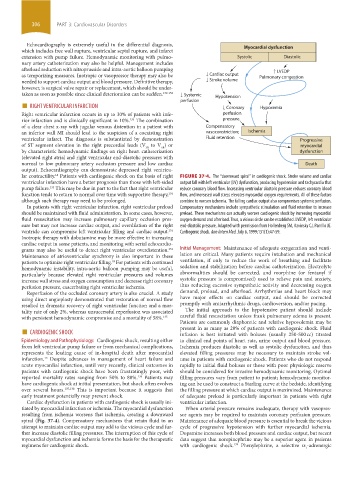
                 over several hours. 137,138  This is important because it suggests that   the filling pressure at which cardiac output is maximized. Maintenance
                 early treatment potentially may prevent shock.        of adequate preload is particularly important in patients with right
                   Cardiac dysfunction in patients with cardiogenic shock is usually ini-  ventricular infarction.
                 tiated by myocardial infarction or ischemia. The myocardial dysfunction   When arterial pressure remains inadequate, therapy with vasopres-
                 resulting from ischemia worsens that ischemia, creating a downward   sor agents may be required to maintain coronary perfusion pressure.
                 spiral (Fig. 37-4). Compensatory mechanisms that retain fluid in an   Maintenance of adequate blood pressure is essential to break the vicious
                 attempt to maintain cardiac output may add to the vicious cycle and fur-  cycle of progressive hypotension with further myocardial ischemia.
                 ther increase diastolic filling pressures. The interruption of this cycle of   Dopamine increases both blood pressure and cardiac output, but recent
                 myocardial dysfunction and ischemia forms the basis for the therapeutic   data suggest that norepinephrine may be a superior agent in patients
                 regimens for cardiogenic shock.                       with cardiogenic shock.  Phenylephrine, a selective  α -adrenergic
                                                                                         139
                                                                                                                  1


            section03.indd   306                                                                                       1/23/2015   2:07:23 PM

