


Page 438 - Hall et al (2015) Principles of Critical Care-McGraw-Hill
P. 438
308     PART 3: Cardiovascular Disorders


                   TABLE 37-5     Indications for Temporary Transvenous Pacing in Acute   infarction: randomised placebo-controlled trial.  Lancet. 2005;
                             Myocardial Infarction                        366:1622-1632.
                  Class I                                                  • Drakos SG, Uriel N. Spotlight on cardiogenic shock therapies in
                  Asystole                                                the era of mechanical circulatory support.  Curr Opin Cardiol.
                                                                          2014;29:241-243.
                  Complete heart block
                                                                           • Fraker TD Jr, Fihn SD, Gibbons RJ, et al. 2007 chronic angina
                  Mobitz type II second-degree heart block                focused update of the ACC/AHA 2002 Guidelines for the man-
                  Bilateral bundle branch block (alternating BBB or RBBB with alternating LAFB/LPHB)  agement of patients with chronic stable angina: a report of the
                  New bifascicular block (RBBB with LAFB or LPHB, or LBBB) with first-degree AV block  American College of Cardiology/American Heart Association
                                                                          Task Force on Practice Guidelines Writing Group to develop the
                  Symptomatic bradycardia
                                                                          focused update of the 2002 Guidelines for the management of
                  Class IIa                                               patients with chronic stable angina. Circulation. 2007;116:2762-2772.
                  New bifascicular block                                   • Hochman JS, Sleeper LA, White HD, et al. One-year survival
                  RBBB with first-degree AV block                         following early revascularization for cardiogenic shock.  JAMA.
                                                                          2001;285:190-192.
                  Incessant V T, for atrial or ventricular overdrive pacing
                                                                           • Hollenberg SM. Recognition and treatment of cardiogenic shock.
                  Recurrent sinus pauses (>3 seconds) not responsive to atropine
                                                                          Semin Respir Crit Care Med. 2004;25:661-671.
                  New LBBB a
                                                                           • Jaffe AS, Babuin L, Apple FS. Biomarkers in acute cardiac disease:
                  Class IIb                                               the present and the future. J Am Coll Cardiol. 2006;48:1-11.
                  Bifascicular block of indeterminate age                  • Keeley EC, Boura JA, Grines CL. Primary angioplasty versus
                  New isolated RBBB                                       intravenous thrombolytic therapy for acute myocardial infarc-
                                                                          tion: a quantitative review of 23 randomised trials.  Lancet.
                  Class III
                                                                          2003;361:13-20.
                  First-degree AV block
                                                                           • Kushner FG, Hand M, Smith SC Jr, et al. 2009 Focused Updates:
                  Type I second-degree AV block                           ACC/AHA Guidelines for the Management of Patients With
                  Accelerated idioventricular rhythm                      ST-Elevation Myocardial Infarction (Updating the 2004 Guideline
                                                                          and 2007 Focused Update) and ACC/AHA/SCAI Guidelines on
                  Known preexisting BBB or fascicular block
                                                                          Percutaneous Coronary Intervention (Updating the 2005 Guideline
                 AV, atrioventricular; BBB, bundle branch block; LAFB, left anterior fascicular block; LBBB, left bundle branch   and 2007 Focused Update): a report of the American College of
                 block; LPFB, left posterior fascicular block; RBBB, right bundle branch block; VT, ventricular tachycardia.  Cardiology Foundation/American Heart Association Task Force on
                 a Controversial                                          Practice Guidelines. Circulation. 2009;120:2271-2306.
                 Rating of recommendations:                                • Mehran R, Brodie B, Cox DA, et al. The Harmonizing Outcomes
                 Class I: General agreement treatment is effective.       with RevasculariZatiON and Stents in Acute Myocardial Infarction
                                                                          (HORIZONS-AMI) Trial: study design and rationale. Am Heart J.
                 Class IIa: Weight of evidence favors efficacy.
                                                                          2008;156:44-56.
                 Class IIb: Efficacy less well established by evidence or opinion.
                                                                           • Thiele H, Zeymer U, Neumann F-J, et al. Intra-aortic balloon
                 Class III: General agreement treatment is not useful and in some cases may be harmful.
                                                                          counterpulsation in acute myocardial infarction complicated by
                 Data from Ryan et al. ACC/AHA guidelines for the management of patients with acute myocardial infarc-  cardiogenic shock (IABP-SHOCK II): final 12 month results of a
                 tion. J Am Coll Cardiol. September 1999;34(3):890-911.   randomised, open-label trial. Lancet. 2013;382:1638-1645.
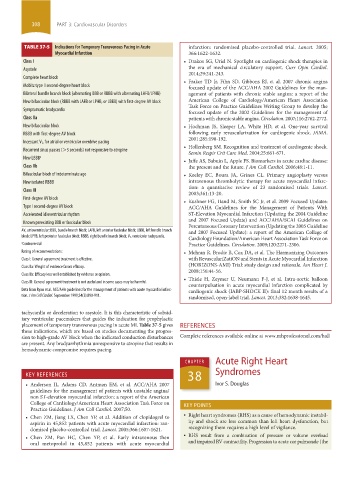
                 tachycardia or deceleration to asystole. It is this characteristic of subsid-
                 iary ventricular pacemakers that guides the indication for prophylactic
                 placement of temporary transvenous pacing in acute MI. Table 37-5 gives   REFERENCES
                 these indications, which are based on studies documenting the progres-
                 sion to high-grade AV block when the indicated conduction disturbances   Complete references available online at www.mhprofessional.com/hall
                 are present. Any bradyarrhythmia unresponsive to atropine that results in
                 hemodynamic compromise requires pacing.

                                                                         CHAPTER   Acute Right Heart

                   KEY REFERENCES                                         38       Syndromes
                     • Anderson JL, Adams CD, Antman EM, et al. ACC/AHA 2007       Ivor S. Douglas
                    guidelines for the management of patients with unstable angina/
                    non ST-elevation myocardial infarction: a report of the American
                    College of Cardiology/American Heart Association Task Force on   KEY POINTS
                    Practice Guidelines. J Am Coll Cardiol. 2007;50.
                     • Chen ZM, Jiang LX, Chen YP, et al. Addition of clopidogrel to     •  Right heart syndromes (RHS) as a cause of hemodynamic instabil-
                    aspirin in 45,852 patients with acute myocardial infarction: ran-  ity and shock are less common than left heart dysfunction, but
                    domised placebo-controlled trial. Lancet. 2005;366:1607-1621.  recognizing them requires a high level of vigilance.
                     • Chen ZM, Pan HC, Chen YP, et al. Early intravenous then     •  RHS result from a combination of pressure or volume overload
                    oral metoprolol in 45,852 patients with acute myocardial       and impaired RV contractility. Progression to acute cor pulmonale (the


            section03.indd   308                                                                                       1/23/2015   2:07:24 PM

