


Page 460 - Hall et al (2015) Principles of Critical Care-McGraw-Hill
P. 460
330     PART 3: Cardiovascular Disorders


                 only 11% would give thrombolytic therapy for a large PE without hypo-    TABLE 39-6    Thrombolytic Dosing Strategies in Acute Massive Pulmonary Embolism
                 tension, severe hypoxemia, or RV strain.  Nearly all would give throm-
                                              124
                 bolytics to a patient with shock due to PE, and there is modest evidence   rt-PA, 100 mg over 2 hours a
                 to support this approach. When patients with massive PE were given   Urokinase, 4400 U/kg bolus, followed by 4400 U/kg/h for 24 hours a
                 alteplase (1 mg/kg over 1 hour) in an uncontrolled trial, there was sig-  Streptokinase, 250,000 U over 30 minutes, followed by 100,000 U/h for 24 hours a
                 nificant clinical improvement in 11 of 15 with shock.  Right ventricular
                                                       125
                 function improves more rapidly in patients given alteplase (100 mg over   rt-PA, 0.6 mg/kg bolus over 2-15 minutes
                 2 hours) and heparin compared to heparin alone, and patients receiving   rt-PA, 1 mg/kg over 10 minutes
                 alteplase for PE-associated shock were less likely to have an in-hospital   Tenecteplase weight (wt) based bolus over 5 seconds: wt <60 kg, give 30 mg; 60-69 kg,
                 subsequent PE.  The only randomized clinical trial comparing throm-  give 35 mg; 70-79 kg, give 40 mg; 80-89 kg, give 45; ≥90 kg, give 50 mg
                            126
                 bolysis (streptokinase, 1,500,000 over 1 hour) with heparin in patients   Urokinase, 1,000,000 U bolus over 10 minutes, then 2,000,000 U over 110 minutes
                 with massive embolism and hypoperfusion enrolled only eight patients,
                 but showed a dramatic mortality benefit for thrombolytic therapy; all   Urokinase, 15,000 U/kg bolus over 10 minutes
                 four patients receiving heparin alone died, while there were no deaths in   Streptokinase, 1,500,000 U over 1 hour
                 the streptokinase group. 127                          Note: Heparin is infused at 1300 U/h following the thrombolytic infusion when the aPTT falls below
                 Submassive PE  Evidence of right ventricular dysfunction, even in the absence   twice normal, and is adjusted to keep the aPTT between 1.5 and 2.5 times control.
                 of any hemodynamic instability, is indisputably associated with a higher   a Regimens approved by the Food and Drug Administration. Tenecteplase has not been approved for
                 mortality.  This clinical condition has been termed submassive PE: PE   PE. The dosing regimen listed is approved for acute MI and is being tested in a clinical trial setting of
                        37
                 which has not yet provoked hypotension, but where the risk for death is   submassive PE. 134
                 high. The utility of echocardiography in prognostication has led to great
                 interest as to whether echocardiographic criteria should be used routinely
                                                                                                                         141
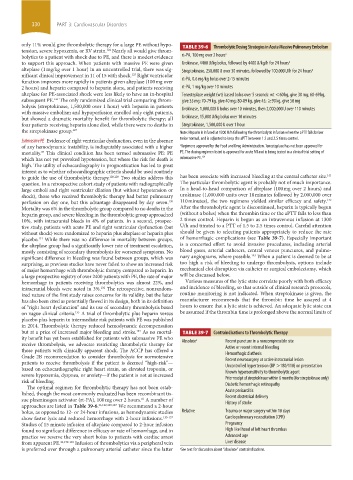
                 to guide the use of thrombolytic therapy. 128,129  Two studies address this   has been associate with increased bleeding at the central catheter site.
                 question. In a retrospective cohort study of patients with radiographically   The particular thrombolytic agent is probably not of much importance.
                 large emboli and right ventricular dilation (but without hypotension or   In a head-to-head comparison of alteplase (100 mg over 2 hours) and
                 shock), those who received thrombolytic therapy had better pulmonary   urokinase (1,000,000 units over 10 minutes followed by 2,000,000 over
                                                                                                                         142
                 perfusion on day one, but this advantage disappeared by day seven.    110 minutes), the two regimens yielded similar efficacy and safety.
                                                                   130
                 Mortality was 6% in the thrombolytic group compared to no deaths in the   After the thrombolytic agent is discontinued, heparin is typically begun
                 heparin group, and severe bleeding in the thrombolytic group approached   (without a bolus) when the thrombin time or the aPTT falls to less than
                 10%, with intracranial bleeds in 4% of patients. In a second, prospec-  2 times control. Heparin is begun as an intravenous infusion at 1300
                 tive study, patients with acute PE and right ventricular dysfunction (but   U/h and titrated to a PTT of 1.5 to 2.5 times control. Careful attention
                 without shock) were randomized to heparin plus alteplase or heparin plus   should be given to selecting patients appropriately to reduce the rate
                 placebo.  While there was no difference in mortality between groups,   of   hemorrhagic complications (see  Table 39-7). Especially important
                       131
                 the alteplase group had a significantly lower rate of treatment escalation,   is a   concerted effort to avoid invasive procedures, including arterial
                 mostly consisting of  secondary thrombolysis for worsened symptoms. No   blood gases, arterial catheters, central venous punctures, and pulmo-
                                                                                                143
                 significant difference in bleeding was found between groups, which was   nary angiograms, where possible.  When a patient is deemed to be at
                 surprising, as previous studies have never failed to show an increased risk   too high a risk of bleeding to undergo thrombolysis, options include
                 of major hemorrhage with thrombolytic therapy compared to heparin. In   mechanical clot disruption via catheter or surgical embolectomy, which
                 a large prospective registry of over 2400 patients with PE, the rate of major   will be discussed below.
                 hemorrhage in patients receiving thrombolytics was almost 22%, and   Various measures of the lytic state correlate poorly with both efficacy
                 intracranial bleeds were noted in 3%.  The retrospective, nonrandom-  and incidence of bleeding, so that outside of clinical research protocols,
                                            132
                 ized nature of the first study raises concerns for its validity, but the latter   routine monitoring is not indicated. When streptokinase is given, the
                 has also been cited as potentially flawed in its design, both in its definition   manufacturer recommends that the thrombin time be assayed at 4
                 of “right heart dysfunction” and its use of secondary thrombolysis based   hours to ensure that a lytic state is achieved. An adequate lytic state can
                 on vague clinical criteria.  A trial of thrombolytic plus heparin versus   be assumed if the thrombin time is prolonged above the normal limits of
                                   133
                 placebo plus heparin in intermediate risk patients with PE was published
                 in 2014. Thrombolytic therapy reduced hemodynamic decompensation
                 but at a price of increased major bleeding and stroke.  As no mortal-    TABLE 39-7    Contraindications to Thrombolytic Therapy
                                                        134
                 ity benefit has yet been established for patients with submassive PE who   a
                 receive thrombolysis, we advocate restricting thrombolytic therapy for   Absolute  Recent puncture in a noncompressible site
                 those patients with clinically apparent shock. The ACCP has offered a   Active or recent internal bleeding
                 Grade 2B recommendation to consider thrombolysis for normotensive     Hemorrhagic diathesis
                 patients to receive thrombolysis if the patient is deemed “high-risk”—  Recent neurosurgery or active intracranial lesion
                 based on echocardiographic right heart strain, an elevated troponin, or   Uncontrolled hypertension (BP >180/110) on presentation
                 severe hypoxemia, dyspnea, or anxiety—if the patient is not at increased   Known hypersensitivity to thrombolytic agent
                 risk of bleeding.                                                     Prior receipt of streptokinase within 6 months (for streptokinase only)
                   The optimal regimen for thrombolytic therapy has not been estab-    Diabetic hemorrhagic retinopathy
                 lished, though the most commonly evaluated has been recombinant tis-  Acute pericarditis
                 sue plasminogen activator (rt-PA), 100 mg over 2 hours.  A number of   Recent obstetrical delivery
                                                          41
                 approaches are listed in Table 39-6. 41,122,125,127  We recommend a 2-hour   History of stroke
                 bolus, as opposed to 12- or 24-hour infusions, as hemodynamic studies   Relative  Trauma or major surgery within 10 days
                 show faster lysis and reduced hemorrhage with 2-hour infusions. 135-137    Cardiopulmonary resuscitation (CPR)
                 Studies of 15 minute infusion of alteplase compared to 2-hour infusion   Pregnancy
                 found no significant difference in efficacy or rate of hemorrhage, and in   High likelihood of left heart thrombus
                 practice we reserve the very short bolus to patients with cardiac arrest   Advanced age
                 from apparent PE. 41,138-140  Infusion of thrombolytics via a peripheral vein   Liver disease
                 is preferred over through a pulmonary arterial catheter since the latter   a See text for discussion about “absolute” contraindications.


            section03.indd   330                                                                                       1/23/2015   2:07:37 PM

