


Page 463 - Hall et al (2015) Principles of Critical Care-McGraw-Hill
P. 463
CHAPTER 39: Pulmonary Embolic Disorders: Thrombus, Air, and Fat  333


                    points bear mention. It is clear that pharmacologic prophylaxis decreases     TABLE 39-8    Etiology of Air Embolism
                    the  risk  of  VTE  in  the  ICU, 177,178   and  thus  most  critically  ill  patients
                    should receive prophylactic heparin or LMWH. Mechanical prophylac-  Surgery and Trauma Related  Nonsurgical
                    tic strategies such as sequential compression devices are recommended if   Upright neurosurgery  Central line placement  Cardiopulmonary
                    patients have a contraindication to prophylactic-dose anticoagulation.                        resuscitation
                                                                      179
                    Twice-daily unfractionated heparin was equally efficacious at reducing   Liver transplantation  Central line removal  Gastrointestinal endoscopy
                    DVT compared to once-daily dalteparin, though the dalteparin group   Total hip replacement  Head/neck trauma
                    had significantly reduced rates of PE and of heparin—induced throm-  Harrington rod insertion  Dental implant surgery  Barotrauma
                    bosis, leading some to advocate LMWH as the preferred prophylactic   Spinal fusion  Pacemaker insertion  Positive-pressure  ventilation
                    regimen.  The use of IVC filters as a prophylactic strategy has not been                 Positive-pressure  ventilation
                          180
                    investigated, and most recommendations are to use only retrievable   Pulsed saline irrigation  Tenkhoff catheterization
                      filters for patients with known DVT who must interrupt anticoagulation,   Tissue expander removal  Intra-aortic balloon pump
                    and then to remove the filter once anticoagulation can be resumed. 179,181  Cesarean section  Bone marrow harvest
                                                                          Arthroscopy      Epidural catheterization
                    AIR EMBOLISM
                                                                          Open heart surgery  Percutaneous lung biopsy
                    The syndrome of air (or gas) embolism results when air enters the vas-  Hysterectomy  Pulmonary contusion
                    culature, travels to the pulmonary circulation, and causes circulatory or
                    respiratory embarrassment. It is uncommonly recognized in critically ill   Retrograde pyelography  Laser bronchoscopy
                    patients, but is quite likely underdiagnosed.         Hemodialysis     Transurethral prostate resection
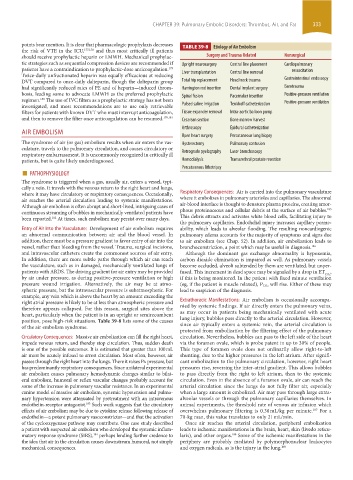
                        ■  PATHOPHYSIOLOGY                                Percutaneous lithotripsy

                    The syndrome is triggered when a gas, usually air, enters a vessel, typi-
                    cally a vein. It travels with the venous return to the right heart and lungs,
                    where it may have circulatory or respiratory consequences. Occasionally,   Respiratory Consequences:  Air is carried into the pulmonary vasculature
                    air reaches the arterial circulation leading to systemic manifestations.   where it embolizes in pulmonary arterioles and capillaries. The abnormal
                    Although air embolism is often abrupt and short-lived, intriguing cases of   air-blood interface is thought to denature plasma proteins,  creating amor-
                                                                                                                            185
                    continuous streaming of bubbles in mechanically ventilated patients have   phous proteinaceous and cellular debris at the surface of air bubbles.
                    been reported.  At times, such embolism may persist over many days.  This debris attracts and activates white blood cells, facilitating injury to
                              182
                                                                          the pulmonary capillaries. Endothelial injury increases capillary perme-
                    Entry of Air Into the Vasculature:  Development of air embolism requires   ability, which leads to alveolar flooding. The resulting noncardiogenic
                    an  abnormal  communication  between  air  and  the  blood  vessel.  In   pulmonary edema accounts for the majority of symptoms and signs due
                      addition, there must be a pressure gradient to favor entry of air into the   to air embolism (see Chap. 52). In addition, air embolization leads to
                    vessel, rather than bleeding from the vessel. Trauma, surgical  incisions,   bronchoconstriction, a point which may be useful in diagnosis. 186
                    and intravascular catheters create the commonest sources of air entry.   Although the dominant gas exchange abnormality is hypoxemia,
                    In addition, there are more subtle paths through which air can reach   carbon dioxide elimination is impaired as well. As pulmonary vessels
                    the vasculature, such as in damaged, mechanically ventilated lungs of   become occluded, alveoli subtended by them are ventilated, but unper-
                    patients with ARDS. The driving gradient for air entry may be  provided   fused. This increment in dead space may be signaled by a drop in ET  ,
                                                                                                                           CO 2
                    by air under pressure, as during positive-pressure ventilation or high   if this is being monitored. In the patient with fixed minute ventilation
                    pressure wound irrigation. Alternatively, the air may be at atmo-  (eg, if the patient is muscle relaxed), P CO 2  will rise. Either of these may
                    spheric pressure, but the intravascular pressure is subatmospheric. For   lead to suspicion of the diagnosis.
                    example, any vein which is above the heart by an amount exceeding the
                    right atrial pressure is likely to be at less than atmospheric pressure and   Extrathoracic  Manifestations:  Air embolism is occasionally accompa-
                    therefore appears collapsed. For this reason, surgical sites above the   nied by systemic findings. If air directly enters the pulmonary veins,
                    heart, particularly when the patient is in an upright or semirecumbent   as may occur in patients being mechanically ventilated with acute
                    position, pose high-risk situations. Table 39-8 lists some of the causes   lung injury, bubbles pass directly to the arterial circulation. However,
                    of the air embolism syndrome.                         since air typically enters a systemic vein, the arterial circulation is
                                                                          protected from embolization by the filtering effect of the pulmonary
                    Circulatory Consequences:  Massive air embolization can fill the right heart,   circulation. Nevertheless, bubbles can pass to the left side of the heart
                    impede venous return, and thereby stop circulation. Thus, sudden death   via the foramen ovale, which is probe patent in up to 30% of people.
                    is one of the possible outcomes. It is estimated that greater than 100 mL   This type of foramen ovale does not ordinarily allow right-to-left
                    air must be acutely infused to arrest circulation. Most often, however, air    shunting, due to the higher pressures in the left atrium. After signifi-
                    passes through the right heart into the lungs. There it raises Pa pressure, but   cant embolization to the pulmonary circulation, however, right heart
                    has predominantly respiratory consequences. Since unilateral experimental   pressures rise, reversing the inter-atrial gradient. This allows bubbles
                    air embolism causes pulmonary hemodynamic changes similar to bilat-  to pass directly from the right to left atrium, then to the systemic
                    eral embolism, humoral or reflex vascular changes probably account for   circulation. Even in the absence of a foramen ovale, air can reach the
                    some of the increase in pulmonary vascular resistance. In an experimental   arterial circulation since the lungs do not fully filter air, especially
                    canine model of massive air embolism, systemic hypotension and pulmo-  when a large amount is embolized. Air may pass through large extra-
                    nary hypertension were attenuated by pretreatment with an intravenous   alveolar vessels or through the pulmonary capillaries themselves. In
                    endothelin-receptor antagonist.  Such work suggests that the  circulatory   animal experiments, the threshold rate of venous air infusion which
                                          183
                                                                                                                       187
                    effects of air embolism may be due to cytokine release  following release of   overwhelms pulmonary filtering is 0.30 mL/kg per minute.  For a
                    endothelin—a potent pulmonary vasoconstrictor—and that the activation   70-kg man, this value translates to only 21 mL/min.
                    of the cyclooxygenase pathway may contribute. One case study described   Once  air  reaches  the  arterial  circulation,  peripheral  embolization
                    a patient with suspected air embolism who developed the  systemic inflam-  leads to ischemic manifestations in the brain, heart, skin (livedo reticu-
                                                                                           188
                    matory response syndrome (SIRS),  perhaps lending further credence to   laris), and other organs.  Some of the ischemic manifestations in the
                                            184
                    the idea that air in the circulation causes downstream humoral, not simply   periphery are probably mediated by polymorphonuclear  leukocytes
                    mechanical, consequences.                             and oxygen radicals, as is the injury in the lung. 189


            section03.indd   333                                                                                       1/23/2015   2:07:38 PM

