


Page 464 - Hall et al (2015) Principles of Critical Care-McGraw-Hill
P. 464
334     PART 3: Cardiovascular Disorders


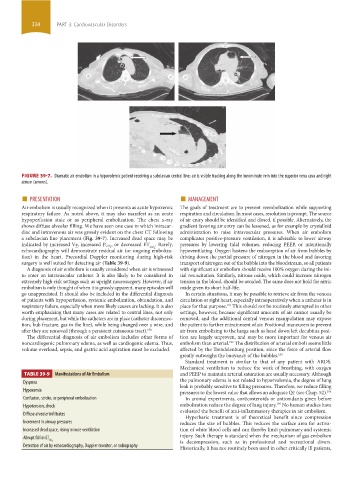
                 FIGURE 39-7.  Dramatic air embolism in a hypovolemic patient receiving a subclavian central line; air is visible tracking along the innominate vein into the superior vena cava and right
                 atrium (arrows).
                     ■  PRESENTATION                                       ■  MANAGEMENT


                 Air embolism is usually recognized when it presents as acute hypoxemic   The goals of treatment are to prevent reembolization while supporting
                 respiratory failure. As noted above, it may also manifest as an acute     respiration and circulation. In most cases, resolution is prompt. The source
                 hypoperfusion state or as peripheral embolization. The chest x-ray   of air entry should be identified and closed, if possible. Alternatively, the
                 shows diffuse alveolar filling. We have seen one case in which intracar-  gradient favoring air entry can be lessened, as for example by  crystalloid
                 diac and intravenous air was grossly evident on the chest CT following   administration to raise intravascular pressures. When air embolism
                 a subclavian line placement (Fig. 39-7). Increased dead space may be   complicates positive-pressure ventilation, it is advisable to lower airway
                                                , or decreased ET  . Rarely,   pressures by lowering tidal volumes, reducing PEEP, or intentionally
                 indicated by increased Ve, increased P CO 2  CO 2
                 echocardiography will demonstrate residual air (or ongoing emboliza-  hypoventilating. Oxygen hastens the reabsorption of air from bubbles by
                 tion) in the heart. Precordial Doppler monitoring during high-risk   driving down the partial pressure of nitrogen in the blood and favoring
                 surgery is well suited for detecting air (Table 39-9).  transport of nitrogen out of the bubble into the bloodstream, so all patients
                   A diagnosis of air embolism is usually considered when air is witnessed   with significant air embolism should receive 100% oxygen during the ini-
                 to enter an intravascular catheter. It is also likely to be considered in   tial resuscitation. Similarly, nitrous oxide, which could increase nitrogen
                 extremely high-risk settings such as upright neurosurgery. However, if air   tension in the blood, should be avoided. The same does not hold for nitric
                 embolism is only thought of when it is grossly apparent, many episodes will   oxide given its short half-life.
                 go unappreciated. It should also be included in the differential diagnosis   In certain situations, it may be possible to retrieve air from the venous
                 of patients with hypoperfusion, systemic embolization, obtundation, and   circulation or right heart, especially intraoperatively when a catheter is in
                 respiratory failure, especially when more likely causes are lacking. It is also   place for that purpose.  This should not be routinely attempted in other
                                                                                       191
                 worth emphasizing that many cases are related to central lines, not only   settings, however, because significant amounts of air cannot  usually be
                 during placement, but while the catheters are in place (catheter disconnec-  removed, and the additional central venous manipulation may expose
                 tion, hub fracture, gas in the line), while being changed over a wire, and   the patient to further entrainment of air. Positional maneuvers to prevent
                 after they are removed (through a persistent cutaneous tract). 190  air from embolizing to the lungs such as head down left decubitus posi-
                   The differential diagnosis of air embolism includes other forms of   tion are largely unproven, and may be more important for venous air
                 noncardiogenic pulmonary edema, as well as cardiogenic edema. Thus,   embolism than arterial.  The distribution of arterial emboli seems little
                                                                                        192
                 volume overload, sepsis, and gastric acid aspiration must be excluded.  affected by the Trendelenburg position, since the force of arterial flow
                                                                       greatly outweighs the buoyancy of the bubbles. 193
                                                                         Standard treatment is similar to that of any patient with ARDS.
                                                                       Mechanical ventilation to reduce the work of breathing, with oxygen
                   TABLE 39-9    Manifestations of Air Embolism        and PEEP to maintain arterial saturation are usually necessary. Although
                                                                       the pulmonary edema is not related to hypervolemia, the degree of lung
                  Dyspnea
                                                                       leak is probably sensitive to filling pressures. Therefore, we reduce filling
                  Hypoxemia                                            pressures to the lowest value that allows an adequate Q ˙ t (see Chap. 52). 194
                  Confusion, stroke, or peripheral embolization          In animal experiments, corticosteroids or antioxidants given before
                                                                                                        195
                  Hypotension, shock                                   embolization reduce the degree of lung injury.  No human studies have
                                                                       evaluated the benefit of anti-inflammatory therapies in air embolism.
                  Diffuse alveolar infiltrates
                                                                         Hyperbaric treatment is of theoretical benefit since compression
                  Increment in airway pressures                        reduces the size of bubbles. This reduces the surface area for activa-
                  Increased dead space, rising minute ventilation      tion of white blood cells and can thereby limit pulmonary and systemic
                  Abrupt fall in ET                                    injury. Such therapy is standard when the mechanism of gas embolism
                           CO 2                                        is decompression, such as in professional and recreational divers.
                  Detection of air by echocardiography, Doppler monitor, or radiography
                                                                       Historically, it has not routinely been used in other critically ill patients,


            section03.indd   334                                                                                       1/23/2015   2:07:39 PM

