


Page 455 - Hall et al (2015) Principles of Critical Care-McGraw-Hill
P. 455
CHAPTER 39: Pulmonary Embolic Disorders: Thrombus, Air, and Fat  325


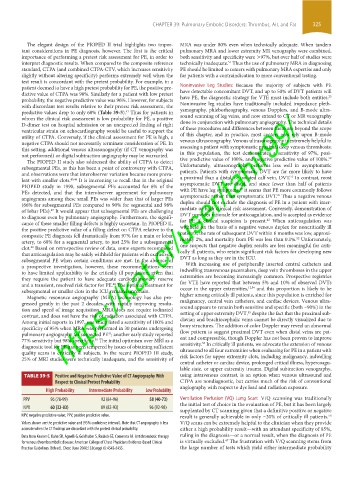
                     The elegant design of the PIOPED II trial highlights two impor-  MRA was under 80% even when technically adequate. When tandem
                    tant considerations in PE diagnosis, however. The first is the critical   pulmonary MRA and lower extremity MR venography were combined,
                    importance of performing a pretest risk assessment for PE, in order to   both sensitivity and specificity were >97%, but over half of studies were
                    interpret diagnostic results. When compared to the composite reference   technically inadequate.  Thus the use of pulmonary MRA in diagnosing
                                                                                          51
                    standard, CTPA (and combined CTPA-CTV, which increases sensitivity   PE should be limited to centers with pulmonary MRA expertise and only
                    slightly without altering specificity) performs extremely well when the   for patients with a contraindication to more conventional testing.
                    test result is concordant with the pretest probability. For example, in a
                    patient deemed to have a high pretest probability for PE, the positive pre-  Noninvasive Leg Studies:  Because the majority of subjects with PE
                    dictive value of CTPA was 96%. Similarly for a patient with low pretest   have detectable concomitant DVT, and up to 50% of DVT patients will
                                                                                                                            25
                    probability, the negative predictive value was 96%. However, for subjects   have PE, the diagnostic strategy for VTE must include both entities.
                    with discordant test results relative to their pretest risk assessment, the   Noninvasive  leg studies  have traditionally included impedance pleth-
                                  https://kat.cr/user/tahir99/
                    predictive values drop to only 60% (Table 39-5).  Thus for patients in   ysmography, phleborheography, venous Dopplers, and B-mode ultra-
                                                       42
                    whom the clinical risk assessment is low probability for PE, a positive   sound scanning of leg veins, and now extend to CT or MR venography
                    D-dimer test on hospital admission or an unexpected finding of right   done in conjunction with pulmonary angiography. The technical details
                    ventricular strain on echocardiography would be useful to support the   of these procedures and differences between them are beyond the scope
                    utility of CTPA. Conversely, if the clinical assessment for PE is high, a   of this chapter, and in practice, most centers now rely upon B-mode
                    negative CTPA should not necessarily terminate consideration of PE. In   venous ultrasonography. Venous ultrasonography is extremely helpful in
                    this setting, additional venous ultrasonography (if CT venography was   assessing a patient with symptomatic proximal deep venous thrombosis;
                    not performed) or digital subtraction angiography may be warranted.  in this population, the test demonstrates a sensitivity of 97%, posi-
                                                                                                                            52
                     The PIOPED II study also addressed the ability of CTPA to detect   tive predictive value of 100%, and negative predictive value of 100%.
                    subsegmental PEs, as this has been a point of controversy with CTPA,   Unfortunately, ultrasonography performs less well in asymptomatic
                    and observations were that interobserver variation became more preva-  patients. Patients with symptomatic DVT are far more likely to have
                                                                                                               53
                    lent with smaller clots. 45,46  It is interesting to recall that in the original   a proximal than a distal, or isolated calf vein, DVT.  In contrast, most
                    PIOPED study in 1990, subsegmental PEs accounted for 6% of the   asymptomatic DVT are distal, and since fewer than half of patients
                                                                                              19
                    PEs detected, and that the interobserver agreement for pulmonary   with PE have leg symptoms,  it seems that PE more commonly  follows
                                                                                                           47
                    angiograms among these small PEs was wider than that of larger PEs   asymptomatic rather than symptomatic DVT.  Thus a negative venous
                    (66% for subsegmental PEs compared to 90% for segmental and 98%   duplex should not exclude the diagnosis of PE in a patient with inter-
                    of lobar PEs).  It would appear that subsegmental PEs are challenging   mediate or high clinical risk assessment. Conversely, demonstration of
                              47
                    to diagnose even by pulmonary angiography. Furthermore, the signifi-  DVT provides rationale for anticoagulation, and is accepted as evidence
                                                                                                       42
                    cance of these smaller filling defects is highly uncertain. In PIOPED II,   for PE if clinical suspicion is present.  When anticoagulation was
                    the positive predictive value of a filling defect on CTPA relative to the   withheld on the basis of a negative venous duplex for noncritically ill
                    composite PE diagnosis fell dramatically from 97% for a main or lobar   patients, the rate of subsequent DVT within 6 months was low, approxi-
                                                                                                                 52
                    artery, to 68% for a segmental artery, to just 25% for a subsegmental   mately 2%, and mortality from PE was less than 0.1%.  Unfortunately,
                    clot.  Based on retrospective review of data, some experts recommend   one suspects that negative duplex results are less meaningful for criti-
                       42
                    that anticoagulation may be safely withheld for patients with exclusively   cally ill patients, who retain significant risk factors for developing new
                    subsegmental PE when certain conditions are met. In the absence of   DVT as long as they are in the ICU.
                    a prospective investigation, however, these recommendations seem   With increasing use of peripherally inserted central catheters and
                    to have limited applicability to the critically ill population, given that   indwelling transvenous pacemakers, deep vein thromboses in the upper
                    they require the patient to have adequate cardiopulmonary reserve   extremities are becoming increasingly common. Prospective registries
                    and a transient, resolved risk factor for PE.  The optimal treatment for   for VTE have reported that between 5% and 10% of observed DVTs
                                                   48
                                                                                                 12,54
                      subsegmental or smaller clots in the ICU remains uncertain.  occur in the upper extremities,   and this proportion is likely to be
                     Magnetic resonance angiography (MRA) technology has also pro-  higher among critically ill patients, since this population is enriched for
                    gressed greatly in the past 2 decades, with rapidly improving resolu-  malignancy, central vein catheters, and cardiac devices. Venous ultra-
                    tion and speed of image acquisition. MRA does not require iodinated   sound appears to remain both sensitive and specific (both ~90%) in the
                                                                                                 55
                    contrast, and does not have the risk of radiation associated with CTPA.   setting of upper extremity DVT,  despite the fact that the proximal sub-
                    Among initial reports in 1997, one study listed a sensitivity of 100% and   clavian and brachiocephalic veins cannot be directly visualized due to
                    specificity of 95% when MRA was performed in 30 patients undergoing   bony structures. The addition of color Doppler may reveal an abnormal
                    pulmonary angiography for suspected PE ; another early study reported   flow pattern to suggest proximal DVT even when distal veins are pat-
                                                 49
                    77% sensitivity but 98% specificity.  The initial optimism over MRI as a   ent and compressible, though Doppler has not been proven to improve
                                             50
                                                                                 55
                    diagnostic tool for PE has been tempered by issues of obtaining sufficient   sensitivity.  In critically ill patients, we advocate the extension of venous
                    quality scans in critically ill subjects. In the recent PIOPED III study,   ultrasound to all four extremities when evaluating for PE in a patient with
                    25% of MRI studies were technically inadequate, and the sensitivity of   risk factors for upper extremity clots, including malignancy, indwelling
                                                                          central catheter or cardiac device, prolonged critical illness, hypercoagu-
                                                                          lable state, or upper extremity trauma. Digital subtraction venography,
                      TABLE 39-5     Positive and Negative Predictive Value of CT Angiography With   using intravenous contrast, is an option when venous ultrasound and
                               Respect to Clinical Pretest Probability    CTPA are nondiagnostic, but carries much of the risk of conventional
                                                                          angiography with respect to dye load and radiation exposure.
                            High Probability  Intermediate Probability  Low Probability
                    PPV      96 (78-99)        92 (84-96)      58 (40-73)  Ventilation Perfusion (VQ) Lung Scan:  V/Q  scanning  was  traditionally
                                                                          the initial test of choice in the evaluation of PE, but it has been largely
                    NPV      60 (32-83)        89 (82-93)      96 (92-98)
                                                                          supplanted by CT scanning given that a definitive positive or negative
                    NPV, negative predictive value; PPV, positive predictive value.  result is generally achievable in only ~20% of critically ill patients.
                                                                                                                            56
                    Values shown are the predictive value and (95% confidence interval). Note that CT angiography is less   V/Q scans can be extremely helpful to the clinician when they provide
                    accurate when the CT findings are discordant with the pretest clinical probability.  either a high probability result—with an attendant specificity of 85%,
                    Data from Kearon C, Kahn SR, Agnelli G, Goldhaber S, Raskob GE, Comerota AJ. Antithrombotic therapy   ruling in the diagnosis—or a normal result, when the diagnosis of PE
                                                                                         47
                    for venous thromboembolic disease: American College of Chest Physicians Evidence-Based Clinical   is virtually excluded.  The frustration with V/Q scanning stems from
                    Practice Guidelines (8th ed). Chest. June 2008;133(suppl 6):454S-545S.  the large number of tests which yield either intermediate probability


            section03.indd   325                                                                                       1/23/2015   2:07:35 PM

