


Page 465 - Hall et al (2015) Principles of Critical Care-McGraw-Hill
P. 465
CHAPTER 39: Pulmonary Embolic Disorders: Thrombus, Air, and Fat  335


                    in  large  part  due  to  the  availability  of  decompression  chambers  and   endothelium, their concentration in the systemic circulation during
                    the risks attendant with transferring critically ill patients. In France,   critical illness does not rise sufficiently to account for lung injury.
                    the sole decompression unit serving Paris published their experience
                    of decompressing 119 patients with iatrogenic air embolism over an   Traumatic Embolism:  Fracture of bone releases neutral fat which
                    11-year period, and reported a 1-year mortality rate of 21%.  The only   embolizes into the pulmonary vasculature. The derivation of this fat
                                                               196
                    reported adverse outcome was one seizure during hyperbaric treat-  from bone is supported by the finding of coincident particles of bone
                    ment, which resolved upon decreasing the fraction of inspired oxygen.   marrow at autopsy in patients with long bone fractures and by echo-
                    The hyperbaric protocol used consisted of one dive, with 15 minutes at   cardiographic studies showing frequent, often dramatic embolism at
                                                                                                  201
                    4 atmospheres (ATA), then a 45-minute plateau at 3 ATA, followed by   the time of medullary reaming.  Even in traumatic embolism, the
                    45 minutes at 2 ATA.  Since patients usually respond readily to stan-  syndrome appears to be more than a localized, mechanical obstruc-
                                   196
                    dard supportive measures, and since the syndrome typically resolves in   tion, however. Intravascular hydrolysis of fat by lung lipase releases
                    only 24 to 48 hours, we have not typically utilized hyperbaric therapy   toxic FFAs, which generate endothelial injury. Systemic findings
                    except in the most extreme and persistent cases. While some advocate   in FES probably relate to passage of venous fat emboli across the
                    that hyperbaric therapy must be initiated early to have an effect, we   pulmonary circulation, although serum-derived fat may play a role.
                    would stress the importance of resuscitation prior to leaving the ICU for   Elevated right heart pressures following embolism may open a probe-
                                                                                                                            202
                    an unproven therapy. When such patients are transported by air, a pres-  patent foramen ovale, causing severe, even fatal systemic embolism.
                    surized craft flying at low altitude should be requested.  Further, fat can cross the pulmonary circuit even in the absence of a
                                                                          right-to-left shunt, as has been shown in experimental animals. Fat
                                                                          was able to traverse the pulmonary microcirculation even though
                    FAT EMBOLISM                                          15-micron radiolabeled microspheres could not, perhaps due to
                                                                          enhanced deformability of fat emboli. 203
                    The fat embolism syndrome (FES) is associated with fat particles in the
                    microcirculation of the lung. It consists typically of lung dysfunction,     ■  CLINICAL MANIFESTATIONS
                    neurologic manifestations, and petechiae, usually following a latent
                    interval. It is most common following long bone fractures, typically   Following  injury,  there  is  usually  a  latent  interval  of  12  to  72  hours
                    presenting as dyspnea and confusion. However, FES is seen after other   before the syndrome becomes evident. The dominant findings are
                    forms of trauma and in several nontraumatic conditions as well. For   related to lung injury and neurologic dysfunction. Patients with FES
                    example, FES has been proposed as a major cause of the acute chest   present as ARDS, with dyspnea, hypoxemia, and a diffuse lung lesion.
                    syndrome in patients with sickle cell disease (see Chap. 96).  More   In addition, there is often confusion, obtundation, or coma, signs due
                                                                 197
                    recently, patients have been presenting with FES following often unregu-  to cerebral fat embolism rather than coincident hypoxemia. The typical
                    lated cosmetic procedures involving silicone or mineral oil injection.    neuropathologic findings include fat microemboli and diffuse petechial
                                                                      198
                    After long bone or pelvic fracture, the incidence of the syndrome is at   hemorrhagic infarcts. Petechiae are also seen on the skin, particularly
                    least 10% when patients are prospectively screened,  although serious   over the upper chest, neck, and face, though they appear only in 50% of
                                                         199
                    clinical manifestations are seen in only 1% to 3%. Since the clinical   patients. On fundoscopic examination, embolized fat may be detected
                    presentation is usually mild, FES is often unrecognized. Even when lung   in retinal vessels (Purtscher retinopathy). Often thrombocytopenia and
                    injury is obvious, its cause may be attributed to infection, aspiration, or   anemia are present. Rare patients will develop a full blown acute right
                    traumatic ARDS, rather than to fat embolization. Some of the causes of   heart syndrome.
                                                                           The diagnosis is usually based on the clinical findings in a patient at risk
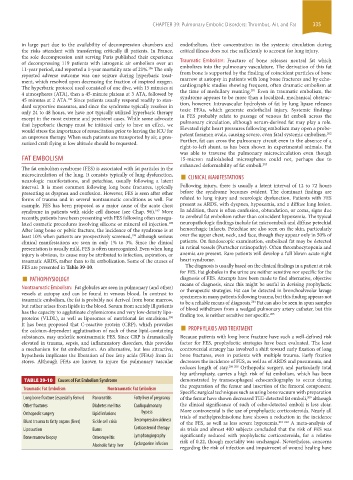
                    FES are presented in Table 39-10.                     for FES. Fat globules in the urine are neither sensitive nor specific for the
                        ■  PATHOPHYSIOLOGY                                diagnosis of FES. Attempts have been made to find alternative, objective
                    Nontraumatic Embolism:  Fat globules are seen in pulmonary (and other)   means of diagnosis, since this might be useful in devising prophylactic
                                                                          or therapeutic strategies. Fat can be detected in bronchoalveolar lavage
                    vessels  at  autopsy  and  can  be  found  in  venous  blood.  In  contrast  to   specimens in many patients following trauma, but this finding appears not
                    traumatic embolism, the fat is probably not derived from bone marrow,   to be a reliable means of diagnosis.  Fat can also be seen in spun samples
                                                                                                  204
                    but rather arises from lipids in the blood. Serum from acutely ill patients   of blood withdrawn from a wedged pulmonary artery catheter, but this
                    has the capacity to agglutinate chylomicrons and very low-density lipo-  finding too, is neither sensitive nor specific. 205
                    proteins (VLDL), as well as liposomes of nutritional fat emulsions.
                                                                      200
                    It has been proposed that C-reactive protein (CRP), which provokes     ■
                    the calcium-dependent agglutination of each of these lipid-containing   PROPHYLAXIS AND TREATMENT
                    substances, may underlie nontraumatic FES. Since CRP is dramatically   Because patients with long bone fracture have such a well-defined risk
                    elevated in trauma, sepsis, and inflammatory disorders, this provides   factor for FES, prophylactic strategies have been evaluated. The least
                    a  mechanism  for  fat  embolization.  An  alternative,  but  less  attractive,   controversial strategy has involved a shift toward early fixation of long
                    hypothesis implicates the liberation of free fatty acids (FFAs) from fat   bone fractures, even in patients with multiple trauma. Early fixation
                    stores. Although FFAs are known to injure the pulmonary vascular   decreases the incidence of FES, as well as of ARDS and pneumonia, and
                                                                          reduces length of stay. 206-208  Orthopedic surgery, and particularly total
                                                                          hip arthroplasty, carries a high risk of fat embolism, which has been
                      TABLE 39-10    Causes of Fat Embolism Syndrome      demonstrated by transesophageal echocardiography to occur during
                                                                          the preparation of the femur and insertion of the femoral component.
                    Traumatic Fat Embolism       Nontraumatic Fat Embolism
                                                                          Specific surgical techniques such as using bone vacuum with preparation
                    Long bone fracture (especially femur)  Pancreatitis  Fatty liver of pregnancy  of the femur have shown decreased TEE-detected fat emboli,  although
                                                                                                                     209
                    Other fractures         Diabetes mellitus  Cardiopulmonary   the clinical significance  of such of echo-detected emboli is less clear.
                    Orthopedic surgery      Lipid infusions  bypass       More controversial is the use of prophylactic corticosteroids. Nearly all
                                                                          trials of methylprednisolone have shown a reduction in the incidence
                    Blunt trauma to fatty organs (liver)  Sickle cell crisis  Decompression sickness  of the FES, as well as less severe hypoxemia. 210-212  A meta- analysis of
                    Liposuction             Burns         Corticosteroid therapy  sis trials and almost 400 subjects concluded that the risk of FES was
                    Bone marrow biopsy      Osteomyelitis  Lymphangiography  significantly  reduced  with  prophylactic  corticosteroids,  for  a  relative
                                                                          risk of 0.22, though mortality was unchanged. Nevertheless, concerns
                                            Alcoholic fatty liver  Cyclosporine infusion
                                                                          regarding the risk of infection and impairment of wound healing have


            section03.indd   335                                                                                       1/23/2015   2:07:39 PM

