


Page 467 - Hall et al (2015) Principles of Critical Care-McGraw-Hill
P. 467
CHAPTER 40: Pericardial Disease  337


                      tion:                    Floor:


                       I                        aVR                      V1                       V4


                       II                       aVL                      V2                       V5


                      III                       aVF                      V3                       V6


                       II


                      V1


                      V5

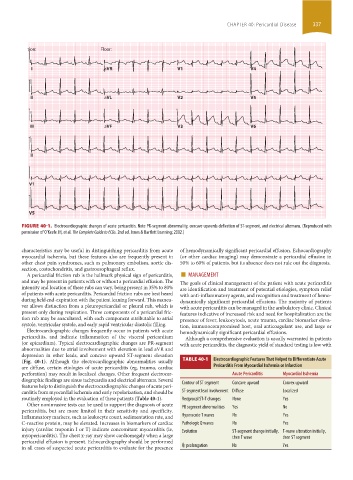
                    FIGURE 40-1.  Electrocardiographic changes of acute pericarditis. Note PR-segment abnormality, concave upwards deflection of ST-segment, and electrical alternans. (Reproduced with
                    permission of O’Keefe JH, et al. The Complete Guide to ECGs. 2nd ed. Jones & Bartlett Learning; 2002.)


                      characteristics may be useful in distinguishing pericarditis from acute   of hemodynamically significant pericardial effusion. Echocardiography
                    myocardial ischemia, but these features also are frequently present in   (or other cardiac imaging) may demonstrate a pericardial effusion in
                    other chest pain syndromes, such as pulmonary embolism, aortic dis-  50% to 60% of patients, but its absence does not rule out the diagnosis.
                    section, costochondritis, and gastroesophageal reflux.
                     A pericardial friction rub is the hallmark physical sign of pericarditis,     ■  MANAGEMENT
                    and may be present in patients with or without a pericardial effusion. The   The goals of clinical management of the patient with acute pericarditis
                    intensity and location of these rubs can vary, being present in 35% to 80%   are identification and treatment of potential etiologies, symptom relief
                    of patients with acute pericarditis. Pericardial friction rubs are best heard   with anti-inflammatory agents, and recognition and treatment of hemo-
                    during held end-expiration with the patient leaning forward. This maneu-  dynamically significant pericardial effusions. The majority of patients
                    ver allows distinction from a pleuropericardial or pleural rub, which is   with acute pericarditis can be managed in the ambulatory clinic. Clinical
                    present only during respiration. Three components of a pericardial fric-  features indicative of increased risk and need for hospitalization are the
                    tion rub may be auscultated, with each component attributable to atrial   presence of fever, leukocytosis, acute trauma, cardiac biomarker eleva-
                    systole, ventricular systole, and early rapid ventricular diastolic filling.  tion, immunocompromised host, oral anticoagulant use, and large or
                     Electrocardiographic changes frequently occur in patients with acute   hemodynamically significant pericardial effusions.
                    pericarditis, and indicate inflammation of the visceral pericardium   Although a comprehensive evaluation is usually warranted in patients
                    (or epicardium). Typical electrocardiographic changes are PR-segment   with acute pericarditis, the diagnostic yield of standard testing is low with
                    abnormalities due to atrial involvement with elevation in lead aVR and
                    depression in  other leads,  and  concave  upward  ST-segment  elevation
                    (Fig.  40-1). Although the electrocardiographic abnormalities usually     TABLE 40-1     Electrocardiographic Features That Helped to Differentiate Acute
                    are diffuse, certain etiologies of acute pericarditis (eg, trauma, cardiac   Pericarditis From Myocardial Ischemia or Infarction
                    perforation) may result in localized changes. Other frequent electrocar-  Acute Pericarditis  Myocardial Ischemia
                    diographic findings are sinus tachycardia and electrical alternans. Several
                    features help to distinguish the electrocardiographic changes of acute peri-  Contour of ST segment  Concave upward  Convex upward
                    carditis from myocardial ischemia and early repolarization, and should be       ST-segment lead involvement Diffuse  Localized
                    routinely employed in the evaluation of these patients (Table 40-1).  Reciprocal ST-T changes  None  Yes
                     Other noninvasive tests can be used to support the diagnosis of acute   PR segment abnormalities  Yes  No
                    pericarditis,  but  are  more  limited  in  their  sensitivity  and  specificity.
                    Inflammatory markers, such as leukocyte count, sedimentation rate, and   Hyperacute T waves  No  Yes
                    C-reactive protein, may be elevated. Increases in biomarkers of cardiac   Pathologic Q waves  No  Yes
                    injury (cardiac troponin I or T) indicate concomitant myocarditis (ie,   Evolution  ST-segment change initially,  T-wave alteration initially,
                    myopericarditis). The chest x-ray may show cardiomegaly when a large   then T wave       then ST segment
                    pericardial effusion is present. Echocardiography should be performed
                                                                          ˙
                    in all cases of suspected acute pericarditis to evaluate for the presence   Qt prolongation  No  Yes


            section03.indd   337                                                                                       1/23/2015   2:07:41 PM

