


Page 468 - Hall et al (2015) Principles of Critical Care-McGraw-Hill
P. 468
338     PART 3: Cardiovascular Disorders


                 specific causes identified in less than 20% of cases. Important  etiologies to   of the cardiac chambers. This impairment precipitates a reduction in
                 consider for further evaluation are those that require  specific therapy, such   cardiac output, followed by increases in pulmonary venous and jugular
                 neoplastic disorders, autoimmune disease, trauma (eg, postsurgical), and   venous pressures. With inspiration, there is a fall in the driving pressure
                 infection (eg, tuberculosis). The vast majority of cases of acute pericarditis   to fill the left ventricle, subsequently leading to a reduction in ventricu-
                 are viral or idiopathic, and thus are usually benign and responsive to anti-  lar filling and stroke volume. The fall in left ventricular stroke volume
                 inflammatory drugs. For patients with a concomitant pericardial effusion,   during inspiration manifests as a relative decrease in pulse pressure or
                 pericardiocentesis  may  be   considered.  Pericardiocentesis  can  assist  in   peak systolic pressure, which is the hallmark finding of pulsus paradoxus
                 diagnosis when other testing is  inconclusive, and is indicated for treat-  in patients with cardiac tamponade.
                 ment of cardiac tamponade or drug-refractory, symptomatic pericardial   There are uncommon clinical presentations of cardiac tamponade.
                 effusions.                                            Cardiac tamponade may be localized, when a loculated pericardial effu-
                   Targeted therapy of the underlying etiology of acute pericarditis   sion is tactically located to impair ventricular filling. This manifestation
                 is indicated when a cause is identified and treatment is appropriate   may occur after  cardiac  surgery or  other postoperative  settings.  The
                 (eg, tuberculosis, uremia, thyroid disease). For analgesia and treatment   loculated effusion may be present in the posterior pericardial space adja-
                 of the pericardial inflammation, NSAIDs are the mainstay of medical   cent to the atria, which poses challenges for detection by echocardiogra-
                 therapy. The properties of these drugs provide effective relief in 70%   phy. Posterior loculated effusions should be suspected in a postoperative
                 to 80% of patients. The efficacy of medical therapy varies according to   patient with hemodynamic instability.
                 the underlying etiology, with response rates greatest among those with   Low-pressure cardiac tamponade occurs without elevated jugular
                 idiopathic or presumed viral causes. It is important to note that relatively   venous pressure because the intracardiac filling pressures are low.
                                                                                                                          6
                 high doses of these medications are required for them to exhibit their   Examples of this manifestation are patients with tuberculosis or malig-
                 anti-inflammatory effect (eg, aspirin, 650-1000 mg every 6-8  hours;   nancy complicated by severe dehydration. Finally, pneumopericardium
                   ibuprofen, 400-800 mg  every 8  hours; indomethacin,  50 mg  every   with cardiac tamponade may result from gas-forming bacterial pericar-
                 8 hours). Furthermore, although these drugs can result in acute relief of   ditis after penetrating chest trauma.
                 to reduce the risk of recurrence of inflammation. Of note, for pericarditis   ■  DIAGNOSIS
                 symptoms, slow tapering over a period of 2 to 4 weeks is recommended
                 associated with myocardial infarction, NSAIDs other than aspirin should   Cardiac tamponade should be suspected when there is a compatible
                 be avoided due to their effect of impairment of myocardial healing and   history, hypotension, and an elevated jugular venous pressure or pulsus
                 potential for increasing the risk of mechanical complications.  paradoxus. The chest x-ray (eg, “water-bottle heart”) and electrocar-
                   Colchicine  (0.5-1.2 mg/d for 3 months), in addition to NSAIDs, is   diography (eg, sinus tachycardia, electrical alternans) may be helpful.
                 an effective adjunctive therapy for acute pericarditis. The efficacy of   Echocardiography is the primary modality for diagnosing cardiac
                 colchicine has been demonstrated in several randomized and retrospec-    tamponade. However,  knowledge  of  the  invasive  signs  of  tamponade
                 tive studies, which have shown lower rates of treatment failure (11.7%   also expedites the recognition of its presence, as hemodynamic monitor-
                 vs 36.7%) and recurrent pericarditis (10.7% vs 32.3%) when used in   ing with cardiac catheterization (ie, Swan-Ganz) is commonly available
                 conjunction with standard  NSAID  therapy.   Colchicine  is  generally   in critical care patients.
                                                  1-3
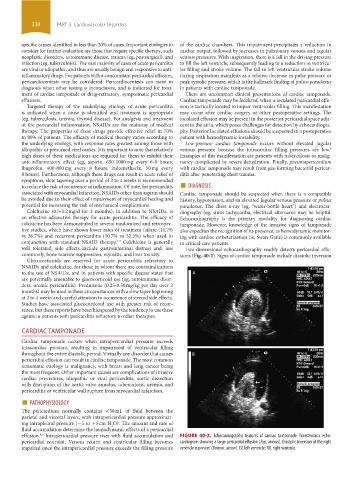
                 well tolerated; side effects include gastrointestinal distress and, less   Two-dimensional echocardiography readily detects pericardial effu-
                   commonly, bone marrow suppression, myositis, and liver toxicity.  sions (Fig. 40-2). Signs of cardiac tamponade include diastolic inversion
                   Glucocorticoids are reserved for acute pericarditis refractory to
                 NSAIDs and colchicine, for those in whom there are contraindications
                 to the use of NSAIDs, and in patients with specific disease states that
                 are potentially amenable to glucocorticoid use (eg, autoimmune disor-
                 ders, uremic pericarditis). Prednisone (0.25-0.50 mg/kg per day over 3
                 months) may be used in these circumstances with a slow taper beginning
                 at 2 to 4 weeks and careful attention to occurrence of steroid side effects.
                 Studies have associated glucocorticoid use with greater risk of recur-
                 rence, but these reports have been hampered by the tendency to use these
                 agents in patients with pericarditis refractory to other therapies.

                 CARDIAC TAMPONADE
                 Cardiac tamponade occurs when intrapericardial pressure exceeds
                 intracardiac pressure, resulting in impairment of ventricular filling
                 throughout the entire diastolic period. Virtually any disorder that causes
                 pericardial effusion can result in cardiac tamponade. The most common
                 atraumatic etiology is malignancy, with breast and lung   cancer being
                 the most frequent. Other important causes are complications of invasive
                 cardiac procedures, idiopathic or viral pericarditis, aortic dissection
                 with disruption of the aortic valve annulus, tuberculosis, uremia, and
                 pericarditis or ventricular wall rupture from myocardial infarction.
                     ■  PATHOPHYSIOLOGY

                 The pericardium normally contains  <50 mL of fluid between the
                 parietal and visceral layers, with intrapericardial pressure approximat-
                 ing intrapleural pressure (−5 to +5 cm H O). The amount and rate of
                                                2
                 fluid accumulation determine the hemodynamic effects of a pericardial
                 effusion.  Intrapericardial pressure rises with fluid accumulation and   FIGURE 40-2.  Echocardiographic  features  of cardiac  tamponade. Transthoracic  echo-
                       4,5
                 pericardial restraint. Venous return and ventricular filling becomes   cardiogram showing a large pericardial effusion (Top, arrows). Diastolic inversion of the right
                 impaired once the intrapericardial pressure exceeds the filling pressure   ventricle is present (Bottom, arrow). LV, left ventricle; RV, right ventricle.


            section03.indd   338                                                                                       1/23/2015   2:07:41 PM

